Cost of Concrete Per Yard: 2026 Scenario Match Guide
Analyze the true cost of concrete per yard across different applications. Match PSI, admixtures, and delivery fees to your 2026 project budget.
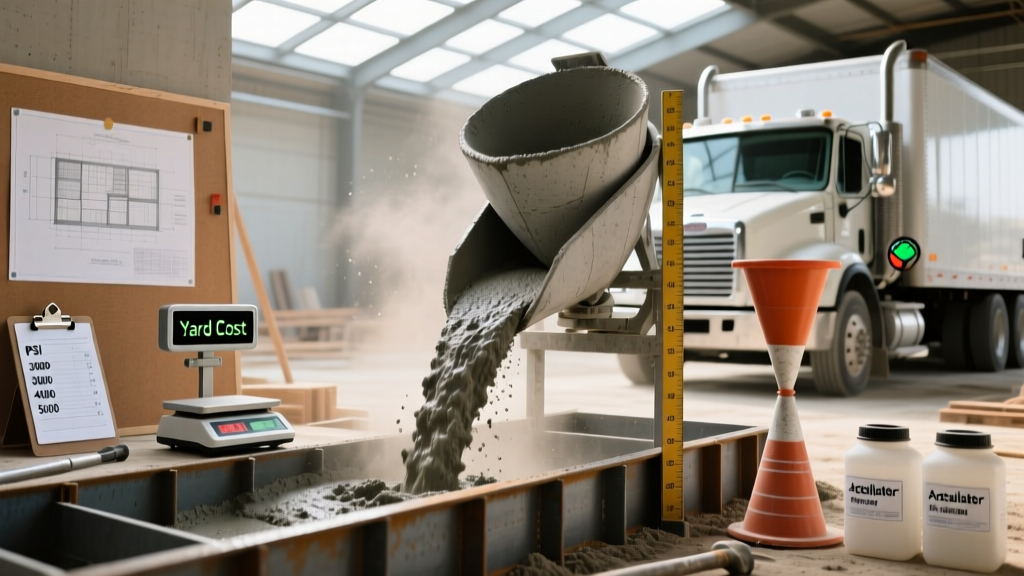
The Base Reality: Material vs. Installed Cost Per Yard
Quoting the cost of concrete per yard without specifying the application is a fundamental estimating error. A cubic yard of concrete is not a monolithic commodity; it is a customizable chemical matrix. In 2026, the baseline material cost for standard 3,000 PSI ready-mix concrete ranges from $135 to $145 per cubic yard. However, the material cost is only the starting point. When you factor in delivery, placement, finishing, and curing, the installed cost per yard jumps significantly, typically landing between $275 and $425 depending on the structural demands and finish requirements of the specific scenario.
According to the National Ready Mixed Concrete Association, the final ticket price is heavily influenced by the mix design, specifically the compressive strength (PSI), the slump (workability), and the inclusion of chemical admixtures. To accurately budget, contractors and homeowners must match the specific application to the required mix profile, rather than simply ordering 'standard concrete' and hoping it meets structural codes.
Scenario Matching Matrix: Which Mix Fits Your Project?
Different structural loads and environmental exposures demand distinct mix designs. The following matrix aligns common residential and light-commercial applications with their required concrete specifications and the corresponding estimated material costs per cubic yard.
| Application Scenario | Target PSI | Slump (inches) | Required Admixtures | Est. Material Cost/Yard |
|---|---|---|---|---|
| Interior Slab-on-Grade | 3,000 - 3,500 | 4 - 5 | Air-entrainment (if unheated) | $135 - $145 |
| Exterior Driveway | 4,000 | 4 | Air-entrainment, Fiber mesh | $155 - $170 |
| Structural Foundation Wall | 4,500 - 5,000 | 5 - 6 | Water reducer, Pumping aid | $165 - $185 |
| Decorative Stamped Patio | 3,500 - 4,000 | 4 | Retarder, Integral color | $195 - $230 |
| Heavy-Duty Shop Floor | 5,000+ | 3 - 4 | Silica fume, Hardening aggregate | $190 - $220 |
As detailed by the Portland Cement Association, increasing the PSI requires a higher cement content or the use of supplementary cementitious materials (SCMs) like fly ash or slag, which directly impacts the per-yard price. Furthermore, adjusting the slump for pumpability requires water-reducing admixtures to maintain the water-cement ratio, adding another $8 to $15 per yard to the batch ticket.
Hidden Cost Variables That Inflate Your Per-Yard Price
The batch plant ticket is rarely the final invoice. Logistics and site-specific constraints introduce surcharges that drastically alter the effective cost of concrete per yard, especially on smaller pours.
Warning: The Short Load Trap
Standard concrete trucks carry 9 to 11 cubic yards. If your project requires less than a full truckload (typically under 7 to 10 yards, depending on the supplier), you will be hit with a 'short load fee.' This fee is usually assessed at $50 to $75 per missing yard. For example, ordering 4 yards from a plant with a 10-yard minimum and a $60/yard short load fee will add $360 in surcharges to your ticket, effectively increasing your per-yard cost by $90.
Logistics Surcharge: Pump Trucks
If the truck cannot back directly up to the forms (common for backyard patios or deep foundation trenches), you must hire a concrete pump. In 2026, expect a pump truck hook-up fee of $150 to $250, plus a volumetric charge of $15 to $22 per cubic yard pumped. For a 20-yard foundation pour, pumping adds roughly $450 to $690 to the total project cost.
Application-Specific Cost Breakdowns
To understand how these variables synthesize in the real world, let us examine two distinct scenarios and their true installed costs.
Scenario A: The Standard Residential Driveway (600 sq ft, 4 inches thick)
A 600-square-foot driveway at 4 inches thick requires approximately 7.4 cubic yards of concrete. Factoring in a 10% waste and overage allowance, you will order 8.2 yards.
- Material: 4,000 PSI mix with 5% air-entrainment (for freeze-thaw resistance) and macro-synthetic fiber mesh for secondary reinforcement. Cost: $165/yard = $1,353.
- Delivery: Full load, no short load fee.
- Labor & Finishing: Forming, grading, placing, and broom finishing at $4.50 per square foot = $2,700.
- True Installed Cost Per Yard: $4,053 total / 8.2 yards = $494 per yard.
Scenario B: The Backyard Stamped Patio (400 sq ft, 4 inches thick)
A 400-square-foot patio requires roughly 5 cubic yards. With a 10% overage, the order is 5.5 yards. Because it is in the backyard, a pump truck is required.
- Material: 3,500 PSI mix with integral color and a retarder to slow curing for stamping. Cost: $210/yard = $1,155.
- Short Load Fee: 4.5 missing yards at $60/yard = $270.
- Pump Truck: $200 base + $18/yard for 5.5 yards = $299.
- Labor & Finishing: Forming, pumping, stamping, and sealing at $14.00 per square foot = $5,600.
- True Installed Cost Per Yard: $7,324 total / 5.5 yards = $1,331 per yard.
This comparison illustrates why searching for a flat 'cost of concrete per yard' is misleading. The decorative patio's installed cost per yard is nearly triple that of the driveway due to short load fees, pumping logistics, and specialized finishing labor.
Decision Framework: When to Pay Premiums for Admixtures
Admixtures alter the chemical behavior of concrete. While they increase the material cost per yard, they often prevent catastrophic failures that cost thousands to repair. Use this framework to decide when to authorize the upcharge:
- Air-Entraining Agents ($8 - $12/yard): Mandatory for any exterior flatwork in climates that experience freeze-thaw cycles. The microscopic air bubbles give expanding ice room to form, preventing surface spalling. Never skip this for driveways or sidewalks in northern regions.
- Calcium Chloride Accelerators ($10 - $15/yard): Conditional. Use only when pouring in cold weather (below 50°F) to speed up the curing process and protect against early freezing. Do not use if the concrete contains embedded steel rebar, as chlorides promote corrosion. Opt for non-chloride accelerators ($18 - $25/yard) for reinforced foundations.
- Retarders ($10 - $15/yard): Conditional. Essential for hot weather pours (above 85°F) or complex decorative stamping where the crew needs extended working time before the concrete sets. Prevents cold joints in large pours.
- Macro-Synthetic Fiber Mesh ($12 - $18/yard): Highly Recommended for Flatwork. Acts as secondary reinforcement to control plastic shrinkage cracking. It does not replace structural rebar or wire mesh for load-bearing capacity, but it significantly reduces surface micro-cracking during the critical first 24 hours of curing.
Sourcing Strategy: Minimizing the Final Ticket Price
Optimizing the cost of concrete per yard requires precise volume calculation and strategic scheduling. Always calculate your yardage using the formula: (Length in feet × Width in feet × Depth in feet) ÷ 27. Add exactly 10% to this number to account for subgrade variations, spillage, and formwork bowing.
Pro-Tip: Schedule your pour for Tuesday through Thursday. Many batch plants charge weekend delivery premiums ranging from $100 to $250 per load, and some plants do not operate on Sundays at all, which can stall a multi-day foundation project.
Finally, verify the plant's washout policy. Environmental regulations strictly prohibit washing out concrete chutes into storm drains. If your site does not have a designated washout pit or area, the driver will need to return to the plant with residual concrete, triggering a washout fee of $50 to $100. By preparing a simple 4x4 foot dirt pit lined with heavy-duty plastic, you can eliminate this fee and keep your final per-yard cost firmly within your estimated budget.
For further reading on current installation averages and regional labor variances, Bob Vila's comprehensive concrete cost guide provides excellent supplemental data on contractor markup rates across different US markets.