Concrete Board vs Hardie Board: 2026 Cost & Install Guide
Compare concrete board vs Hardie board costs for 2026. Get exact pricing, installation labor rates, and expert tips for shower and tile backer boards.

The Nomenclature Problem: Cement vs. Concrete Backer Boards
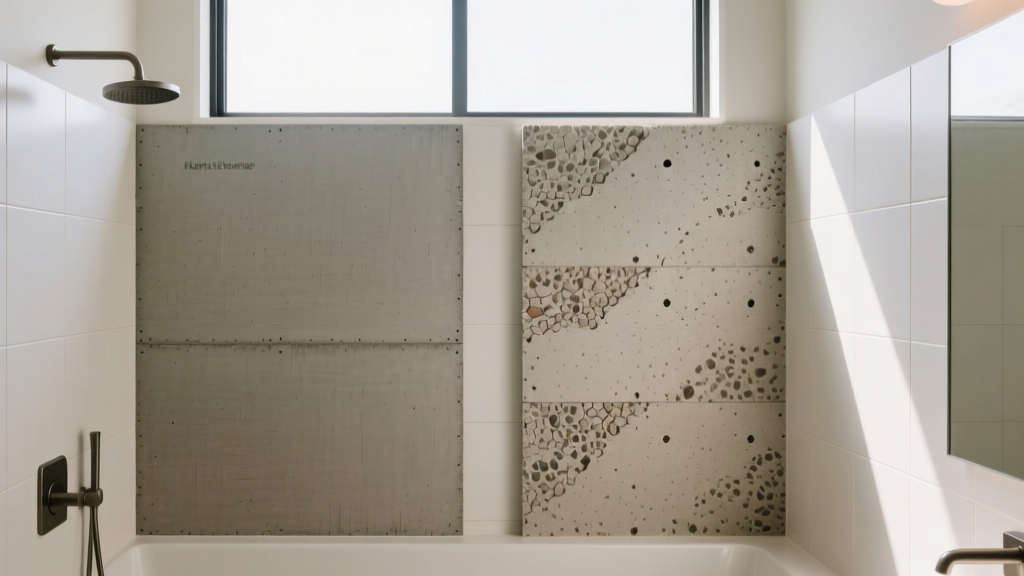
Before analyzing costs, it is critical to clarify industry terminology. When contractors and DIYers search for 'concrete board vs Hardie board' for tile and wet-area applications, they are typically comparing two distinct categories of cementitious backer units (CBUs). 'Hardie board' in this context refers specifically to James Hardie HardieBacker, a fiber-cement board composed of Portland cement, sand, and cellulose fibers. It contains no coarse aggregate, resulting in a smooth, dense surface.
Conversely, 'concrete board' usually refers to aggregate-based cement boards like USG Durock Next Gen or National Gypsum PermaBase. These boards incorporate pumice, expanded polystyrene beads, or coarse sand into the cement matrix, giving them a rougher texture and different structural properties. Understanding this material distinction is the foundation of an accurate 2026 cost breakdown, as the installation labor and accessory requirements diverge significantly between the two.
2026 Material Cost Comparison
Material costs for backer boards have stabilized following the supply chain fluctuations of the early 2020s. Below is the current retail pricing landscape for standard 1/2-inch thick, 3x5-foot panels (15 square feet of coverage).
| Product / Brand | Board Type | Price per Panel (3x5) | Cost per Sq. Ft. | Weight per Panel |
|---|---|---|---|---|
| HardieBacker 500 (James Hardie) | Fiber-Cement (No Aggregate) | $14.85 | $0.99 | 42 lbs |
| Durock Next Gen (USG) | Aggregate-Cement | $13.50 | $0.90 | 38 lbs |
| PermaBase (National Gypsum) | Aggregate-Cement (Polystyrene) | $12.90 | $0.86 | 34 lbs |
Hidden Installation Costs and Labor Variables
The most significant cost divergence between HardieBacker and aggregate concrete boards occurs during the cutting and fastening phases. Professional tile setters typically charge between $2.50 and $4.50 per square foot for backer board installation, but the specific material chosen can push labor toward the higher end of that spectrum.
Cutting Methods and Dust Mitigation
HardieBacker is designed to be scored with a carbide-tipped utility knife and snapped along the score line, similar to drywall. This method generates minimal dust and requires only basic hand tools. For complex cuts around plumbing valves, a standard carbide-grit hole saw suffices.
Aggregate concrete boards like Durock cannot be cleanly score-snapped. They must be cut using an angle grinder equipped with a diamond masonry blade or specialized cement-board shears. This introduces severe hidden costs:
- Silica Dust Containment: Grinding aggregate cement generates respirable crystalline silica. OSHA regulations and basic safety protocols require HEPA-filtered dust extractors, plastic sheeting to seal the work area, and N95/P100 respirators. Setting up and breaking down this containment adds 1 to 2 hours of labor per bathroom.
- Blade Wear: Diamond blades degrade faster when cutting dense pumice and sand aggregates compared to cellulose fiber-cement, adding roughly $15 to $25 in consumable tooling costs per project.
Fastener Requirements
Both board types require alkali-resistant fasteners. Standard drywall screws will corrode when exposed to the high pH of Portland cement and the moisture of thinset mortar, eventually causing rust stains to bleed through your grout lines.
- Buildex Rock-On or Backer-On Screws: Cost approximately $18 per box of 200. You will need roughly 40-50 screws per 15-square-foot panel (spaced 8 inches on center).
- Hot-Dipped Galvanized Roofing Nails: A cheaper alternative at $8 per pound, but they are harder to drive flush without fracturing the board edges, particularly on the denser HardieBacker.
Waterproofing: The Great Equalizer
A common and costly misconception is that either HardieBacker or concrete board is inherently waterproof. They are water-resistant—meaning they will not degrade, swell, or lose structural integrity when wet—but they are highly porous. Water will pass directly through them and rot the wood framing behind.
According to the Tile Council of North America (TCNA) guidelines for wet-area installations, a secondary waterproofing membrane is mandatory for showers. This requirement equalizes the cost between the two board types, as both require the same membrane application.
Waterproofing Membrane Costs (2026 Estimates)
- Liquid-Applied (e.g., Custom Building Products RedGard): Approximately $55 per gallon. One gallon covers roughly 80 square feet with two coats. Cost: $0.68 per sq. ft.
- Sheet-Applied (e.g., Schluter Kerdi): Fabric membrane requires unmodified thinset for adhesion. Cost: $1.85 to $2.20 per sq. ft.
When using a liquid membrane, HardieBacker's smoother surface requires slightly less product to achieve the required 30-mil wet-film thickness compared to the textured, pitted surface of aggregate concrete boards, which can absorb more liquid and require a heavier second coat.
Application Decision Matrix
Choosing between fiber-cement and aggregate-cement boards should be driven by the specific physical demands of the installation area, not just the upfront material cost.
| Application Area | Recommended Board | Technical Rationale |
|---|---|---|
| Standard Shower Walls | HardieBacker 500 (1/2') | Easier to score and snap; lighter weight reduces stress on wall studs; smooth surface bonds well with large-format porcelain. |
| Shower Floors / Pans | HardieBacker 250 (1/4') or Durock | 1/4-inch boards allow for easier floor-height transitions. Durock is preferred if embedding a traditional mortar bed due to its aggressive texture. |
| High-Impact Commercial Areas | Durock or PermaBase (1/2') | The aggregate matrix provides superior impact resistance against heavy carts or equipment compared to fiber-cement. |
| Kitchen Countertops | HardieBacker 500 (1/2') | Dense, void-free surface prevents thinset from sinking into aggregate pits, ensuring a level substrate for natural stone or quartz tiles. |
| Exterior Cladding Substrate | Durock Exterior | Aggregate boards handle freeze-thaw cycles and exterior moisture expansion better than cellulose-based fiber-cement. |
Edge Cases and Common Failure Modes
Even with proper installation, specific failure modes are unique to each material. Understanding these can save thousands in remediation costs.
HardieBacker Edge Crumbling
Because HardieBacker lacks aggregate, its edges are prone to crumbling if cut with dull tools or if screws are driven too close to the edge. The manufacturer's installation guidelines strictly mandate that all fasteners must be placed at least 3/8 inch from the edge and 2 inches from the corners. Failing to adhere to this spacing results in blown-out edges that compromise the structural lock of the tile above.
Durock Aggregate Tear-Out
When cutting holes for shower valves or plumbing penetrations in Durock, the pumice aggregate can tear out violently if a standard spade bit or reciprocating saw is used. This leaves massive voids around the pipe, making it impossible to properly seal the penetration with waterproofing membrane or mortar. Always use a diamond-grit hole saw attached to a heavy-duty drill, cutting at a low RPM to preserve the board's integrity around the penetration.
Final Cost Synthesis: Total Installed Price per 100 Sq. Ft.
To provide a realistic budget for a standard 100-square-foot shower surround (including backer board, alkali-resistant tape, thinset, fasteners, and liquid waterproofing membrane), here is the synthesized 2026 cost breakdown:
HardieBacker System (100 Sq. Ft.)
- Material (7 panels): $103.95
- Fasteners & Tape: $25.00
- Liquid Membrane (RedGard): $75.00
- Labor (Install & Waterproof @ $4.00/sq ft): $400.00
- Total Estimated Cost: $603.95
Aggregate Concrete Board System (e.g., Durock) (100 Sq. Ft.)
- Material (7 panels): $94.50
- Fasteners & Tape: $25.00
- Liquid Membrane (RedGard - requires heavier coat): $85.00
- Labor (Install, Dust Containment & Waterproof @ $4.75/sq ft): $475.00
- Total Estimated Cost: $679.50
While the aggregate concrete board saves roughly $9.45 on raw materials, the increased labor time for dust mitigation, difficult cutting, and heavier membrane application results in a net loss of over $75 per 100 square feet. For interior residential wet areas, fiber-cement boards like HardieBacker offer a superior return on investment through drastically reduced labor friction, provided the installer strictly adheres to edge-clearance fastening protocols and applies a continuous, code-compliant waterproofing membrane.
Written by
Marcus ChenMarcus Chen is a licensed structural engineer (PE) and building materials analyst with over 12 years of experience across residential, commercial, and industrial construction. He holds a Master of Science in Civil Engineering from UC Berkeley and spent six years at Thornton Tomasetti before transitioning to independent consulting and technical writing. Marcus specializes in material selection for seismic-prone regions, concrete reinforcement strategies, and lifecycle cost analysis. His work has been cited by the American Concrete Institute (ACI) and the Structural Engineers Association of California (SEAOC). When he is not on a job site or at his desk, you will find him hiking the Sierra Nevada or restoring a 1920s craftsman bungalow in Oakland, CA.
More from Marcus Chen
View all
Construction Cost
How Much Did the Eiffel Tower Cost to Build?
How much did the Eiffel Tower cost to build in 1889? We adjust for inflation and compare its budget to modern skyscraper construction.
Aug 4, 2026

Fire Resistance
What Is a Fire Resistant Material? Testing & Certification Guide
Discover what is a fire resistant material through ASTM and UL testing. Learn how fire ratings, certifications, and assemblies work in construction.
Aug 4, 2026

Construction Cost
How Much Did the Burj Khalifa Cost to Build?
How much did the Burj Khalifa cost to build? We break down the $1.5B project and extract 5 money-saving strategies for your next build.
Jul 30, 2026