Fiber in Concrete vs Rebar: Structural Reinforcement Guide
Compare fiber in concrete vs rebar for structural reinforcement. Learn dosage rates, ASTM standards, cost differences, and when to use hybrid systems.

The Core Difference: Macro vs. Micro Reinforcement
The debate surrounding fiber in concrete vs rebar often stems from a fundamental misunderstanding of how concrete fails. Concrete possesses high compressive strength but exceptionally low tensile strength—roughly 10% of its compressive capacity. When tensile stresses exceed this threshold, cracking occurs. The choice between fiber reinforcement and steel rebar is not always mutually exclusive; rather, it is a decision between managing micro-cracks (fibers) and resisting macro-structural tensile loads (rebar).
Quick Decision Framework
- Choose Rebar When: The slab is suspended, subjected to heavy dynamic point loads, or must bridge expansive subgrades where structural bending moments are high.
- Choose Fibers When: The primary goal is controlling plastic shrinkage cracking, improving impact resistance, or replacing welded wire mesh (WWM) in ground-bearing slabs.
- Choose Both (Hybrid) When: Designing industrial floors, airport runways, or suspended decks requiring both structural load capacity and tight crack-width control for durability.
Rebar (Steel Reinforcing Bar): The Structural Backbone
Steel rebar provides the primary tensile capacity for structural concrete. Governed by ASTM A615 standards, the most common specification in North America is Grade 60, which indicates a minimum yield strength of 60,000 psi. Rebar does not prevent concrete from cracking; instead, it holds the cracked sections together, transferring tensile stresses across the fracture and preventing catastrophic structural failure.
Sizing, Spacing, and Cover Requirements
Proper rebar placement is critical. The American Concrete Institute (ACI) mandates specific concrete cover depths to protect the steel from corrosion. For slabs cast against earth, a minimum 3-inch cover is required, while slabs exposed to weather typically require 1.5 to 2 inches of cover.
- #3 Bar (3/8 inch): Used for light-duty walkways and thin decorative overlays.
- #4 Bar (1/2 inch): The standard for residential driveways, patios, and light commercial slabs. Typically spaced 16 to 18 inches on center (O.C.).
- #5 Bar (5/8 inch): Required for heavy commercial floors, suspended decks, and foundations. Spaced 12 to 16 inches O.C.
According to the Portland Cement Association, inadequate cover depth or poor consolidation around the rebar matrix are the leading causes of spalling and rebar corrosion in reinforced concrete structures.
Fiber Reinforcement: Micro-Crack Control and Toughness
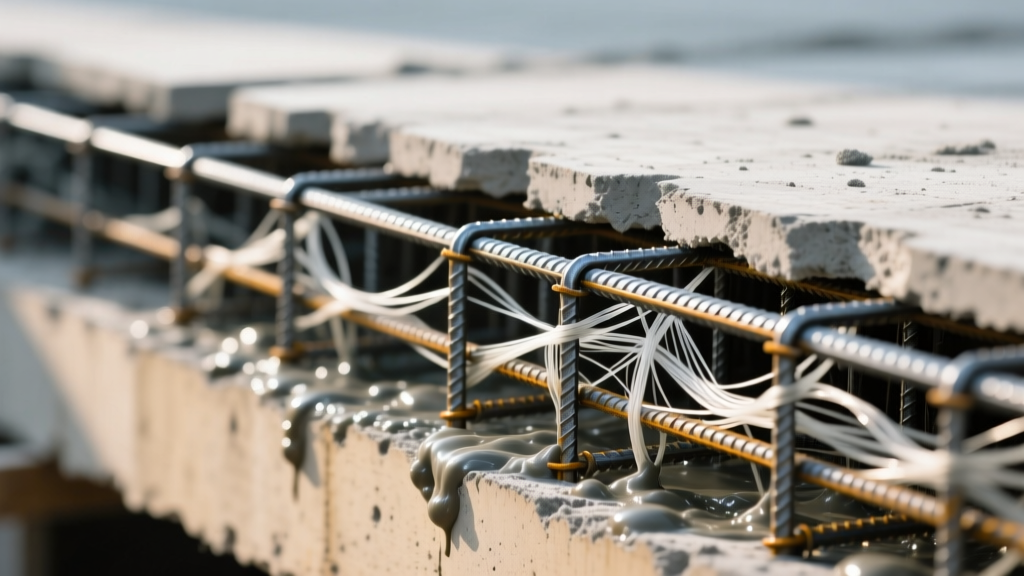
Fiber reinforcement operates on a three-dimensional micro-scale. Millions of discrete fibers are distributed uniformly throughout the concrete matrix during batching. While fibers cannot replace the structural tensile capacity of rebar in suspended elements, they excel at intercepting micro-cracks before they propagate into macro-fractures.
Fiber Classifications and Dosage Rates
Not all fibers perform identically. Selection depends on the specific failure mode you are engineering against:
- Micro-Synthetic Fibers (Polypropylene): Governed by ASTM C1116 Type III. Dosage rates are low, typically 0.5 to 1.5 lbs per cubic yard (cy). Their sole purpose is to mitigate plastic shrinkage cracking during the first 24 hours of curing by providing a micro-scaffold that holds the paste together as water evaporates.
- Macro-Synthetic Fibers: Thicker, longer, and often embossed or fibrillated for mechanical anchoring. Dosage ranges from 3 to 10 lbs/cy. These are engineered to provide post-cracking residual strength and are frequently used to completely replace welded wire mesh (WWM) in ground-bearing slabs.
- Steel Fibers: Governed by ASTM A820. Dosage ranges heavily from 40 to 100 lbs/cy. Used in heavy industrial floors, tunnel linings, and shotcrete applications where high impact resistance and extreme abrasion tolerance are required.
- Basalt and AR-Glass Fibers: Used in highly corrosive environments (e.g., marine structures, chemical plants) where steel would rapidly oxidize. Basalt fibers offer high tensile strength and are completely immune to chloride-induced corrosion.
Head-to-Head Comparison Matrix
| Feature | Steel Rebar (Grade 60) | Macro-Synthetic Fibers | Steel Fibers |
|---|---|---|---|
| Primary Function | Structural tensile load resistance | Post-cracking toughness & WWM replacement | Impact resistance & heavy-duty crack control |
| Crack Prevention | Poor (allows cracking, holds it together) | Good (intersects micro-cracks early) | Excellent (3D matrix restricts crack width) |
| Corrosion Risk | High (requires strict cover depths) | None (chemically inert) | Moderate to High (surface fibers may rust) |
| Labor Impact | High (requires tying, chairing, inspection) | Zero (added at batch plant) | Zero (added at batch plant) |
| Best Application | Suspended slabs, foundations, retaining walls | Warehouses, driveways, parking lots | Industrial floors, tunnel linings, mining |
Cost Analysis: Material and Labor Economics
When evaluating fiber in concrete vs rebar, the raw material cost is only half the equation. Labor economics heavily influence the final project budget.
Real-World Pricing Breakdown
As of 2026, material and labor markets have stabilized, but the premium for skilled rodworkers (rebar tiers) remains a significant line item.
- Rebar System: Material costs for Grade 60 epoxy-coated rebar average $0.95 to $1.30 per pound. A standard 4-inch residential slab requiring a #4 bar grid at 18" O.C. uses roughly 0.12 lbs of steel per square foot. However, the labor to haul, place, tie, and chair the rebar adds $1.50 to $3.00 per square foot, depending on regional union rates and site accessibility.
- Macro-Synthetic Fibers: Adding macro-synthetics to a ready-mix batch typically costs an additional $4.00 to $8.00 per cubic yard. For a 4-inch slab (81 square feet per yard), this equates to roughly $0.05 to $0.10 per square foot in material, with absolutely zero additional placement labor.
- Steel Fibers: Due to the high dosage rates (e.g., 60 lbs/cy), steel fibers add $35.00 to $65.00 per cubic yard. While expensive on a per-yard basis, they eliminate the need for WWM and reduce joint saw-cutting depth, often resulting in a net savings of 10-15% on large industrial pours.
Hybrid Systems: Using Both for Maximum Performance
In advanced structural engineering, the 'versus' mindset is abandoned in favor of hybrid reinforcement. The Federal Highway Administration frequently specifies hybrid systems for concrete bridge decks and heavy-duty pavements. In these scenarios, a bottom mat of epoxy-coated rebar handles the primary negative and positive bending moments, while a dosage of 40 lbs/cy steel fibers or 5 lbs/cy macro-synthetics is integrated into the mix design to control temperature-induced shrinkage and increase the fatigue life of the wearing surface.
Common Failure Modes and Edge Cases
Improper specification or execution leads to distinct failure modes depending on the reinforcement chosen.
Rebar Placement Errors
The most common failure in slab-on-grade construction is rebar resting on the subgrade. If a #4 bar is pulled up into the top third of the slab during the pour, it provides zero resistance to bottom-up tensile bending. Conversely, if it stays on the dirt, it fails to control surface shrinkage. Continuous use of 2-inch or 3-inch concrete chairs and mid-pull techniques are mandatory.
Fiber Batching and 'Balling'
Synthetic and steel fibers can clump into dense 'balls' if introduced improperly at the ready-mix plant. Fibers must be added to the mixer concurrently with the aggregates, or via specialized dosing equipment directly onto the conveyor belt. Adding fibers to a fully mixed, high-slump batch at the end of the mixing cycle almost guarantees uneven dispersion and severe surface clumping.
Frequently Asked Questions
Can macro-synthetic fibers completely replace rebar in a driveway?
No. Macro-synthetic fibers can replace welded wire mesh (WWM) for temperature and shrinkage reinforcement in a ground-bearing driveway. However, if the driveway spans a trench, features an integrated retaining wall, or is subjected to extreme point loads (like RV jacks), structural rebar is required to handle the bending moments.
Do fibers affect the finishability of concrete?
Micro-synthetics (1 lb/cy) have a negligible effect on finishing. However, macro-synthetics and steel fibers can protrude through the surface if over-floated or troweled prematurely. Finishers must wait for the bleed water to evaporate and use a float to push the fibers just below the surface paste before executing the final burn.
Which is better for a basement floor: rebar or fibers?
For a standard 4-inch interior basement slab cast over a vapor barrier and crushed stone, macro-synthetic fibers (at 5 lbs/cy) combined with properly spaced control joints are highly effective and cost-efficient. Rebar is generally unnecessary unless the basement floor is designed as a structural diaphragm or spans over active soil voids.
Written by
David NakamuraDavid Nakamura is a licensed architect (AIA) and construction technology writer focused on sustainable building methods, mass timber engineering, and high-performance building envelopes. He holds a Master of Architecture from the University of Washington and is a certified Passive House Consultant (CPHC). David spent eight years at the Seattle firm Mithun, where he led the design of three LEED Platinum projects, before founding his own practice specializing in net-zero residential design. He serves on the editorial advisory board of GreenBuilder Magazine and has authored peer-reviewed papers on cross-laminated timber (CLT) connections for the Journal of Structural Engineering. In his spare time, David teaches woodworking at Pratt Fine Arts Center and kayaks the Puget Sound.
More from David Nakamura
View all
Construction Cost
Labor Cost to Build a Deck Per Sq Ft: 2026 Installation Guide
Discover the exact labor cost to build a deck per sq ft in 2026. This installation guide breaks down contractor rates, complexity factors, and hidden fees.
Aug 4, 2026

Construction Cost
How Much Does It Cost to Build a 3 Bedroom House? Financing Guide
Learn exactly how much it costs to build a 3 bedroom house and explore 2026 financing options, construction loan types, and budget frameworks for your build.
Aug 4, 2026

Construction Cost
Cost to Build a Tennis Court: 2026 Guide
How much does it cost to build a tennis court in 2026? Breakdowns for asphalt, concrete, and synthetic surfaces plus fencing and lighting.
Jul 30, 2026