Cost of Stamped Concrete vs Pavers: 2026 Specs & Pricing
Compare the cost of stamped concrete vs pavers with 2026 pricing, technical specs, base prep requirements, and long-term maintenance data.

Core Cost Breakdown: Stamped Concrete vs. Pavers
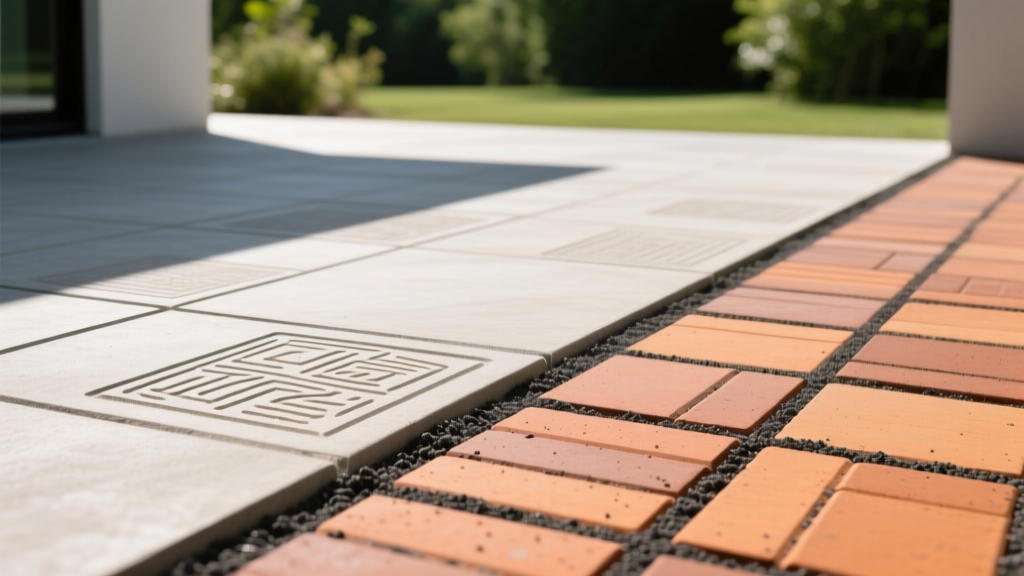
When evaluating the cost of stamped concrete vs pavers for exterior hardscaping, surface-level estimates often obscure the true financial and structural implications of each system. In 2026, material volatility and specialized labor rates have shifted the pricing landscape. Stamped concrete generally presents a lower initial capital expenditure for complex patterns, while interlocking paver systems demand higher upfront labor but offer superior structural modularity.
| System Component | Stamped Concrete (Per Sq.Ft.) | Concrete Pavers (Per Sq.Ft.) | Clay/Stone Pavers (Per Sq.Ft.) |
|---|---|---|---|
| Subgrade & Base Prep | $2.50 - $4.00 | $4.00 - $6.50 | $4.50 - $7.00 |
| Materials (Mix/Pavers/Sand) | $3.50 - $6.00 | $4.50 - $9.00 | $12.00 - $22.00 |
| Labor & Installation | $6.00 - $12.00 | $8.00 - $14.00 | $14.00 - $25.00 |
| Total 2026 Installed Cost | $12.00 - $22.00 | $16.50 - $29.50 | $30.50 - $54.00 |
According to current industry data tracked by HomeGuide's 2026 hardscaping cost indexes, the national average for a mid-range stamped concrete patio sits at $18.50 per square foot, while a comparable interlocking concrete paver system averages $23.00 per square foot. However, these baseline figures exclude critical site-specific modifications such as retaining walls, heavy clay soil remediation, or complex drainage integration.
Technical Specifications & Structural Integrity
The longevity of either system relies entirely on adherence to strict material specifications and subgrade preparation. Surface aesthetics are secondary to structural engineering in exterior flatwork.
Stamped Concrete System Specifications
Stamped concrete is a monolithic, rigid pavement system. Its structural performance is dictated by the concrete mix design, reinforcement strategy, and jointing plan.
- Compressive Strength: Minimum 4,000 PSI at 28 days. For driveways or areas subject to vehicular loads, 4,500 to 5,000 PSI is mandatory.
- Air Entrainment: In climates with freeze-thaw cycles, the mix must include 4% to 6% entrained air (per National Ready Mixed Concrete Association (NRMCA) guidelines) to create microscopic voids that accommodate water expansion.
- Slab Thickness: 4 inches for pedestrian patios and walkways; 5 to 6 inches for driveways and vehicular aprons.
- Reinforcement: Welded wire mesh (6x6 W1.4xW1.4) or synthetic macro-fibers (dosed at 3 to 5 lbs per cubic yard) for secondary shrinkage crack control. For driveways, #3 or #4 epoxy-coated rebar on 24-inch centers is required.
- Control Joints: Saw-cut to a depth of 25% of the slab thickness (1 inch deep for a 4-inch slab). Spacing must not exceed 24 to 30 times the slab thickness in feet (typically 8 to 10 feet apart) to force shrinkage cracking along predetermined, hidden lines.
Stamping requires a precise concrete cure state. If the surface is worked too early, the paste will displace, exposing the aggregate and ruining the color hardener. If worked too late, the stamps will fail to penetrate, resulting in shallow, indistinct patterns. Liquid release agents must be applied uniformly to prevent the polyurethane mats from bonding to the surface paste.
Interlocking Paver System Specifications
Unlike rigid concrete, pavers form a flexible, segmental pavement system. Load distribution occurs through vertical interlock, friction, and edge restraint rather than the tensile strength of the material itself. The Interlocking Concrete Pavement Institute (ICPI) dictates the following structural parameters:
- Subgrade Preparation: Native soil must be compacted to 95% Standard Proctor density. In expansive clay soils, a non-woven geotextile separation fabric is mandatory to prevent the base aggregate from migrating into the subgrade.
- Base Aggregate: 4 to 6 inches of crushed, angular aggregate (ASTM D2940 or locally equivalent 3/4-inch minus gravel) for pedestrian areas; 8 to 10 inches for vehicular loads. The angularity of the crushed stone is critical for mechanical interlock; rounded river gravel is strictly prohibited.
- Bedding Sand: Exactly 1 inch of coarse, washed concrete sand (ASTM C33). This layer is screeded but never compacted prior to paver placement.
- Paver Material Standards: Concrete pavers must meet ASTM C936, requiring a minimum compressive strength of 8,000 PSI and maximum water absorption of 5%. Clay pavers must meet ASTM C902.
- Edge Restraint: Rigid perimeter confinement is non-negotiable. Aluminum or heavy-duty PVC edge restraints must be secured with 10-inch galvanized or stainless steel spikes driven every 12 inches. Without this, lateral creep will cause the perimeter pavers to separate, leading to systemic failure.
Long-Term Maintenance & Lifecycle Cost Matrix
The initial installation cost is only one variable in the total cost of ownership. The maintenance profiles of stamped concrete and pavers diverge significantly after year three.
| Maintenance Factor | Stamped Concrete | Interlocking Pavers |
|---|---|---|
| Sealing Frequency | Every 2 to 3 years (Acrylic solvent or water-based sealers) | Optional; every 3 to 5 years if color enhancement is desired |
| Sealing Cost (Per Sq.Ft.) | $1.50 - $2.50 | $1.00 - $1.80 |
| Joint Maintenance | N/A (Monolithic surface) | Polymeric sand replacement every 5 to 8 years ($1.00 - $1.50/sq.ft.) |
| Crack/Settlement Repair | High difficulty. Requires slab sawing, mudjacking, or full-depth replacement. Color matching aged concrete is nearly impossible. | Low difficulty. Pavers are unzipped, base re-compacted, and pavers reinstalled with zero visual evidence of repair. |
| Surface Traction (Wet) | Low to Moderate. Stamped surfaces and acrylic sealers become highly slippery when wet unless anti-skid additives (e.g., aluminum oxide) are broadcast into the sealer. | High. The physical joints and textured surface of unsealed pavers provide excellent slip resistance. |
Site-Specific Decision Framework
Selecting between stamped concrete and pavers should be driven by site constraints and environmental variables, not just aesthetic preference. Use the following technical framework to determine the optimal system for your project.
Scenario A: High Clay Content & Poor Drainage Sites
Recommendation: Interlocking Pavers.
Expansive clay soils swell when wet and shrink when dry, causing severe differential settlement. A rigid stamped concrete slab will inevitably crack under these tensile stresses, regardless of rebar reinforcement. A flexible paver system, installed over a deep, open-graded aggregate base with geotextile separation, will move dynamically with the subgrade without structural failure.
Scenario B: Complex Curvilinear Designs & Tight Budgets
Recommendation: Stamped Concrete.
Creating tight radii and sweeping curves with rectangular pavers requires extensive cutting, resulting in high material waste (up to 15%) and exorbitant labor hours. Stamped concrete can be formed into any radius and textured with seamless mats, achieving complex organic shapes at a fraction of the labor cost.
Scenario C: Utility Access & Future Excavation
Recommendation: Interlocking Pavers.
If the hardscape area covers main sewer cleanouts, irrigation manifolds, or planned future utility trenches, pavers are the only logical choice. Pavers can be removed and stockpiled, allowing access to subterranean infrastructure, and then reinstalled. Cutting and patching a stamped concrete slab to access a utility line will permanently destroy the aesthetic continuity of the surface.
Scenario D: Extreme Freeze-Thaw & De-icing Chemicals
Recommendation: Stamped Concrete (with caveats) or Unsealed Pavers.
Rock salt and calcium chloride can cause spalling (surface flaking) in both systems if improperly specified. For stamped concrete, a high-air-entrained mix and a breathable, non-film-forming sealer are required. For pavers, avoid sealing entirely, as trapped moisture beneath a surface sealer will freeze and spall the paver face. Specify pavers with a maximum 5% absorption rate to minimize internal water retention.
Expert Insight: The most common point of failure in segmental paver installations is not the paver itself, but the degradation of polymeric joint sand due to improper activation. If polymeric sand is not thoroughly blown off the surface before misting with water, or if it is over-watered, it will form a brittle crust that shatters under foot traffic within one season. Always follow the manufacturer's exact hydration protocols.
Written by
Priya KapoorPriya Kapoor is a real estate market analyst and construction economics researcher with expertise in housing affordability, development feasibility, and infrastructure investment. She holds a Master of Regional Planning from Cornell University and previously worked as a senior analyst at CBRE's Investment Properties group, where she modeled returns for $4B in mixed-use development pipelines. Priya now runs an independent research practice advising developers, municipalities, and REITs on construction cost forecasting and market timing. She publishes the quarterly "BuildMat Market Pulse" report tracking material price indices across 12 commodity categories. Based in Austin, TX, Priya serves on the board of Habitat for Humanity Austin and is a marathon runner.
More from Priya Kapoor
View all
Construction Cost
Cost to Build a 1600 Sq Ft Home in 2026: Full Breakdown
Accurate 2026 cost to build a 1600 sq ft home—material, labor, and regional pricing breakdowns included. Plan your budget with real-time estimates.
Aug 11, 2026

Wood & Lumber
Name the Types of Wood for Pressure Treatment and Preservation
Learn how to name the types of wood best suited for pressure treatment. Compare species treatability, chemical retention levels, and 2026 preservation costs.
Aug 4, 2026

Stone & Masonry
Stone Veneer Suppliers Lindenhurst: 2026 Cost Analysis
Analyze 2026 stone veneer costs in Lindenhurst, NY. Compare local supplier pricing, delivery fees, and Suffolk County installation labor rates.
Aug 4, 2026