Crushed Concrete vs Crushed Limestone: Technical Specs & Use Cases
Compare crushed concrete vs crushed limestone for base layers. Explore technical specs, CBR values, drainage rates, and compaction requirements.

Material Composition and Origin Profiles
When engineering base courses, sub-bases, or structural fill, the choice between Recycled Concrete Aggregate (RCA) and virgin crushed limestone dictates the long-term structural integrity of the pavement or slab above. While both materials can be processed to meet identical gradation requirements, their fundamental mineralogical and physical properties diverge significantly.
Crushed limestone is a sedimentary rock composed primarily of calcium carbonate (CaCO3). It is mechanically fractured from quarried bedrock, yielding angular particles with high compressive strength and low porosity. Conversely, crushed concrete is a composite material. It consists of natural aggregate (which may itself be limestone, granite, or gravel) bound by residual, hydrated Portland cement paste. This adhered mortar paste is the primary variable that alters the geotechnical behavior of RCA, increasing its water absorption, lowering its specific gravity, and introducing complex chemical interactions with the surrounding soil matrix.
Geotechnical and Structural Specifications
Geotechnical engineers evaluate base materials based on their ability to distribute loads and resist deformation under traffic or structural weight. The following table outlines the typical baseline specifications for dense-graded crushed limestone versus processed RCA when tested under standardized ASTM protocols.
| Property | Test Standard | Crushed Limestone | Crushed Concrete (RCA) |
|---|---|---|---|
| Bulk Specific Gravity (Gsb) | ASTM C127 / C128 | 2.60 - 2.75 | 2.30 - 2.50 |
| Water Absorption Rate | ASTM C127 / C128 | 0.5% - 2.0% | 3.0% - 9.0% |
| Los Angeles Abrasion Loss | ASTM C131 | 20% - 30% | 30% - 45% |
| California Bearing Ratio (CBR) | ASTM D1883 | 80 - 110+ | 70 - 100 |
| Sodium Sulfate Soundness | ASTM C88 | < 15% loss | 15% - 25% loss |
| Optimum Moisture Content (OMC) | ASTM D1557 | 8% - 12% | 12% - 16% |
Compaction and Moisture Density Relationships
The most critical field challenge when substituting crushed limestone with RCA lies in moisture management during compaction. Because the residual cement paste in RCA is highly porous, it acts as a sponge. If a contractor applies the Optimum Moisture Content (OMC) parameters derived from a limestone Modified Proctor test (ASTM D1557) to an RCA base, the aggregate will rapidly absorb the mixing water. The result is a base that is effectively too dry internally, preventing the fine particles from lubricating and achieving Maximum Dry Density (MDD).
Freeze-Thaw Durability and Soundness
In northern climates subject to seasonal freezing, the sulfate soundness test (ASTM C88) is a primary indicator of freeze-thaw durability. Crushed limestone typically exhibits low soundness loss (under 15%) due to its dense, impermeable crystalline structure. RCA, however, frequently records soundness losses between 15% and 25%. The hydrated cement paste spalls and degrades under the hydraulic pressure of freezing pore water. For highway base courses in freeze-thaw zones, state DOTs often mandate a maximum soundness loss of 15%, which can disqualify lower-grade RCA unless it is blended with virgin aggregate or restricted to non-structural fill applications.
Hydrological Performance and Drainage Metrics
The permeability of a base course dictates its ability to drain infiltrating surface water, preventing hydrostatic pressure buildup and subgrade softening. Clean, open-graded crushed limestone provides excellent drainage, with permeability coefficients (k) often exceeding 10^-2 cm/s.
RCA presents a hydrological complication: the milling and crushing process generates a high volume of micro-fines (material passing the No. 200 sieve). These fines are primarily pulverized cement paste. If the RCA is not washed or air-classified, these fines fill the void spaces between the coarse particles, drastically reducing the coefficient of permeability to 10^-4 cm/s or lower. While this creates a denser, more stable layer for slab-on-grade foundations, it makes unwashed RCA unsuitable for French drains, retaining wall backfill, or permeable pavement reservoirs where rapid exfiltration is required.
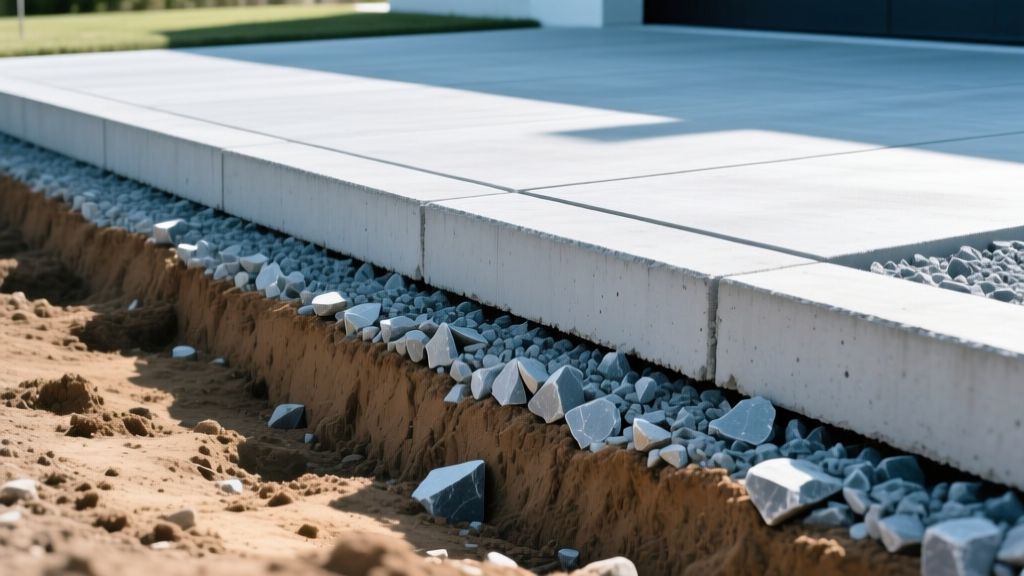
Gradation Standards and Sieve Analysis
Both materials can be processed to meet dense-graded aggregate specifications, such as ASTM D2940 or AASHTO M6. However, the particle shape and texture differ. Crushed limestone yields highly angular, cubical particles with rough fractured faces that provide excellent mechanical interlock and high internal friction angles (often >45 degrees).
RCA particles tend to be more rounded and smooth, particularly if the original concrete was river-gravel-based. To compensate for the lower internal friction angle of RCA, gradation specifications often require a higher percentage of material passing the No. 4 sieve to create a tighter matrix. When ordering RCA for a structural base, specify a 'dense-graded, washed' product with a maximum allowable of 5% passing the No. 200 sieve to balance structural interlock with controlled drainage.
Decision Matrix: Selecting the Right Aggregate
Choosing between crushed concrete and crushed limestone requires evaluating the specific engineering demands of the project against material availability and cost.
- Heavy Traffic Pavements (High ESALs): Use crushed limestone. The higher CBR, lower abrasion loss, and superior resistance to fatigue cracking under heavy axle loads make it the mandatory choice for arterial roads and industrial logistics yards.
- Residential Driveways and Parking Lots: RCA is highly suitable. The traffic loads are low, and the cost savings (typically 20% to 40% less than virgin limestone) offset the minor reductions in structural capacity.
- Slab-on-Grade Foundations: RCA is excellent as a capillary break and vapor barrier sub-layer, provided it is well-graded and compacted. The residual fines can actually help create a tighter seal against vapor transmission compared to clean limestone.
- Retaining Wall Backfill and French Drains: Use strictly clean, washed crushed limestone. The fines in RCA will migrate, clog perforated pipes, and increase lateral earth pressure due to poor drainage.
Environmental and LEED Certification Impacts
From a sustainability perspective, RCA holds a distinct advantage. Utilizing recycled concrete diverts demolition debris from landfills and reduces the carbon footprint associated with quarrying and transporting virgin limestone. Projects pursuing LEED v4.1 certification can earn credits under the 'Building Product Disclosure and Optimization - Sourcing of Raw Materials' category by specifying RCA. According to the EPA Sustainable Materials Management guidelines, concrete is one of the most heavily recycled C&D materials, and specifying local RCA drastically cuts transportation-related greenhouse gas emissions.
Furthermore, the FHWA Pavement Recycling Portal extensively documents the viability of RCA in base and sub-base applications, noting that when processed to state DOT specifications, RCA performs equivalently to virgin aggregates in low-to-medium traffic environments. Engineers must weigh the immediate geotechnical superiority of limestone against the lifecycle environmental benefits and potential cost reductions of crushed concrete, tailoring the specification to the exact load, drainage, and chemical requirements of the site.
Written by
David NakamuraDavid Nakamura is a licensed architect (AIA) and construction technology writer focused on sustainable building methods, mass timber engineering, and high-performance building envelopes. He holds a Master of Architecture from the University of Washington and is a certified Passive House Consultant (CPHC). David spent eight years at the Seattle firm Mithun, where he led the design of three LEED Platinum projects, before founding his own practice specializing in net-zero residential design. He serves on the editorial advisory board of GreenBuilder Magazine and has authored peer-reviewed papers on cross-laminated timber (CLT) connections for the Journal of Structural Engineering. In his spare time, David teaches woodworking at Pratt Fine Arts Center and kayaks the Puget Sound.
More from David Nakamura
View all
Construction Cost
Labor Cost to Build a Deck Per Sq Ft: 2026 Installation Guide
Discover the exact labor cost to build a deck per sq ft in 2026. This installation guide breaks down contractor rates, complexity factors, and hidden fees.
Aug 4, 2026

Construction Cost
How Much Does It Cost to Build a 3 Bedroom House? Financing Guide
Learn exactly how much it costs to build a 3 bedroom house and explore 2026 financing options, construction loan types, and budget frameworks for your build.
Aug 4, 2026

Construction Cost
Cost to Build a Tennis Court: 2026 Guide
How much does it cost to build a tennis court in 2026? Breakdowns for asphalt, concrete, and synthetic surfaces plus fencing and lighting.
Jul 30, 2026