Crushed Concrete vs Gravel Driveway Base Installation
Compare crushed concrete vs gravel for driveway bases. Master installation steps, compaction specs, and material costs for a stable, frost-proof foundation.

Subgrade preparation and base material selection dictate the lifespan of any paved surface, concrete slab, or heavy-duty driveway. When evaluating crushed concrete vs gravel for base layers, the decision extends far beyond initial material costs. It involves understanding angularity, fines content, drainage characteristics, and the unique self-cementing properties of recycled materials. A poorly installed base will inevitably lead to frost heave, differential settlement, and catastrophic surface cracking, regardless of the quality of the asphalt or concrete poured above it.
This installation guide provides structural specifications, material handling protocols, and compaction standards required to build a high-performance base layer using either Recycled Concrete Aggregate (RCA) or traditional crushed gravel.
Material Matrix: Crushed Concrete vs Gravel
Before breaking ground, it is critical to understand the mechanical differences between these two aggregates. According to the Environmental Protection Agency (EPA), recycling concrete into aggregate diverts millions of tons from landfills, but the resulting material behaves differently than virgin stone.
| Specification | Crushed Concrete (RCA) | Crushed Gravel (Virgin Aggregate) |
|---|---|---|
| Gradation Standard | Typically #411 or 21A (1.5" minus) | #411, #57, or Crusher Run |
| Angularity | High (fractured faces from crushing) | High (if crushed); Low (if river rock) |
| Binding Properties | Self-cementing (residual hydrated cement) | Mechanical interlock only (requires fines) |
| Optimal Moisture | Requires higher water content for activation | Standard Optimum Moisture Content (OMC) |
| Average Cost (2026) | $18 - $28 per ton | $28 - $45 per ton |
Phase 1: Subgrade Excavation and Geotextile Separation
The performance of your aggregate base is entirely dependent on the soil beneath it. The California Bearing Ratio (CBR) of your native soil dictates the required thickness of your base layer. For most residential driveways with a CBR between 3 and 5, a compacted base thickness of 6 to 8 inches is mandatory.
- Excavate to Stable Subgrade: Remove all topsoil, organic matter, and loose clay. Excavate to a depth of 10 to 12 inches (accounting for 4 inches of surface concrete/asphalt and 6-8 inches of base). Use a laser level to establish a minimum 2% slope (1/4 inch per foot) for positive drainage.
- Proof-Roll the Subgrade: Drive a heavily loaded vehicle (e.g., a fully loaded 3/4-ton truck) over the exposed dirt. Any areas that rut or pump water indicate soft spots that must be excavated and backfilled with coarse stone.
- Deploy Geotextile Fabric: Lay a 6 oz non-woven geotextile separation fabric (such as US Fabrics 6oz or Mirafi 500X) directly over the compacted dirt. This prevents the aggregate fines from migrating down into the clay subgrade while allowing water to pass through. Overlap all seams by a minimum of 18 inches and pin them with landscape staples.
Phase 2: Installing a Crushed Concrete (RCA) Base
Recycled Concrete Aggregate contains residual, unhydrated cement paste from its original lifecycle. When exposed to moisture, this paste can rehydrate, giving RCA a unique "self-cementing" property that creates a semi-rigid base layer over time.
Spreading and Moisture Conditioning
Order your RCA in a #411 gradation (a mix of 3/4-inch stone and fine stone dust). Spread the material in "lifts" (layers) no thicker than 4 to 6 inches at a time. Attempting to compact an 8-inch lift in a single pass will result in a hard surface crust over a soft, uncompacted core.
Because of the residual cement, RCA requires precise moisture management. If the material is too dry, the cementitious properties remain dormant; if it is too wet, the base will turn to mush under the compactor.
Compaction Protocol
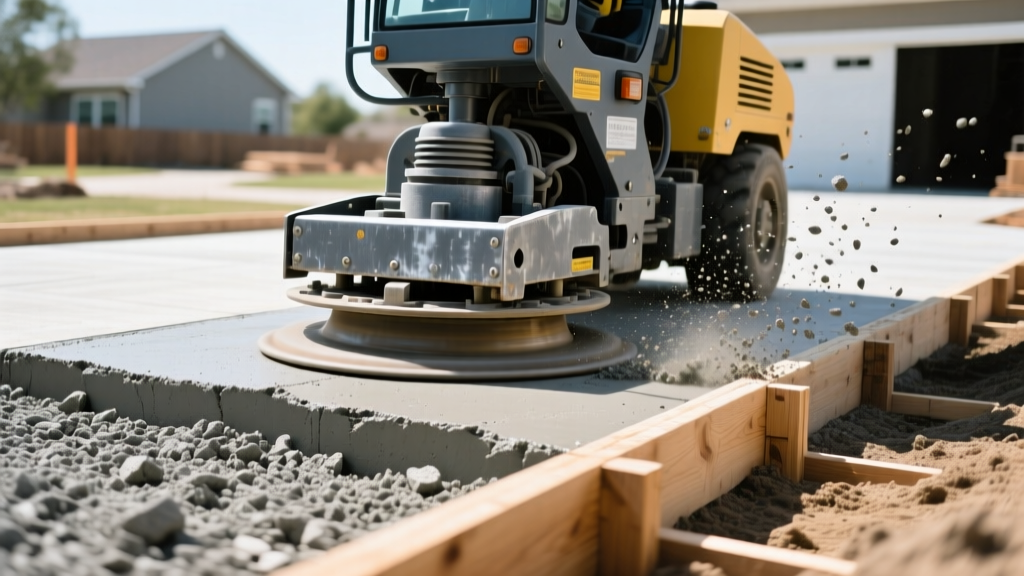
Use a heavy walk-behind vibratory plate compactor (minimum 5,000 lbs of centrifugal force, such as a Wacker Neuson WP1550) or a 1-ton vibratory roller for large areas. Make 4 to 6 overlapping passes. The residual cement in RCA means the base will continue to harden and gain structural strength over the next 14 to 28 days as it cures.
Phase 3: Installing a Crushed Gravel Base
If you opt for virgin crushed gravel, you are relying entirely on mechanical interlock rather than chemical binding. The ASTM D2940 standard outlines the strict gradation requirements for graded aggregate materials used in structural bases to ensure proper density and shear strength.
Choosing the Right Gradation
For a solid base layer beneath concrete or asphalt, specify "Crusher Run" or "#411 Crushed Stone." This material includes the essential stone dust (fines) required to fill the voids between the larger 3/4-inch stones. If you are installing a permeable paver system or a French drain where rapid water evacuation is the priority, switch to #57 washed stone, which lacks fines and will not compact into a solid mass.
Spreading and Compaction
Spread the crushed gravel in 4-inch lifts. Unlike RCA, virgin gravel does not possess self-cementing properties, meaning the fines act merely as a physical filler. Over-watering virgin gravel will wash the fines out of the matrix, destroying the interlock and leaving you with loose, shifting rocks. Maintain a slightly damp state, compact with 4 to 6 overlapping passes, and verify that the surface is completely rigid with no visible deflection when walked upon.
Edge Cases and Failure Modes
Even with perfect installation techniques, specific environmental and material variables can compromise your base.
- Sulfate Contamination in RCA: If the crushed concrete was sourced from a structure heavily exposed to deicing salts or marine environments, it may contain high levels of chlorides and sulfates. Installing this material beneath a new reinforced concrete slab can lead to efflorescence and the corrosion of your new rebar. Always ask your supplier for the source of their RCA.
- High-Plasticity Clay Soils: If your subgrade consists of expansive clay (PI > 20), neither RCA nor standard gravel will prevent frost heave without intervention. You must either over-excavate by an additional 12 inches and backfill with clean sand, or mechanically stabilize the clay subgrade by tilling in Type S hydrated lime before laying your geotextile and aggregate.
- Edge Restraint Failure: Aggregate bases spread laterally under vertical loads. If your driveway or patio lacks rigid edge restraints (such as poured concrete curbs or heavy-duty plastic paver restraints pinned with 12-inch spikes), the outer 6 inches of your base will slowly migrate outward, causing the edges of your surface material to crumble and collapse.
2026 Cost Analysis and Sourcing Logistics
When budgeting your project, calculate material needs by weight, not volume. Aggregate settles significantly during transport and compaction. A standard rule of thumb is that 1.5 tons of compacted #411 base material covers 100 square feet at a depth of 4 inches.
Estimated Material Costs (Per Ton)
- Crushed Concrete (RCA): $18 - $28 / ton
- Crushed Gravel (#411 / Crusher Run): $28 - $45 / ton
- Washed Drainage Stone (#57): $32 - $50 / ton
- Non-Woven Geotextile Fabric: $0.45 - $0.85 / sq. ft.
- Delivery (Dump Truck, up to 20 tons): $150 - $350 flat rate (varies by local fuel surcharges)
For driveways exceeding 500 square feet, order material in bulk via a 20-ton tandem-axle dump truck rather than purchasing bagged aggregate from big-box retailers, which can cost upwards of $120 per ton. Coordinate the delivery to drop the aggregate directly onto your prepared subgrade to minimize double-handling with heavy machinery.
Choosing between crushed concrete and gravel ultimately depends on your local material availability, budget, and the specific load requirements of your project. Crushed concrete offers superior binding and cost-efficiency for heavy-load driveways, while virgin crushed gravel provides a predictable, contaminant-free base ideal for structural concrete slabs. By adhering to strict lift thicknesses, moisture management, and compaction standards, either material will provide a foundation engineered to last decades.
Written by
Marcus ChenMarcus Chen is a licensed structural engineer (PE) and building materials analyst with over 12 years of experience across residential, commercial, and industrial construction. He holds a Master of Science in Civil Engineering from UC Berkeley and spent six years at Thornton Tomasetti before transitioning to independent consulting and technical writing. Marcus specializes in material selection for seismic-prone regions, concrete reinforcement strategies, and lifecycle cost analysis. His work has been cited by the American Concrete Institute (ACI) and the Structural Engineers Association of California (SEAOC). When he is not on a job site or at his desk, you will find him hiking the Sierra Nevada or restoring a 1920s craftsman bungalow in Oakland, CA.
More from Marcus Chen
View all
Construction Cost
How Much Did the Eiffel Tower Cost to Build?
How much did the Eiffel Tower cost to build in 1889? We adjust for inflation and compare its budget to modern skyscraper construction.
Aug 4, 2026

Fire Resistance
What Is a Fire Resistant Material? Testing & Certification Guide
Discover what is a fire resistant material through ASTM and UL testing. Learn how fire ratings, certifications, and assemblies work in construction.
Aug 4, 2026

Construction Cost
How Much Did the Burj Khalifa Cost to Build?
How much did the Burj Khalifa cost to build? We break down the $1.5B project and extract 5 money-saving strategies for your next build.
Jul 30, 2026