DAP Concrete Crack Filler: Performance Specs, Ratings & Cure Times
Analyze DAP concrete crack filler performance specs, including tensile strength, VOC levels, cure times, and ASTM ratings for masonry repairs.
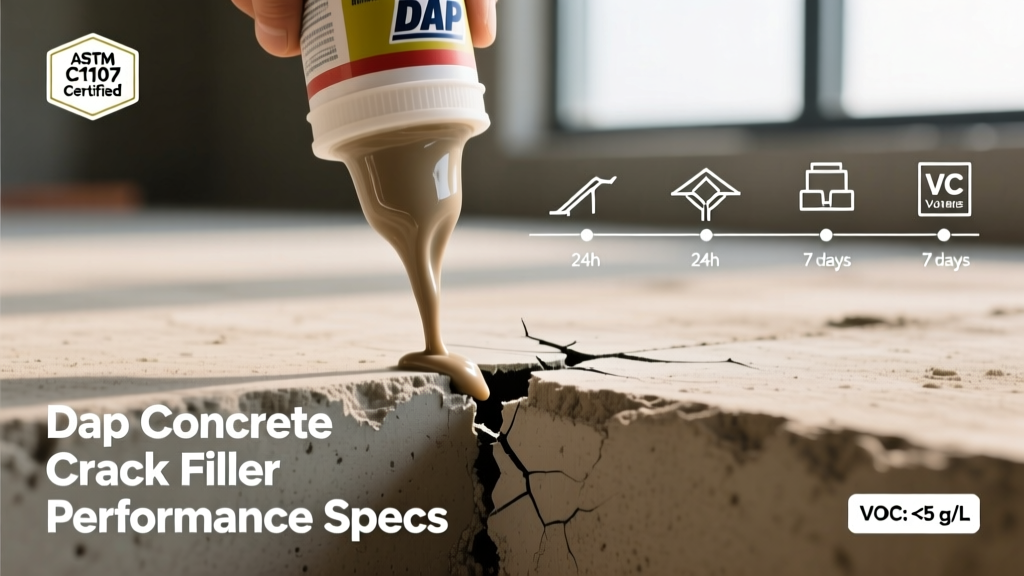
Technical Overview: DAP's Masonry & Concrete Sealant Line
When evaluating DAP concrete crack filler products for structural or cosmetic masonry repair, contractors and DIYers must look beyond the marketing claims on the cartridge. DAP manufactures two primary chemistries for concrete crack repair: traditional acrylic latex emulsions (like the DAP Textured Concrete Crack Filler) and advanced silyl-modified hybrid polymers (like the DAP 3.0 Advanced Concrete & Masonry Sealant). As of 2026, the industry has largely shifted toward hybrid polymers for exterior applications due to superior UV resistance and elongation capabilities, though acrylics remain relevant for specific interior or low-movement cosmetic fixes.
Understanding the exact technical data sheet (TDS) specifications is critical for preventing premature adhesion failure, especially in environments subject to freeze-thaw cycles and hydrostatic pressure. This guide breaks down the performance ratings, environmental tolerances, and application specifications required to achieve a lasting repair.
Core Performance Specifications & ASTM Ratings
The performance of any concrete joint sealant is benchmarked against ASTM C920, the standard specification for elastomeric joint sealants. While DAP's consumer-grade acrylics do not always carry a full ASTM C920 classification, their advanced hybrid polymers are engineered to meet or exceed specific movement classes.
Comparative Data Matrix: Acrylic vs. Hybrid Polymer
| Specification | DAP Textured Acrylic Filler | DAP 3.0 Advanced Hybrid Polymer |
|---|---|---|
| Base Chemistry | Acrylic Latex Emulsion | Silyl-Modified Polymer (SMP) |
| Movement Capability | ±12.5% (Class 12.5) | ±35% to ±50% (Exceeds Class 25) |
| Tack-Free Time | 30 - 60 minutes | 30 minutes |
| Full Cure Time | 7 - 14 days (depth dependent) | 24 - 48 hours |
| Shore A Hardness | ~25 (Soft, sandable) | ~30 (Flexible, durable) |
| VOC Content | < 50 g/L | < 30 g/L |
| Paintability | Paintable after 4 hours | Paintable after 30 minutes |
| Water Submersion | Not recommended | Waterproof in 30 mins; submersible |
Both formulations easily comply with the strictest regional air quality standards, including the EPA's architectural coating guidelines and SCAQMD Rule 1168. For projects requiring LEED v4.1 compliance or adhering to EPA VOC limits for architectural sealants, DAP's low-VOC formulations ensure no off-gassing penalties during interior slab repairs.
Environmental Tolerances & Substrate Preparation
The most common cause of DAP concrete crack filler failure is not product defect, but improper application outside of environmental tolerances or poor substrate preparation. Concrete is a highly porous, alkaline substrate that requires specific conditions for optimal chemical bonding.
Application Thresholds
- Temperature Range: Apply only when ambient and surface temperatures are between 40°F (4°C) and 100°F (38°C).
- Moisture Tolerance: While DAP 3.0 can be applied to damp substrates, standing water must be removed. The "damp" condition should resemble a wrung-out sponge, not a flooded joint.
- Alkalinity Limits: Fresh concrete (less than 28 days old) has a pH above 12, which can saponify and degrade acrylic binders. Hybrid polymers tolerate higher alkalinity, but a minimum 14-day cure for the concrete slab is still recommended before sealing.
Joint Routing and Backer Rod Sizing
For cracks wider than 1/4 inch, simply filling the void with sealant leads to cohesive failure. The sealant must be hourglass-shaped to allow for stretching and compression. Use a closed-cell polyethylene backer rod that is 25% larger than the crack width to ensure a tight friction fit. This prevents three-point adhesion—a scenario where the sealant sticks to the bottom and both sides of the joint, tearing the material apart when the concrete expands.
If routing or widening concrete cracks with an angle grinder, operators must use OSHA-compliant dust extraction systems or wet-cutting methods to prevent inhalation of respirable crystalline silica. Refer to OSHA hazard communication guidelines for mandatory PPE requirements during masonry grinding.
Diagnostic Guide: Common Failure Modes
When a DAP concrete crack filler repair fails, the fracture pattern reveals the root cause. Use this diagnostic framework to troubleshoot past failures before reapplying.
1. Adhesive Failure (Peeling from the sidewalls)
Symptom: The sealant pulls away cleanly from the concrete edge, leaving the concrete exposed.
Cause: Substrate contamination. Concrete dust, laitance, or previous silicone residue prevented the primer/sealant from bonding.
Fix: Wire brush the joint, vacuum thoroughly, and wipe with denatured alcohol or a TSP solution. For highly porous or degraded concrete, apply a dedicated masonry primer before filling.
2. Cohesive Failure (Tearing down the middle)
Symptom: The sealant remains stuck to both sides of the crack but splits open down the center.
Cause: Exceeded movement capability or three-point adhesion. The concrete expanded beyond the ±12.5% limit of the acrylic filler, or the sealant bonded to the bottom of the joint.
Fix: Upgrade to DAP 3.0 Advanced Hybrid Polymer for higher elongation (±35%+). Ensure a backer rod is installed so the sealant only adheres to the two vertical sidewalls.
3. Substrate Failure (Concrete spalling)
Symptom: The sealant remains intact, but it pulls chunks of the concrete surface away with it.
Cause: The concrete surface is too weak, friable, or spalling due to freeze-thaw damage.
Fix: The sealant is stronger than the substrate. You must rout out the weak concrete until you reach solid, sound aggregate before applying the filler.
Cost Analysis and Coverage Rates (2026 Data)
Calculating material requirements requires understanding the geometry of the bead. A standard 10.1 oz (300 mL) cartridge of DAP concrete crack filler yields the following linear coverage:
| Bead Size (Width x Depth) | Linear Footage per 10.1 oz Tube | Estimated Material Cost (2026) |
|---|---|---|
| 1/4" x 1/4" (Standard hairline/trim) | ~30 linear feet | $0.20 - $0.26 per foot |
| 3/8" x 3/8" (Standard driveway crack) | ~14 linear feet | $0.43 - $0.57 per foot |
| 1/2" x 1/2" (Expansion joints) | ~8 linear feet | $0.75 - $1.00 per foot |
Note: Pricing reflects average retail costs for DAP 3.0 and Textured Acrylic lines in early 2026. Bulk contractor pricing (12-packs) typically reduces per-tube costs by 15-20%.
Expert Verdict: Product Selection Framework
Choosing the correct DAP product depends entirely on the joint's function and environmental exposure.
- Choose DAP Textured Acrylic Filler when: Repairing static, non-moving hairline cracks in interior concrete floors, basement walls, or cosmetic stucco blemishes where a sandable, paintable, matte finish is required to blend with surrounding textures.
- Choose DAP 3.0 Advanced Hybrid Polymer when: Sealing exterior driveway cracks, patio expansion joints, or foundation perimeters. The SMP chemistry provides the necessary elasticity to handle thermal expansion, resists UV degradation without a topcoat, and withstands hydrostatic pressure from soil moisture.
By matching the specific elongation class and cure profile of the DAP product to the mechanical demands of your concrete joint, you ensure a repair that outlasts the seasonal freeze-thaw cycle without requiring annual maintenance.