Southport Concrete Installation in Southport, North Carolina
Expert guide to Southport concrete installation in Southport, North Carolina. Covers coastal mix designs, rebar protection, and sandy soil subgrade prep.
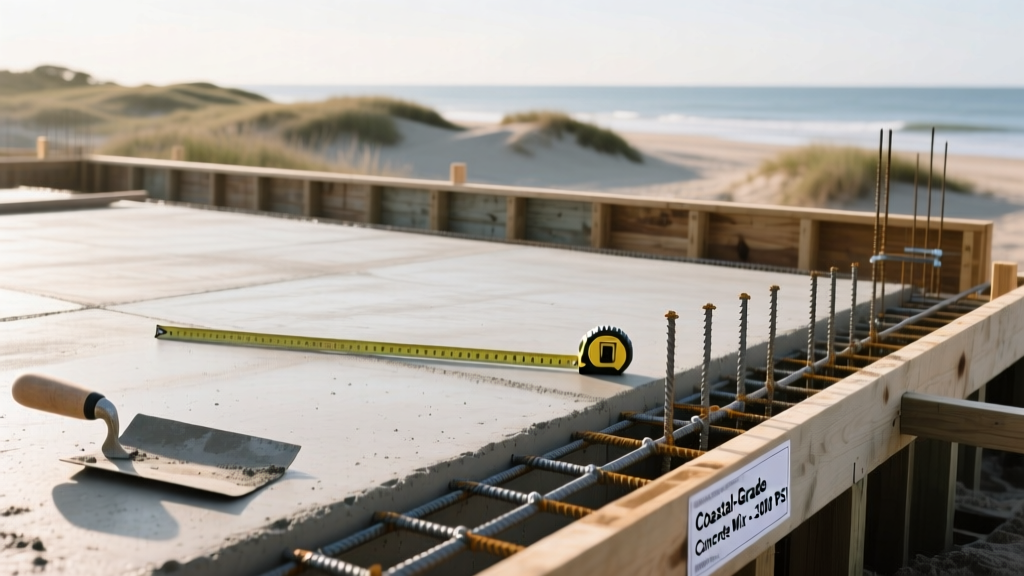
The Coastal Challenge: Why Southport Demands Specialized Concrete
Installing flatwork, foundations, or structural elements in Southport, North Carolina, requires a fundamental departure from standard inland concrete practices. Situated at the confluence of the Cape Fear River and the Atlantic Intracoastal Waterway, Southport presents a unique microclimate characterized by high humidity, relentless salt spray, and a shallow, fluctuating water table. Standard 3,000 PSI driveway mixes that perform adequately in Raleigh or Charlotte will rapidly succumb to chloride-induced rebar corrosion and sulfate attack in Brunswick County's coastal soils.
Successful Southport concrete installation hinges on three pillars: impermeable mix designs, aggressive corrosion mitigation for embedded metals, and meticulous subgrade preparation tailored to the region's native Wando and Kenansville sandy soil series. This guide details the exact installation and application procedures required to ensure structural longevity in this demanding coastal environment.
Engineered Mix Designs for Brunswick County's Salt Air
The primary enemy of coastal concrete is chloride ingress. When salt penetrates the concrete matrix and reaches the steel reinforcement, it destroys the passive oxide layer protecting the steel, leading to expansive rust that spalls the concrete from the inside out. To combat this, ready-mix suppliers servicing Southport must formulate high-density, low-permeability concrete.
Optimal Coastal Mix Parameters
| Parameter | Specification | Engineering Rationale |
|---|---|---|
| Compressive Strength | 4,500 PSI (28-day) | Higher cementitious content inherently reduces capillary porosity. |
| Water-Cement Ratio (w/c) | 0.42 Maximum | Restricts the capillary pore network, severely limiting chloride penetration. |
| Cement Type | Type II (MH) or Type V | Provides moderate to high sulfate resistance against tidal soil salts. |
| SCM Replacement | 30% Slag or 20% Class F Fly Ash | Supplementary Cementitious Materials refine pore structure and lower heat of hydration. |
| Air Entrainment | 5.0% - 7.0% | Ensures durability during rare but damaging coastal freeze-thaw cycles. |
By utilizing Portland Cement Association (PCA) guidelines for marine environments, the inclusion of slag cement or Class F fly ash is non-negotiable. These SCMs react with calcium hydroxide to form additional calcium silicate hydrate (C-S-H), effectively blocking the microscopic pathways that saltwater uses to infiltrate the slab.
Subgrade Preparation in Sandy Coastal Soils
Southport's native soils are predominantly poorly drained, loamy sands. While sand offers excellent bearing capacity when confined, it is highly susceptible to capillary action, wicking moisture directly from the water table into the concrete slab. Proper subgrade preparation is critical to prevent moisture vapor transmission (MVT) and subsequent flooring failures or mold growth.
- Excavation and Proof-Rolling: Excavate to a minimum depth of 12 inches below the finished floor elevation. Proof-roll the native subgrade with a fully loaded tandem-axle dump truck to identify soft spots. Any yielding areas must be undercut and backfilled with compacted aggregate base course (ABC) stone.
- Capillary Break: Install a 4-inch to 6-inch layer of clean, washed #57 crushed stone. This layer acts as a capillary break, preventing groundwater from wicking upward into the slab.
- Vapor Retarder Installation: Lay a minimum 15-mil polyethylene vapor barrier (such as Stego Wrap Class A) directly over the stone, compliant with ASTM E1745 standards. Tape all seams with manufacturer-approved moisture-resistant tape and seal all penetrations.
- Protection During Rebar Tying: Coastal contractors must use thick rubber-soled boots and prohibit sharp tools from dropping on the vapor barrier. Any punctures must be patched with a 12x12 inch piece of vapor barrier and sealed.
Reinforcement Strategies: Beating Chloride-Induced Corrosion
Even with a low w/c ratio, micro-cracking is inevitable in concrete. When cracks expose rebar to Southport's salt-laden air, standard black steel will corrode rapidly. For any structural element, foundation, or flatwork within 1,500 feet of the Intracoastal Waterway or the Cape Fear River, enhanced reinforcement protocols are mandatory.
CRITICAL WARNING: Rebar Chair Selection
Never use standard metal-wire rebar chairs (bolsters) in coastal Southport installations. The metal chairs will rust long before the rebar does, creating a 'rust bleed' pathway directly to the surface of the concrete. Always specify heavy-duty plastic or concrete-tipped chairs to maintain the required clear cover without introducing secondary corrosion points.
Specify ASTM A775 epoxy-coated reinforcing steel for all foundations and retaining walls. According to the FEMA P-55 Coastal Construction Manual, maintaining a minimum clear concrete cover of 3 inches over the rebar is essential in marine splash and salt-spray zones. For critical structural columns or seawall tie-beams, consider stainless-steel-clad rebar or fiberglass rebar (GFRP) to entirely eliminate the corrosion vector.
Step-by-Step Pouring and Curing Procedures
The coastal breeze off the Atlantic can cause rapid surface evaporation, leading to plastic shrinkage cracking even on overcast, humid days. The application procedure must account for these localized wind dynamics.
- Windbreak Deployment: Before the first truck arrives, erect temporary windbreaks (such as scaffold netting or plywood barriers) on the windward side of the pour to reduce surface wind velocity below 15 mph.
- Evaporation Retardants: Have a spray tank filled with an aliphatic alcohol evaporation retardant (e.g., Euclid Chemical EUCO BAR) ready. Apply a fine mist immediately after screeding if the evaporation rate exceeds 0.2 lbs/sq ft/hr.
- Vibration and Consolidation: Use high-frequency pencil vibrators to consolidate the low-slump (4-inch max) coastal mix. Over-vibration will cause the heavy aggregate to settle and bring excessive cement paste (laitance) to the surface, which is highly prone to dusting and scaling.
- Finishing: Avoid adding water to the surface during troweling. If the surface dries too quickly, use a spray bottle with a liquid densifier or retardant, never plain water, which will locally increase the w/c ratio and ruin the surface durability.
- Curing Compound Application: Within 30 minutes of final finishing, apply an ASTM C309 Type 2 (white-pigmented) liquid membrane-forming curing compound. The white pigment reflects the intense North Carolina UV radiation, keeping the slab temperature down and preventing thermal shock while retaining internal moisture for a full 7-day hydration cycle.
Cost Expectations for Southport Concrete Projects
Building in a coastal zone carries a premium. The table below outlines the estimated 2026 material and labor costs for concrete installation in Southport, reflecting the necessary upgrades for coastal durability.
| Project Component | Standard Inland Cost | Southport Coastal Specification Cost |
|---|---|---|
| Ready-Mix Concrete (per cubic yard) | $135 - $150 | $175 - $210 (Includes SCMs & low w/c) |
| Reinforcement (per sq. ft.) | $0.85 - $1.20 (Black steel) | $1.80 - $2.50 (Epoxy-coated + plastic chairs) |
| Vapor Barrier & Subgrade (per sq. ft.) | $0.40 - $0.60 | $0.90 - $1.30 (15-mil barrier + ABC stone) |
| Total Installed Flatwork (per sq. ft.) | $8.00 - $11.00 | $13.50 - $17.50 |
Frequently Asked Questions
Can I use standard 3,000 PSI concrete for a detached garage in Southport?
While local building codes may technically allow 3,000 PSI for minor detached structures, it is highly discouraged. The high water table and salt air will degrade a standard mix within 10 to 15 years. Upgrading to a 4,500 PSI mix with fly ash adds roughly $40 per cubic yard but doubles the lifespan of the slab.
How long should I wait before sealing a new coastal concrete driveway?
Wait a minimum of 28 days to allow the concrete to fully cure and off-gas internal moisture. When sealing, use a penetrating silane/siloxane water repellent rather than a surface-forming acrylic. Penetrating sealers block chloride ions from entering the pores without creating a slippery surface film when wet from coastal rain.
Does the Intracoastal Waterway proximity affect my footing depth?
Yes. Southport's sandy soils are prone to scour and shifting near the waterway. Footings must extend a minimum of 12 inches below the undisturbed soil line, but geotechnical engineers often require 18 to 24 inches of depth, or the use of helical piers, for properties directly on the marsh or waterway to prevent differential settlement.