Fiber Mesh Concrete vs Wire Mesh: Driveway & Slab Showcase
Compare fiber mesh concrete vs wire mesh for driveways, patios, and industrial slabs. Expert cost, labor, and application breakdowns for modern builds.

The Reinforcement Debate: Structural Integrity vs. Job-Site Efficiency
When engineering a concrete slab, controlling cracking and managing tensile stress are non-negotiable. The choice between fiber mesh concrete and welded wire mesh (WWR) dictates not only the structural longevity of the slab but also the labor logistics and final finish quality. While traditionalists often default to wire mesh for its visible, tangible grid, modern ready-mix facilities increasingly push synthetic and steel fiber reinforcement for its seamless integration and elimination of on-site placement errors.
This application showcase breaks down the exact performance metrics, cost variables, and ideal use cases for fiber mesh concrete vs wire mesh, providing contractors and homeowners with a definitive framework for slab reinforcement.
Material Specifications & ASTM Standards
To make an informed decision, you must look past the marketing terminology and examine the engineering standards governing these materials.
Welded Wire Reinforcement (WWR)
Governed by ASTM A1064, WWR consists of cold-drawn steel wires welded at right angles. For residential and light-commercial slabs, the industry standard is a 6x6 inch grid pattern.
- W1.4xW1.4 (10-gauge): Standard for 4-inch residential slabs, driveways, and patios. Provides approximately 0.028 square inches of steel per foot of width.
- W2.0xW2.0 (8-gauge): Used for 5-to-6-inch slabs subjected to heavier vehicular loads, such as RV pads or light commercial loading docks.
Fiber Mesh Reinforcement
Fibers are classified under ASTM C1116 and are dosed directly into the concrete truck at the batch plant. They are categorized by size and structural capability:
- Micro-Synthetic Fibers: Typically 3/4-inch polypropylene or nylon. Dosed at 1 to 1.5 lbs per cubic yard. Their sole function is mitigating plastic shrinkage cracking during the first 24 hours of curing. They offer zero structural post-crack tensile strength.
- Macro-Synthetic Fibers: Ranging from 1.5 to 2.5 inches, often embossed or deformed for mechanical anchoring. Dosed at 3 to 7 lbs per cubic yard. These are engineered to replace wire mesh and light rebar, providing measurable post-crack flexural strength (residual strength) and load transfer across joints.
- Steel Fibers: Hooked-end carbon steel, dosed at 40 to 80 lbs per cubic yard, reserved for heavy industrial applications.
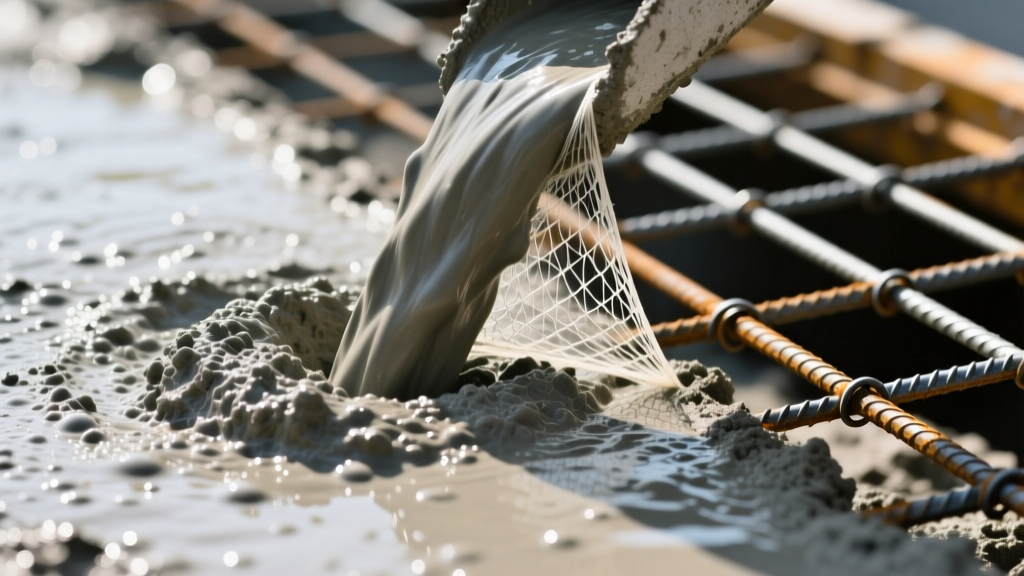
Application Showcase: Matching Reinforcement to the Project
1. Residential Driveways & Garage Slabs
For a standard 4-inch driveway, macro-synthetic fibers (dosed at 4 lbs/cy) frequently outperform W1.4 wire mesh in real-world conditions. The primary reason is placement. Wire mesh must be positioned in the upper third of the slab to effectively resist tensile forces caused by slab bending. If the crew fails to pull the mesh up during the pour—a common job-site error—the wire sits uselessly at the bottom of the slab, offering no crack prevention. Fiber mesh is distributed three-dimensionally throughout the entire cross-section, guaranteeing reinforcement exactly where the micro-cracks initiate.
2. Stamped & Decorative Patios
When pouring stamped concrete, acid-stained floors, or exposed aggregate patios, fiber mesh is the undisputed choice. Wire mesh carries a severe risk of rust bleeding. If a wire strand ends up too close to the surface during the finishing process, it will oxidize, creating permanent, unsightly rust stains that bleed through decorative sealers and color hardeners. Synthetic fibers are entirely non-corrosive and invisible at the surface, preserving the aesthetic integrity of high-end architectural finishes.
3. Industrial Warehouse & Heavy-Duty Floors
For 6-inch to 8-inch industrial slabs subjected to heavy forklift traffic and dynamic point loads, the comparison shifts. While heavy-dosed macro-synthetics (7 lbs/cy) are increasingly used for light manufacturing, steel fiber reinforcement or a dual-system (steel fibers combined with a rebar grid at the joints) remains the standard for heavy industrial facilities. Wire mesh alone is generally insufficient for these heavy-duty applications, as it lacks the localized impact resistance required to prevent joint spalling under steel-wheeled traffic.
Cost, Labor, and Logistics Matrix
The decision between fiber mesh concrete vs wire mesh often comes down to the total installed cost, which includes both material and labor. The table below outlines the financial and logistical footprint for a standard 1,000 square foot, 4-inch slab.
| Metric | W1.4 Wire Mesh (6x6) | Macro-Synthetic Fiber (4 lbs/cy) |
|---|---|---|
| Material Cost (per sq ft) | $0.25 - $0.35 | $0.12 - $0.18 (added to ready-mix) |
| Support Chairs / Lap Wire | $0.05 - $0.08 per sq ft | $0.00 |
| On-Site Labor (Placement) | 2 - 3 hours (tying, cutting, pulling) | 0 hours (pre-mixed at batch plant) |
| Equipment Required | Bolt cutters, tie wire, pliers | None |
| Total Estimated Added Cost | $450 - $600 | $150 - $220 |
Critical Failure Modes & Job-Site Realities
Wire Mesh Failure Mode: The "Bottom-Slab" Syndrome
The most frequent failure in wire-reinforced flatwork occurs when the mesh is laid flat on the subgrade and never elevated during the pour. Concrete shrinks as it cures, creating tensile stress at the top surface. If the wire is at the bottom, it cannot bridge the cracks forming at the top. To prevent this, contractors must use concrete chairs (spacers) or manually hook and pull the mesh into the upper third of the slab as the concrete is struck off. This requires skilled labor and slows down the pour.
Fiber Mesh Failure Mode: Clumping and Balling
Synthetic fibers can clump together (known as "balling") if introduced improperly at the batch plant, particularly in low-slump mixes or during cold-weather batching. If a clump of fibers makes it into the slab, it creates a localized weak point and can tear the surface during troweling. To mitigate this, specify high-quality, collated fibers that are designed to disperse rapidly upon contact with the moisture in the mix, and ensure the batch plant operator adheres to the manufacturer's mixing time requirements.
The Subgrade Variable
Neither wire mesh nor fiber mesh will save a slab poured over a poorly compacted subgrade. Differential settlement will cause structural cracking that vastly exceeds the tensile capacity of W1.4 wire or 4 lbs/cy macro-synthetics. A minimum of 4 inches of compacted, angular aggregate base (such as 3/4-inch crushed stone) is mandatory to ensure uniform support and proper drainage beneath the slab.
The Engineer’s Decision Framework
Use this practical framework to select the correct reinforcement for your next project:
- Is the slab decorative, stamped, or acid-stained?
Decision: Use Macro-Synthetic Fiber Mesh. Eliminates rust-bleed risks and surface snagging during detailed troweling. - Is the crew small, or is crane/pump access limited?
Decision: Use Fiber Mesh. Eliminating the physical weight and bulk of wire rolls speeds up site prep and reduces physical strain on the finishing crew. - Does the local building code or structural engineer explicitly mandate WWR?
Decision: Use Wire Mesh. Some municipal codes for garage slabs or suspended decks still strictly specify ASTM A1064 wire or rebar. Always verify local amendments before substituting with fibers. - Is the slab subjected to heavy point loads (e.g., RV jacks, industrial racking)?
Decision: Upgrade to W2.0xW2.0 (8-gauge) wire mesh, or increase macro-synthetic fiber dosage to 6-7 lbs/cy, combined with thickened edge footings.
Ultimately, the choice between fiber mesh concrete vs wire mesh is not about which material is universally "better," but which material aligns with the specific structural demands, aesthetic requirements, and labor realities of the job site. By matching the reinforcement to the application, contractors can deliver slabs that are both structurally sound and economically efficient.
Written by
Elena RodriguezElena Rodriguez is a civil engineer and technical writer specializing in concrete technology, masonry systems, and ASTM/ACI compliance. She earned her B.S. in Civil Engineering from Texas A&M University and spent a decade at a materials testing laboratory, performing over 2,000 concrete compressive strength tests and masonry prism evaluations. Elena is an ACI-certified Field Testing Technician (Grade I) and a member of ASTM Committee C12 on Natural Building Stone. She currently consults on forensic engineering cases involving concrete failures and moisture intrusion. Based in San Antonio, TX, Elena is a proud member of the Society of Women Engineers (SWE) and coaches her daughter's FIRST Robotics team.
More from Elena Rodriguez
View all
Walls & Panels
Cost Analysis: Light Gauge Steel Framing Advantages and Disadvantages
Evaluate light gauge steel framing advantages and disadvantages through a strict cost analysis lens, comparing material, labor, and lifecycle expenses.
Aug 4, 2026

Walls & Panels
Gypsum Board Types: Exact Specifications, Thickness & Dimensions
Compare standard, Type X, and moisture-resistant gypsum board types. Get exact specifications, thicknesses, dimensions, and ASTM standards for your project.
Aug 4, 2026

Fire Resistance
Best Fire-Resistant Outdoor Decking Materials: 2026 Buyer Guide
Discover the best fire-resistant outdoor decking materials for 2026. Compare Class A PVC, aluminum, and hardwood options for WUI compliance and safety.
Aug 4, 2026