Driveway Pavers vs Concrete: 2026 Cost Breakdown Analysis
Compare driveway pavers vs concrete with our 2026 cost breakdown. Analyze installation, maintenance, and long-term ROI for both driveway materials.

The Core Dilemma: Upfront Capital vs. Lifetime Serviceability
Choosing between driveway pavers vs concrete hinges on a fundamental trade-off: lower initial capital expenditure versus long-term serviceability and localized repair economics. In 2026, material volatility, specialized labor rates, and stringent municipal stormwater regulations have significantly widened the cost gap between these two paving systems. While poured concrete remains the default for budget-conscious builds, interlocking pavers offer superior performance in regions with severe freeze-thaw cycles and expansive clay soils. This analysis deconstructs the exact material, labor, and lifecycle costs for a standard 500-square-foot residential driveway, utilizing current 2026 market rates and American Society for Testing and Materials (ASTM) specifications.
- Standard Poured Concrete (Broom Finish): $4,500 – $6,000 ($9 – $12 / sq. ft.)
- Stamped/Decorative Concrete: $8,500 – $12,500 ($17 – $25 / sq. ft.)
- Standard Interlocking Concrete Pavers: $8,500 – $11,500 ($17 – $23 / sq. ft.)
- Permeable Interlocking Pavers (PICP): $11,000 – $15,000 ($22 – $30 / sq. ft.)
Poured Concrete Driveways: Detailed Cost Matrix
The economics of a poured concrete driveway are heavily front-loaded toward labor and forming. The material itself—ready-mix concrete—is relatively inexpensive, but the site preparation and finishing require skilled tradespeople. For a vehicular driveway, the industry standard mandates a minimum 4,000 PSI compressive strength mix with 5% to 7% air entrainment (per American Concrete Institute guidelines) to withstand freeze-thaw scaling. The water-cement (w/c) ratio must be kept at or below 0.45 to minimize shrinkage cracking.
Material & Labor Breakdown
| Component | Specification | Estimated Cost (per sq. ft.) |
|---|---|---|
| Subgrade Prep | Excavation, grading, and compaction of native soil | $1.50 – $2.50 |
| Base Material | 4 inches of compacted dense-graded aggregate (ASTM D2940) | $1.00 – $1.50 |
| Ready-Mix Concrete | 4,000 PSI, air-entrained, 4-inch slab thickness | $2.50 – $3.50 |
| Reinforcement | Welded wire mesh (6x6 W2.9xW2.9) or #4 rebar at 24" O.C. | $0.75 – $1.25 |
| Labor & Finishing | Formwork, pouring, screeding, and broom finishing | $3.50 – $5.00 |
Hidden Costs & Structural Upgrades
Contractors frequently exclude critical durability upgrades from base quotes. Saw-cutting control joints, which must be spaced at intervals 2 to 3 times the slab thickness (typically 10 feet apart) and cut to one-quarter of the slab depth, costs an additional $1.25 to $2.00 per linear foot. Furthermore, applying a penetrating silane-siloxane sealer to prevent chloride intrusion from de-icing salts adds $0.20 to $0.35 per square foot and must be reapplied every 3 to 5 years.
Interlocking Pavers: Detailed Cost Matrix
When evaluating driveway pavers vs concrete, pavers shift the cost burden from the surface material to the underlying base infrastructure. According to the Interlocking Concrete Pavement Institute (ICPI), a paver driveway is only as strong as its base. Vehicular pavers must meet ASTM C936 standards, requiring a minimum compressive strength of 8,000 PSI and a thickness of at least 2 3/8 inches (60mm), though 3 1/8 inches (80mm) is highly recommended for driveways that will support occasional heavy loads like RVs or dump trucks.
Material & Labor Breakdown
| Component | Specification | Estimated Cost (per sq. ft.) |
|---|---|---|
| Subgrade Prep | Deeper excavation (8-12 inches) and geotextile fabric over clay | $2.50 – $4.00 |
| Base Material | 6-8 inches of ASTM #57 and #8 open-graded or dense-graded stone | $2.50 – $3.50 |
| Bedding Sand | 1 inch of ASTM C33 coarse concrete sand (never masonry sand) | $0.50 – $0.75 |
| Paver Units | ASTM C936 concrete pavers (standard tumbled or smooth) | $3.50 – $6.00 |
| Edge Restraint | Heavy-duty plastic snap-edge or poured concrete curb | $1.50 – $2.50 |
| Labor & Compaction | Laying, plate compaction, and joint sand sweeping | $6.00 – $9.00 |
The Hidden Expense: Base Compaction & Jointing
The most common failure mode in paver installations is differential settling, leading to ponding water and tripping hazards. Preventing this requires mechanical compaction of the base aggregate using a vibratory plate compactor to achieve 95% to 98% Standard Proctor density. Additionally, modern installations mandate the use of polymeric joint sand. Unlike traditional silica sand, polymeric sand contains water-activated polymers that bind the sand grains together, preventing washout and inhibiting weed growth. Budget $0.15 to $0.25 per square foot for high-quality polymeric sand and the labor to activate it properly.
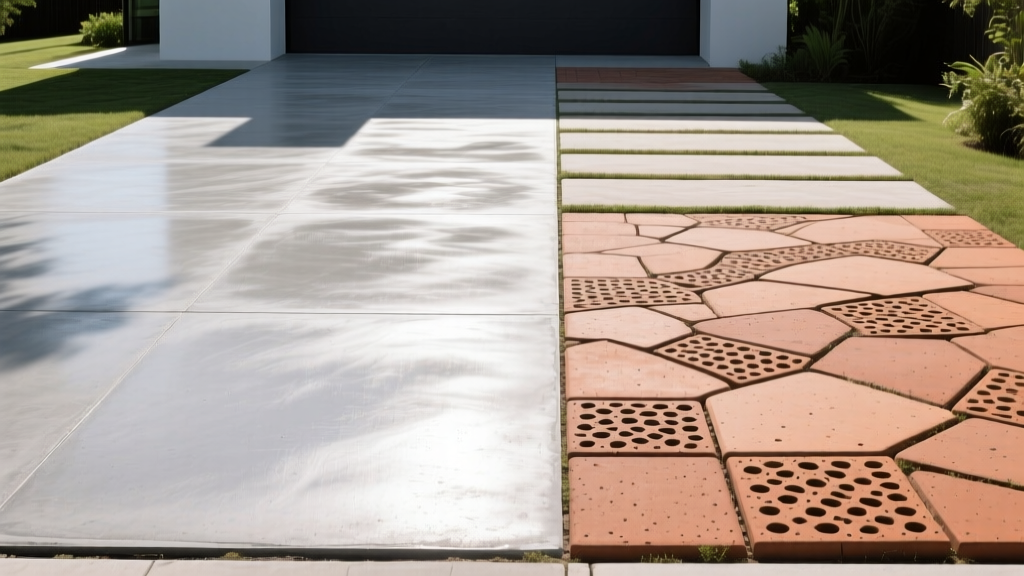
Head-to-Head Comparison: 20-Year Lifecycle Cost Analysis
The initial installation cost only tells half the story. Concrete is a monolithic, rigid pavement; when it fails, it fails catastrophically (e.g., a massive crack from tree root heave or subgrade washout). Pavers represent a flexible pavement system; they can be unzipped, the base repaired, and the exact same units reinstalled. Below is a projected 20-year lifecycle cost for a 500 sq. ft. driveway in a temperate climate with moderate freeze-thaw cycles.
| Cost Category | Poured Concrete (Broom) | Interlocking Pavers |
|---|---|---|
| Initial Installation | $5,250 | $10,000 |
| Sealing / Joint Stabilization (Years 5, 10, 15) | $450 (Siloxane Sealer) | $300 (Polymeric Sand Top-up) |
| Mid-Life Repair (Year 12) | $1,200 (Slab replacement due to root heave) | $150 (Pull, re-grade base, relay) |
| End-of-Life Salvage Value | $0 (Requires $800 demo/haul away) | $500 (Pavers can be reused or sold) |
| Net 20-Year Cost | $7,700 | $9,950 |
While pavers maintain a higher net cost over two decades, the gap narrows significantly when factoring in the aesthetic longevity. Stamped concrete, which costs nearly as much as pavers initially, will inevitably show wear patterns on the sealer and color hardener, requiring expensive resurfacing or complete demolition by year 15. Pavers retain their structural color integrity throughout their lifespan.
Site-Specific Variables That Skew the Budget
Baseline pricing assumes a flat, easily accessible lot with stable, well-draining soils. The following site conditions will trigger immediate cost escalations:
- Expansive Clay Soils: Requires the installation of a non-woven geotextile separation fabric (e.g., Mirafi 500X) beneath the aggregate base to prevent clay pumping. Adds $0.75/sq. ft.
- Steep Gradients (>5% Slope): Concrete requires extensive forming and specialized finishing techniques to prevent surface slumping before curing. Pavers require rigid poured-concrete edge restraints rather than plastic snap-edges to prevent downhill creep. Adds 15-20% to total labor.
- Limited Access: If a concrete pump truck is required because ready-mix trucks cannot reach the pour site, expect a $800 to $1,200 daily pump fee. Pavers can be hand-carried or moved via mini-skid steer, avoiding this penalty.
Permeable Systems & Municipal Stormwater Rebates
A critical 2026 financial variable in the driveway pavers vs concrete debate is municipal stormwater management. Many urban and suburban municipalities now heavily restrict the percentage of impervious surface area on residential lots. Permeable Interlocking Concrete Pavement (PICP) utilizes open-graded aggregates and wider joints filled with clean, washed ASTM #8 or #9 stone, allowing water to infiltrate directly into the subgrade. While PICP installations cost 20% to 30% more than standard pavers, many municipalities offer stormwater utility fee reductions or direct rebates ranging from $500 to $2,500 for installing verified permeable systems, effectively neutralizing the cost premium.
Specify Poured Concrete If: Your primary constraint is upfront budget, the site features heavy, continuous static loads (e.g., parked heavy machinery or RVs on jack stands), or the design calls for a minimalist, seamless modern aesthetic.
Specify Interlocking Pavers If: The site is located in a severe freeze-thaw climate, the soil contains expansive clays or is heavily wooded with invasive root systems, or local zoning mandates strict stormwater infiltration rates that favor permeable PICP systems.
Written by
James ThorntonJames Thornton is a construction industry veteran with 25 years of hands-on experience in wood framing, lumber grading, and residential building codes. He started as a framing carpenter in rural Oregon, earned his ICC Residential Building Inspector certification, and eventually became a senior plan reviewer for the City of Portland Bureau of Development Services. James holds a B.S. in Wood Science & Technology from Oregon State University and is a certified lumber grader through the West Coast Lumber Inspection Bureau (WCLIB). He has inspected over 3,000 residential construction sites and authored the city's internal guide on advanced framing techniques (2x6 at 24" O.C.). James lives in Bend, OR, where he builds custom timber-frame cabins and competes in lumberjack sports.
More from James Thornton
View all
Insulation
Best Home Insulation Materials: Complete 2026 Guide
Compare top home insulation materials for 2026. Find R-values, installed costs per square foot, and best uses for fiberglass, spray foam, and mineral wool.
Aug 4, 2026

Sustainable Building
Certify Your Green Building Material for LEED and WELL
Step-by-step guide to certifying a green building material for LEED v5 and WELL v2. Master EPDs, HPDs, and VOC limits for 2026 project specifications.
Aug 4, 2026

Stone & Masonry
Veneer Stacked Stone Panels: Interior Design & Style Showcase
Discover how veneer stacked stone panels transform interiors. Explore modern design profiles, material pairings, and technical installation specs.
Aug 4, 2026