Plastic vs Concrete Septic Tank: Complete Material Guide
Compare plastic vs concrete septic tanks for your property. Explore costs, lifespans, installation depths, and durability to make the right choice.

The Physics of Subsurface Containment
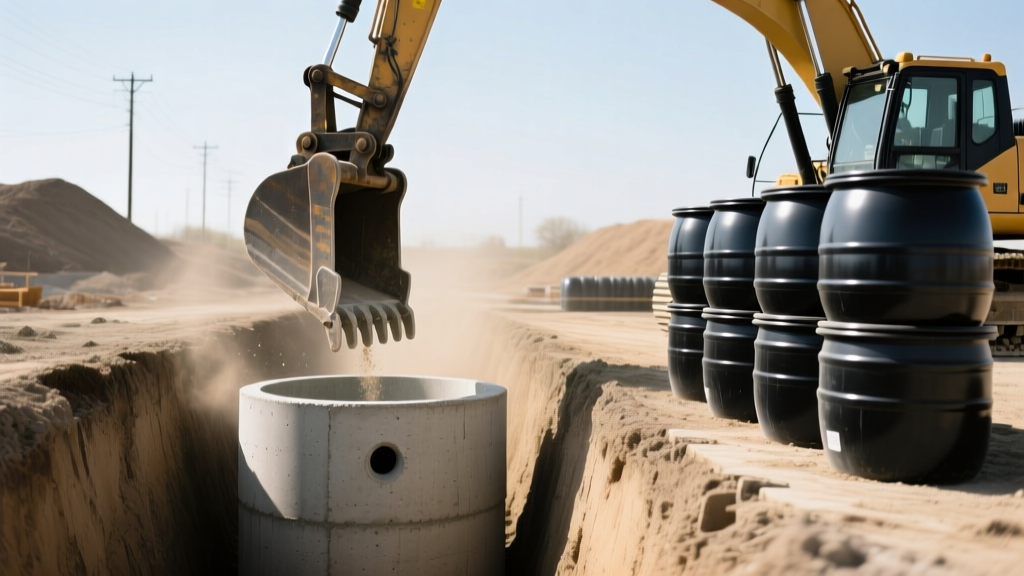
Selecting between a plastic and concrete septic tank is not merely a preference for one material over another; it is an engineering decision dictated by soil mechanics, hydrostatic pressure, and long-term chemical exposure. While both materials must meet stringent local health codes and EPA wastewater guidelines, their physical behaviors underground diverge drastically. A 1,000-gallon concrete tank weighs approximately 8,500 to 10,000 pounds, anchoring itself through sheer mass. A polyethylene tank of the same capacity weighs roughly 800 to 1,100 pounds, relying on structural ribbing and soil friction to resist deformation and buoyancy.
This guide dissects the material science, installation variables, and lifecycle economics of both options, providing the precise data needed to specify the correct containment vessel for your site conditions.
Precast Concrete Tanks: Structural Dominance
Concrete septic tanks manufactured to ASTM C1227 standards are the industry baseline for high-load and deep-burial applications. These tanks are cast with 4,000 to 5,000 PSI compressive strength concrete, reinforced with steel rebar or structural synthetic fibers.
Load-Bearing and Depth Capabilities
Because of their mass and compressive strength, concrete tanks can withstand H-20 highway loading (the standard for vehicular traffic) when buried with as little as 12 inches of soil cover, provided a reinforced concrete traffic lid is used. They are routinely buried up to 8 feet deep without requiring special soil bedding beyond standard compaction. In expansive clay soils that exert immense lateral pressure during wet-dry cycles, the rigid walls of a precast concrete tank resist inward bowing far better than flexible plastics.
The Vulnerability: Crown Corrosion
Concrete's primary enemy in a septic environment is not structural loading, but chemical degradation. Anaerobic bacteria in the tank produce hydrogen sulfide (H2S) gas. In the vapor space above the liquid level (the crown), H2S combines with moisture to form sulfuric acid. Over 20 to 30 years, this acid eats away at the concrete matrix, exposing the rebar. Modern mitigation requires specifying tanks with a high-density polyurethane or epoxy coating on the interior crown, or ensuring the inlet/outlet baffles promote aggressive cross-ventilation to expel gases before they condense.
Polyethylene (Plastic) Tanks: Weight and Flexibility
Rotationally molded polyethylene tanks, certified under NSF/ANSI 46, offer distinct logistical advantages. Their lightweight nature eliminates the need for cranes or heavy-duty excavators, allowing installation with a standard skid steer or mini-excavator.
Bedding and Backfill Specifics
Unlike concrete, plastic tanks cannot simply be dropped into a dirt trench. They require a highly specific bedding matrix to prevent structural ovaling. The tank must rest on a 6-inch pad of compacted, flowable fill or fine sand. Backfill must be introduced in 12-inch lifts, simultaneously filling the tank with water to equalize internal and external pressure. Failure to follow this equalization protocol routinely results in the tank walls buckling inward under the weight of the backfill.
Economic Breakdown: 2026 Pricing Matrix
Upfront material costs frequently mislead buyers. The total installed cost must factor in heavy equipment mobilization, bedding materials, and anchoring requirements. Below is a realistic cost matrix for a standard 1,000-gallon residential system.
| Cost Factor | Precast Concrete | Polyethylene (Plastic) |
|---|---|---|
| Tank Material Cost | $1,400 - $2,200 | $900 - $1,500 |
| Delivery & Rigging | $400 - $800 (Requires flatbed & crane) | $150 - $300 (Standard trailer) |
| Heavy Equipment Rental | Included in rigging or large backhoe ($600) | Mini-excavator ($350) |
| Bedding & Backfill Material | $100 (Native soil often acceptable) | $350 (Requires imported sand/gravel) |
| Buoyancy Anchoring (If needed) | $0 (Self-anchoring) | $600 - $1,200 |
| Total Estimated Installed Cost | $2,500 - $4,100 | $2,350 - $4,550 |
Failure Modes and Troubleshooting
Understanding how each material fails allows site engineers and homeowners to implement preventative maintenance. According to Penn State Extension wastewater research, material failure accounts for a significant percentage of premature system replacements.
Concrete Failure Diagnostics
- Symptom: Concrete chunks found in the pump-out truck or visible rebar rust stains on the tank ceiling.
- Cause: Advanced crown corrosion due to sulfuric acid attack.
- Fix: If structural integrity of the walls remains intact, the crown can sometimes be repaired with a specialized epoxy mortar patch. If the baffle wall is compromised, a structural liner or full tank replacement is required.
- Symptom: Tank settling or tilting.
- Cause: Improper base compaction. A 10,000 lb tank will sink into unconsolidated clay.
- Fix: Requires excavation and hydraulic jacking to re-level the tank onto a new crushed-stone base.
Plastic Failure Diagnostics
- Symptom: Difficulty passing a plumbing snake through the inlet pipe; pipe appears sheared or misaligned.
- Cause: Tank buoyancy or soil settlement causing the tank to shift, snapping rigid PVC connections.
- Fix: Excavate the inlet/outlet, install flexible rubber couplings (Fernco fittings) to absorb future minor shifts, and verify anchoring straps.
- Symptom: Tank walls visibly bowed inward during an inspection.
- Cause: Improper backfill procedures or exceeding maximum burial depth (usually 4 feet of cover for standard poly tanks).
- Fix: If deformation is minor, the tank can sometimes be pushed back into shape while empty, then backfilled with a flowable slurry mix (cement, sand, water) that locks the shape in place permanently.
Decision Framework: Specifying the Right Material
Do not default to the cheapest option on the supplier quote. Use this site-specific matrix to dictate your material selection.
Specify Precast Concrete When:
- Deep Burial is Required: The site topography dictates the tank must be buried deeper than 5 feet to maintain gravity flow from the foundation.
- High Traffic Areas: The tank will be located under a driveway, parking pad, or equipment path.
- Expansive Soils: Soil tests indicate high plasticity clay that swells significantly when wet.
- High Water Tables: The seasonal water table rises above the bottom of the proposed tank excavation, making plastic buoyancy mitigation too expensive.
Specify Polyethylene (Plastic) When:
- Restricted Site Access: The installation site is fenced, heavily landscaped, or inaccessible to large flatbed trucks and cranes.
- Highly Acidic Soils: The native soil pH is exceptionally low, which can degrade the exterior of uncoated concrete over decades.
- Shallow Bedrock: Excavation is difficult, requiring a shallower tank profile where plastic's lighter weight allows for easier maneuvering in tight trench spaces.
- Corrosive Industrial Wastewater: The system handles specific chemical effluents (from workshops or specialized agriculture) that would rapidly dissolve concrete but are inert to high-density polyethylene.
Written by
Priya KapoorPriya Kapoor is a real estate market analyst and construction economics researcher with expertise in housing affordability, development feasibility, and infrastructure investment. She holds a Master of Regional Planning from Cornell University and previously worked as a senior analyst at CBRE's Investment Properties group, where she modeled returns for $4B in mixed-use development pipelines. Priya now runs an independent research practice advising developers, municipalities, and REITs on construction cost forecasting and market timing. She publishes the quarterly "BuildMat Market Pulse" report tracking material price indices across 12 commodity categories. Based in Austin, TX, Priya serves on the board of Habitat for Humanity Austin and is a marathon runner.
More from Priya Kapoor
View all
Construction Cost
Cost to Build a 1600 Sq Ft Home in 2026: Full Breakdown
Accurate 2026 cost to build a 1600 sq ft home—material, labor, and regional pricing breakdowns included. Plan your budget with real-time estimates.
Aug 11, 2026

Wood & Lumber
Name the Types of Wood for Pressure Treatment and Preservation
Learn how to name the types of wood best suited for pressure treatment. Compare species treatability, chemical retention levels, and 2026 preservation costs.
Aug 4, 2026

Stone & Masonry
Stone Veneer Suppliers Lindenhurst: 2026 Cost Analysis
Analyze 2026 stone veneer costs in Lindenhurst, NY. Compare local supplier pricing, delivery fees, and Suffolk County installation labor rates.
Aug 4, 2026