Top Exterior Concrete Paint Brands & Product Lines Tested for 2026
Compare top exterior concrete paint brands for 2026. Deep dives into Sherwin-Williams Loxon, Behr Elastomeric, and Rust-Oleum with pricing and specs.
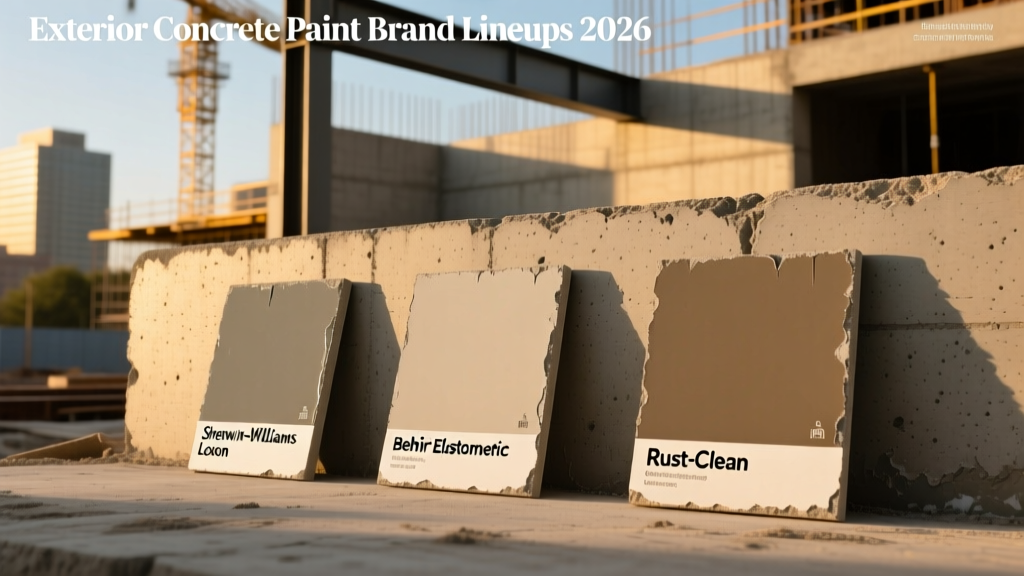
Painting exterior concrete is fundamentally different from painting wood or drywall. Concrete is a highly alkaline, porous, and moisture-dynamic substrate. Applying standard architectural acrylics to an unsealed concrete block or stucco wall almost guarantees saponification (alkali burn), efflorescence push-through, and catastrophic peeling within 18 months. To achieve a durable finish, you must select an exterior concrete paint specifically engineered to withstand pH levels up to 13 and resist hydrostatic vapor pressure.
This deep-dive analyzes the leading exterior concrete paint product lines available in 2026, breaking down their chemical binders, coverage rates, real-world pricing, and specific failure modes.
The Chemistry of Failure: Saponification and Hydrostatic Pressure
Before selecting a product line, it is critical to understand why standard paints fail on masonry. Fresh concrete and mortar have a pH of 12 to 13. When standard alkyd or low-grade acrylic paints are applied to highly alkaline surfaces, the moisture in the paint reacts with the alkali to form soap—a process called saponification. This destroys the paint's binder, causing it to liquefy and peel.
The second major failure vector is hydrostatic pressure. Concrete acts like a rigid sponge. If moisture is trapped behind the wall (such as in below-grade foundations or retaining walls), vapor pressure pushes outward. If the exterior coating has a low perm rating (meaning it is entirely impermeable), the trapped vapor will blister and blow the paint off the substrate. Therefore, the best exterior concrete paints must strike a precise balance: they must be thick enough to bridge hairline cracks and repel liquid water, yet breathable enough to allow water vapor to escape.
Sherwin-Williams Loxon Line: The Professional Standard
The Sherwin-Williams Loxon family has dominated the commercial masonry coating market for over a decade. For 2026, the Loxon Concrete & Masonry Coating remains the benchmark for 100% acrylic alkaline-resistant paints.
Product Specifications & Performance
- Binder Type: 100% Acrylic Copolymer
- Alkali Resistance: Withstands pH up to 13 without a specialized primer (if the surface is fully cured).
- Thickness: Standard architectural mil thickness (approx. 4.0 wet mils / 2.0 dry mils).
- Coverage Rate: 300 to 400 square feet per gallon on smooth concrete; 200 to 250 sq ft/gal on rough stucco.
- Cost: $75 to $92 per gallon (retail/pro pricing varies by region).
Behr Premium Elastomeric: The Big-Box Heavyweight
For residential contractors and DIYers sourcing from big-box retailers, Behr Premium Elastomeric Masonry, Stucco & Brick Paint is the most accessible high-build option. Unlike standard acrylics, elastomeric coatings are designed to stretch, bridging existing hairline cracks (up to 1/16 inch) to prevent water intrusion.
Product Specifications & Performance
- Binder Type: Elastomeric Acrylic
- Thickness: High-build (approx. 16 wet mils / 8 to 12 dry mils).
- Coverage Rate: 75 to 125 square feet per gallon. (Note: You must apply two coats to achieve the warranted waterproofing film thickness, effectively cutting coverage in half).
- Cost: $48 to $58 per gallon.
The Cost-per-Square-Foot Reality: While Behr Elastomeric appears cheaper per gallon than Sherwin-Williams Loxon, the math changes when calculating cost per square foot. Because Behr covers only ~100 sq ft/gal and requires two coats, you need 2 gallons for a 100 sq ft area ($104). Loxon covers ~300 sq ft/gal, requiring less than half a gallon for the same area (~$40). Elastomerics should only be chosen when crack-bridging is the primary objective, not for general budget painting.
Rust-Oleum Mathys Murfill: The Waterproofing Specialist
For severe weather exposure and coastal environments, the Rust-Oleum Mathys Murfill Waterproofing Coating offers superior elongation properties. Murfill is a European-engineered product now widely distributed in North America for high-end commercial waterproofing.
- Elongation: 400% (can stretch four times its original size without tearing).
- Crack Bridging: Bridges dynamic cracks up to 2mm wide.
- Permeability: Highly breathable (Sd value < 0.1m), preventing trapped vapor blistering.
- Cost: $85 to $110 per gallon.
Head-to-Head Product Matrix
| Product Line | Coating Type | Coverage (Sq Ft/Gal) | Dry Mil Thickness | Best Use Case |
|---|---|---|---|---|
| SW Loxon Concrete & Masonry | 100% Acrylic | 300 - 400 | 2.0 mils | New, smooth, or lightly textured alkaline masonry |
| Behr Premium Elastomeric | Elastomeric Acrylic | 75 - 125 | 8.0 - 12.0 mils | Older stucco with hairline cracking; high sun exposure |
| Rust-Oleum Mathys Murfill | Elastomeric Waterproofing | 60 - 90 | 12.0+ mils | Coastal zones, dynamic cracking, severe wind-driven rain |
| UGL Drylok Masonry Waterproofer | Portland Cement/Acrylic | 75 - 100 | Variable | Below-grade exterior foundation walls (positive side) |
Application Protocol: Avoiding the Top 3 Failure Modes
Even the most expensive elastomeric coating will fail if the substrate is not properly prepared. According to guidelines published by the Concrete Network, surface preparation accounts for 80% of a coating's lifespan.
1. Moisture Testing (The Plastic Sheet Method)
Never paint exterior concrete that is actively weeping or holding internal moisture. Perform the plastic sheet test as outlined in ASTM D4263. Tape a 16x16 inch square of clear 4-mil polyethylene plastic tightly to the concrete surface. Leave it for 16 hours. If condensation forms under the plastic or the concrete darkens, the moisture vapor transmission (MVT) rate is too high for standard acrylics. You must address exterior drainage or use a specialized breathable silane/siloxane sealer instead of a film-forming paint.
2. Efflorescence Removal
Efflorescence (the white, powdery salt deposits) will push through any paint film. Do not simply paint over it. Mechanically remove it with a stiff nylon brush, then treat the area with a commercial efflorescence remover or a diluted muriatic acid solution (1 part acid to 10 parts water). Neutralize the surface with a baking soda and water rinse, and allow it to dry completely.
3. Priming and pH Verification
Test the surface pH using distilled water and litmus paper. If the pH is above 10, apply an alkali-resisting primer. For highly porous CMU (Concrete Masonry Units), use a block filler or masonry conditioner to fill the voids; otherwise, the paint will sink into the pores, leaving an uneven, starved film on the surface that lacks UV protection.
Final Selection Framework
Choose Sherwin-Williams Loxon if you are painting new, structurally sound concrete block or stucco and need a breathable, cost-effective, alkali-resistant finish. Choose Behr Elastomeric if you are renovating an older residential stucco facade riddled with micro-cracks and need a thick, flexible bridge. Choose Rust-Oleum Mathys Murfill for commercial buildings in extreme weather zones where dynamic movement and wind-driven rain demand maximum elongation and waterproofing.