Sealed vs Unsealed Concrete: Cost, Lifespan, and Maintenance Guide
Compare sealed vs unsealed concrete for driveways and patios. Explore costs, lifespan, maintenance, and the best penetrating and film-forming sealers.

The Core Difference: Porosity and Protection
Concrete is often perceived as a solid, impenetrable stone, but at a microscopic level, it is essentially a rigid sponge. A standard 4-inch thick concrete slab contains a network of capillary pores that can wick several gallons of water, chlorides, and oils from the surface down to the subgrade. The decision between sealed vs unsealed concrete is fundamentally a choice about managing this porosity and the resulting Moisture Vapor Transmission (MVT).
Leaving concrete unsealed preserves its natural breathability and eliminates upfront chemical costs, but exposes the cementitious matrix to environmental degradation. Sealing the concrete interrupts the capillary action, either by lining the pores internally or by capping the surface with an impermeable film. According to the Portland Cement Association's guidelines on freeze-thaw durability, managing water ingress is the single most critical factor in extending the service life of exterior flatwork in cold climates.
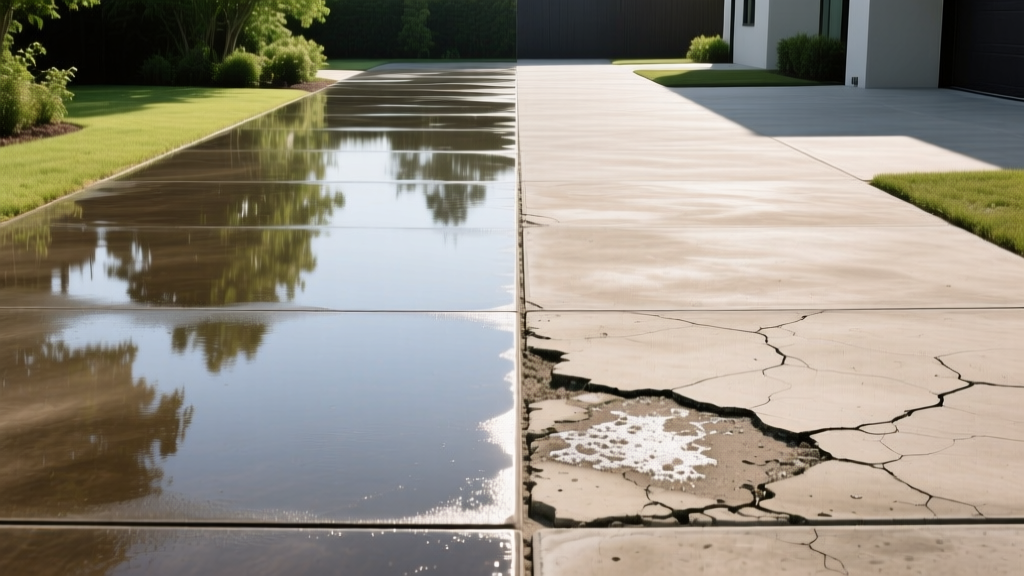
Unsealed Concrete: Performance and Failure Modes
Unsealed concrete is the default state for municipal sidewalks, basic residential patios, and industrial warehouse floors. While it requires zero initial chemical maintenance, it is highly susceptible to specific failure modes driven by environmental exposure.
Common Failure Modes of Unsealed Slabs
- Freeze-Thaw Spalling: When unsealed concrete absorbs water and temperatures drop below freezing, the water expands by 9%. This internal hydraulic pressure exceeds the concrete's tensile strength (typically 300-500 PSI), causing the surface layer to pop off or 'spall'.
- Chloride and Chemical Attack: De-icing salts (magnesium chloride and calcium chloride) penetrate unsealed pores and react with the calcium hydroxide in the cement paste, forming expansive salts that destroy the matrix from the inside out.
- Efflorescence: Water moving through the slab dissolves water-soluble calcium salts and carries them to the surface. When the water evaporates, it leaves behind a stubborn, chalky white residue.
- Surface Dusting: Without a densifier or sealer, the weak layer of cement and fine aggregate on the surface (laitance) slowly abrades under foot and tire traffic, creating a perpetual layer of fine concrete dust.
Despite these vulnerabilities, unsealed concrete offers superior slip resistance (a high coefficient of friction when wet) and a natural, rustic aesthetic that many architectural designs intentionally seek.
Sealed Concrete: Penetrating vs. Film-Forming
The term 'concrete sealer' is a broad umbrella covering two entirely different chemical mechanisms: penetrating sealers that work below the surface, and film-forming sealers that sit on top of it. Understanding this distinction is critical for avoiding catastrophic application failures.
Penetrating Sealers (Sub-Surface Protection)
These sealers do not change the look or traction of the concrete. They react chemically within the pores.
- Silane/Siloxane: These are hydrophobic water repellents. Silane molecules are smaller and penetrate deeper (up to 1/4 inch), making them ideal for dense, steel-troweled concrete. Siloxane molecules are larger and better suited for porous, broom-finished concrete. They line the pores with a water-repelling resin while allowing water vapor to escape.
- Lithium Silicate (Densifiers): These react with the free lime (calcium hydroxide) in the concrete to form calcium silicate hydrate (C-S-H), the same glue that gives concrete its strength. They permanently harden the surface and stop dusting, but do not repel water or oil on their own.
Film-Forming Sealers (Surface Coatings)
These create a physical barrier on top of the slab. They alter the appearance (gloss, color enhancement) and provide stain resistance, but they trap moisture if applied incorrectly.
- Acrylics: The most common residential choice. Solvent-based acrylics provide a 'wet look' that enhances stamped or colored concrete. Water-based acrylics are more environmentally friendly but offer a more natural, matte finish. Both degrade under UV exposure and require reapplication every 1 to 3 years.
- Polyurethanes: Highly abrasion-resistant and UV-stable. Often used as a topcoat over epoxy or stamped concrete. They are thinner than epoxies but offer superior scratch resistance.
- Epoxies and Polyaspartics: High-build, impermeable coatings used primarily for garage floors and commercial interiors. Modern polyaspartic formulations (an advanced aliphatic polyurea) can be installed in a single day and will not yellow under UV light, unlike traditional epoxies.
Sealer Comparison Matrix
| Sealer Type | Mechanism | Breathability | UV Stability | Lifespan | Cost (Mat/Labor) |
|---|---|---|---|---|---|
| Silane/Siloxane | Pore-lining (Hydrophobic) | High (Breathable) | Excellent | 5-10 Years | $0.50 - $1.25 / sq ft |
| Lithium Silicate | Chemical Densifier | High (Breathable) | Excellent | Permanent | $0.75 - $1.50 / sq ft |
| Acrylic (Solvent) | Surface Film | Low (Traps Moisture) | Good (May yellow) | 1-3 Years | $1.00 - $2.50 / sq ft |
| Polyurethane | Surface Film | Low | Excellent | 5-7 Years | $2.00 - $3.50 / sq ft |
| Polyaspartic | High-Build Film | None (Impermeable) | Excellent | 15+ Years | $4.00 - $7.00 / sq ft |
Cost Analysis: Initial Investment vs. Long-Term ROI
When evaluating sealed vs unsealed concrete, the immediate cost of sealing must be weighed against the long-term remediation costs of unsealed slabs. The National Ready Mixed Concrete Association's durability resources emphasize that proactive surface protection drastically reduces lifecycle maintenance costs.
Decision Framework: Which Should You Choose?
Do not apply a one-size-fits-all approach to concrete sealing. Match the sealer chemistry to the specific environmental and mechanical demands of the slab.
Scenario 1: Exterior Driveways in Cold Climates (De-icing Salts)
Verdict: Sealed (Penetrating Silane/Siloxane).
Why: You must block chloride ion penetration to prevent rebar corrosion and surface spalling. Avoid film-forming acrylics on driveways; they become incredibly slippery when wet and will scratch under tire chains or snowplow blades.
Scenario 2: Stamped and Colored Patios
Verdict: Sealed (Film-Forming Acrylic or Polyurethane).
Why: Stamped concrete relies on surface antiquing stains and color hardeners. Without a solvent-based acrylic or polyurethane topcoat, UV radiation will bleach the colors, and the surface will look perpetually dull and washed out. Reapply a sacrificial wax or fresh acrylic coat every 2 years to maintain the gloss.
Scenario 3: Interior Garage Floors
Verdict: Sealed (Polyaspartic or Epoxy/Polyurethane Hybrid).
Why: Garages face hot tire pickup, oil spills, and dropped tools. Penetrating sealers will not stop oil stains. A high-build polyaspartic coating provides an impermeable, chemical-resistant shield that can be mopped clean. Critical Gotcha: You must perform a calcium chloride MVT test (ASTM F1869) before applying epoxy. If moisture emission exceeds 3-5 lbs per 1,000 sq. ft. per 24 hours, the epoxy will blister and fail.
Scenario 4: Rustic Pathways, Sidewalks, and Pool Decks
Verdict: Unsealed or Lithium Silicate Densifier Only.
Why: Safety is paramount. Film-forming sealers reduce the coefficient of friction, creating a severe slip hazard around pools or on sloped walkways. If the surface is dusting, apply a lithium silicate densifier to harden the surface without altering the natural slip resistance or trapping moisture.
Application and Maintenance Timelines
Proper execution is just as important as product selection. Follow this timeline for optimal adhesion and longevity:
- Day 1-28 (Curing): Allow new concrete to hydrate and off-gas. Use only breathable curing blankets or ASTM C309 compliant dissipating resins if necessary.
- Day 29 (Preparation): Clean the slab. For penetrating sealers, acid etching or light shot-blasting opens the pores. For film-forming coatings, mechanical grinding (using 40- to 80-grit diamond tooling) is mandatory to achieve the CSP (Concrete Surface Profile) required for mechanical adhesion.
- Day 30 (Moisture Testing): Tape a 2x2 foot sheet of clear polyethylene to the concrete. Wait 24 hours. If condensation forms under the plastic, the slab is too wet for film-forming sealers.
- Day 31 (Application): Apply penetrating sealers using a low-pressure pump sprayer, keeping the surface wet for 10 minutes before back-rolling to prevent puddling. Apply film-forming sealers with a microfiber roller in thin, even coats.
- Annual Maintenance: Inspect film-forming sealers each spring. If water no longer beads on the surface (for penetrating sealers) or if the gloss has worn thin (for acrylics), schedule a recoat. Never let a film-forming sealer wear completely down to the bare concrete, or the next recoat will require a full mechanical grind and stripping.
By matching the chemical properties of the sealer to the functional requirements of the slab, you transform concrete from a vulnerable, porous sponge into a highly durable, low-maintenance architectural asset.
Written by
Sarah WhitfieldSarah Whitfield is a chartered quantity surveyor (MRICS) and construction cost analyst with 15 years of experience in material pricing, procurement strategy, and project budgeting. She earned her degree in Construction Management from the University of Reading (UK) and has worked on projects ranging from $2M custom homes to $180M mixed-use developments across North America and Europe. Sarah currently leads cost estimating for BuildMat Insight, maintaining a proprietary database of 4,000+ material price points updated quarterly. She is a frequent contributor to RSMeans cost data panels and has presented at the International Cost Engineering Council (ICEC) congress. Based in Denver, CO, Sarah is an avid trail runner and volunteer mentor for Women in Construction.
More from Sarah Whitfield
View all
Wood & Lumber
What Are the Different Types of Wood? A Builder's Guide
Compare structural softwoods, finish hardwoods, and engineered lumber. Analyze Janka ratings, MOE values, and 2026 pricing for construction.
Aug 4, 2026

Walls & Panels
Steel Framing vs Wood Framing: Corrosion and Moisture Defense
Compare steel framing vs wood framing for moisture resistance. Learn about galvanized coatings, condensation risks, and corrosion protection strategies.
Jul 21, 2026

Stone & Masonry
How to Cut Stone Veneer: Wet Saw vs Grinder Comparison
Compare the best tools for cutting stone veneer. We review wet saws, angle grinders, and chop saws to help you achieve clean, chip-free cuts.
Jul 21, 2026