Grout Haze Remover Performance Ratings: Acid vs Alkaline Specs
Compare grout haze remover performance ratings, pH specifications, and substrate compatibility for cementitious, epoxy, and polymer-modified grouts.
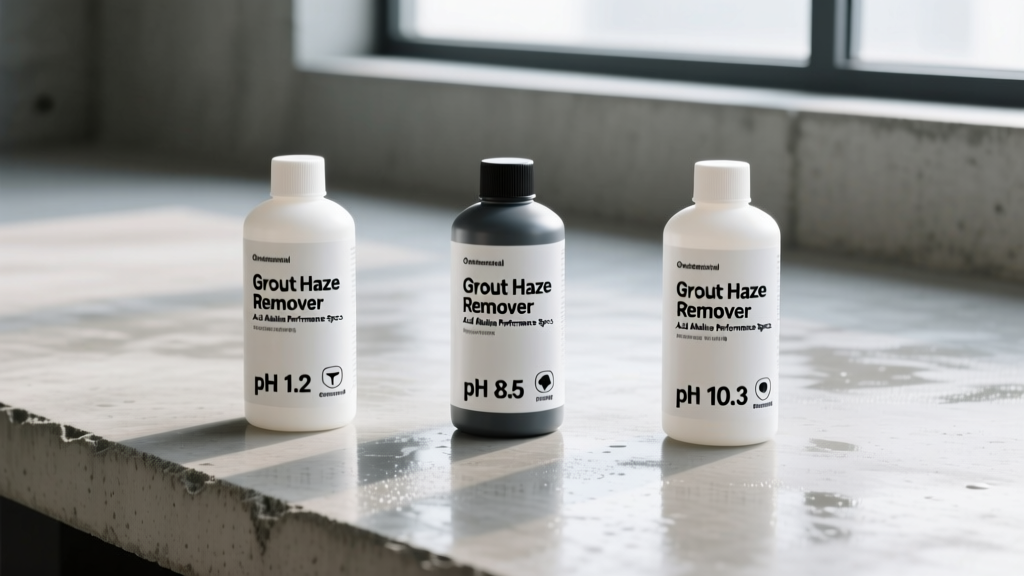
The Chemistry of Haze: Why Formulation Dictates Performance
Grout haze is not merely dried dirt; it is a microscopic layer of Portland cement hydration byproducts—primarily calcium hydroxide—combined with polymer additives that migrate to the surface during the curing process. When standard water fails to remove this residue within the first 24 hours, the calcium hydroxide carbonates and binds to the tile surface. Selecting the correct grout haze remover requires an understanding of the chemical bond you are trying to break.
In 2026, the vast majority of premium cementitious grouts are polymer-modified, containing acrylic or styrene-butadiene latex additives. This creates a dual-layer haze problem: an inorganic cementitious base and an organic polymer film. Acidic removers efficiently dissolve the calcium hydroxide but often leave the polymer film intact, resulting in a stubborn, sticky residue. Conversely, alkaline or bio-enzymatic removers target the organic polymers but lack the aggressive bite required to dissolve heavy cementitious buildup. Understanding these performance specifications is critical for avoiding substrate damage and ensuring a flawless finish.
Performance Specifications Matrix: Acidic vs. Alkaline vs. Bio-Enzymatic
The following matrix outlines the core chemical specifications and performance ratings for the three primary categories of grout haze removers available on the market.
| Formulation Type | Active Ingredients | pH Range | Target Grout Type | Substrate Risk | VOC Content |
|---|---|---|---|---|---|
| Heavy Acidic | Phosphoric Acid, Sulfamic Acid | 1.0 - 2.5 | Unmodified Cementitious | High (Etches natural stone, damages chrome) | < 50 g/L |
| Mild Acidic | Hydroxyacetic Acid, Citric Acid | 2.5 - 4.0 | Light Polymer-Modified | Moderate (Safe for porcelain, risky for marble) | < 50 g/L |
| Alkaline / Solvent | Potassium Hydroxide, Glycol Ethers | 10.0 - 12.5 | Epoxy, Urethane, Heavy Polymer | Low (Safe for most stone, risks unsealed porous tile) | 100 - 250 g/L |
| Bio-Enzymatic / Neutral | Enzyme Blends, Soy-based Solvents | 6.5 - 7.5 | Polymer Film, Light Cementitious | None (Safe for all substrates) | < 10 g/L |
Substrate Compatibility and Etching Thresholds
The most common catastrophic failure in haze removal is chemical etching of calcareous natural stone. According to the Natural Stone Institute, calcareous stones (marble, travertine, limestone, and onyx) are composed primarily of calcium carbonate. Calcium carbonate reacts violently with any solution possessing a pH below 7.0, resulting in permanent microscopic pitting and loss of polish.
⚠️ Critical Warning: The Calcareous Stone Danger Zone
Never apply phosphoric, sulfamic, or hydrochloric acid-based haze removers to marble or travertine. Even 'mild' acidic cleaners with a pH of 4.0 will dull a high-gloss marble finish within 60 seconds of dwell time. For calcareous substrates, you must exclusively use pH-neutral bio-enzymatic removers or specialized alkaline polymer strippers, followed by mechanical agitation with a white nylon pad.
For siliceous stones (granite, slate, quartzite) and manufactured ceramics (porcelain, ceramic, glass), acidic removers with a pH between 1.5 and 3.0 are generally safe, provided the tile does not feature a delicate metallic glaze or an acid-sensitive decorative finish. Always conduct a 10-square-inch test patch in an inconspicuous area before full-scale application.
Top Rated Grout Haze Removers: 2026 Specification Breakdown
Based on current formulation data and field performance metrics, here is a technical breakdown of leading grout haze removers categorized by their specific use cases.
1. Mapei Keranet Easy Care (Mild Acidic)
- Active Chemistry: Organic and inorganic acid blend.
- pH Level: ~2.5 (concentrated).
- Performance Rating: Excellent for standard polymer-modified cementitious grouts on porcelain and ceramic.
- Dilution: 1:1 to 1:3 with water, depending on haze severity.
- Limitation: Not suitable for epoxy grouts or acid-sensitive natural stone.
2. Aqua Mix Cement Grout Haze Remover (Heavy Acidic)
- Active Chemistry: Phosphoric acid base.
- pH Level: ~1.5.
- Performance Rating: Industry standard for aggressive, unmodified cementitious haze and efflorescence.
- Dwell Time: 3 to 5 minutes maximum.
- Limitation: High fume profile; requires aggressive ventilation and will instantly etch calcareous stone.
3. Laticrete Epoxy Grout Haze Remover (Alkaline/Solvent)
- Active Chemistry: Alkaline surfactants and glycol ether solvents.
- pH Level: ~11.0.
- Performance Rating: Specifically engineered to break the cross-linked molecular bonds of epoxy and urethane grout residues.
- Application Note: Requires a 10-minute dwell time and heavy mechanical agitation. Must be rinsed with hot water to emulsify the dissolved epoxy.
Application Protocols: Dwell Times and Agitation Metrics
Chemical specification is only half of the performance equation; application methodology dictates the final result. The National Tile Contractors Association (NTCA) emphasizes that improper dwell times and incorrect agitation tools are the leading causes of tile surface scratching and grout joint degradation.
- Pre-Wetting: Always pre-wet the grout joints with clean water before applying acidic removers. This prevents the acid from penetrating deeply into the porous grout joint and weakening the structural integrity of the cure.
- Application & Dwell: Apply the solution using a low-pressure pump sprayer or a microfiber mop. Allow a dwell time of exactly 3 to 5 minutes. Never allow an acidic remover to dry on the surface, as this will re-deposit the dissolved salts into a harder, more difficult-to-remove crust.
- Agitation: Use a white, non-abrasive nylon scrub pad (e.g., Scotch-Brite No. 461). Never use steel wool or wire brushes; these shed microscopic iron particles that will oxidize and create permanent rust stains in the grout joints.
- Neutralization & Extraction: After agitating, immediately extract the slurry using a wet vacuum. Rinse the floor with clean, cool water. For acidic removers, a final rinse with a mild baking soda solution (1 cup per gallon of water) ensures complete pH neutralization.
Troubleshooting Polymer-Modified Grout Haze
If you have applied an acidic remover and the tile still feels tacky or exhibits a cloudy film under oblique lighting, you are dealing with residual polymer cross-linking. Modern high-performance grouts contain acrylic polymers that are entirely immune to phosphoric and sulfamic acids.
To resolve this, you must pivot to a solvent-based or bio-enzymatic approach. Apply a pH-neutral soy-based bio-solvent or a dedicated polymer stripper. Allow a 10-minute dwell time to soften the acrylic matrix, then agitate with a white nylon pad. This dual-action methodology—acid for the cement, solvent for the polymer—is the only reliable way to achieve a perfectly clear finish on large-format porcelain installations utilizing premium polymer-modified grouts.
VOC Compliance and Indoor Air Quality
When specifying grout haze removers for interior, occupied, or poorly ventilated spaces, Volatile Organic Compound (VOC) limits are a critical performance metric. The Environmental Protection Agency (EPA) notes that high-VOC solvents contribute significantly to indoor air quality degradation and ground-level ozone formation. Most water-based acidic and neutral removers fall well below the strict SCAQMD Rule 1168 limit of 150 g/L for VOC content. However, heavy-duty epoxy haze removers often utilize glycol ethers that push VOC limits higher. In commercial healthcare or educational facilities, always verify the manufacturer's Safety Data Sheet (SDS) to ensure the selected remover complies with local indoor air quality mandates before application.