Types of Concrete Driveways: 2026 Cost & Design Guide
Compare the top types of concrete driveways, including exposed aggregate, stamped, and brushed. Get 2026 pricing, PSI specs, and maintenance data.

Evaluating the Types of Concrete Driveways for Modern Homes
Selecting from the various types of concrete driveways requires balancing structural load requirements, local climate constraints, and aesthetic preferences. While asphalt and pavers remain alternatives, concrete offers a 30- to 50-year lifespan when engineered correctly. In 2026, material innovations in surface retarders, integral colorants, and permeable mix designs have expanded the functional capabilities of residential concrete. This guide breaks down the four primary concrete driveway systems, providing exact engineering specifications, current pricing, and long-term maintenance frameworks.
Driveway System Comparison Matrix
Before examining specific applications, review the baseline performance and cost metrics for the four dominant concrete driveway systems.
| Driveway Type | Avg. Cost (per sq. ft.) | Required PSI | Slip Resistance | Maintenance Level |
|---|---|---|---|---|
| Broom / Brushed Finish | $8.00 - $12.00 | 4,000 PSI | High | Low (Seal every 3-5 yrs) |
| Stamped & Colored | $15.00 - $25.00 | 4,000 PSI | Medium | High (Reseal every 2-3 yrs) |
| Exposed Aggregate | $10.00 - $16.00 | 4,000 PSI | Very High | Medium (Seal every 3-4 yrs) |
| Pervious / Porous | $12.00 - $18.00 | 2,500 - 3,000 PSI | High | High (Annual vacuuming) |
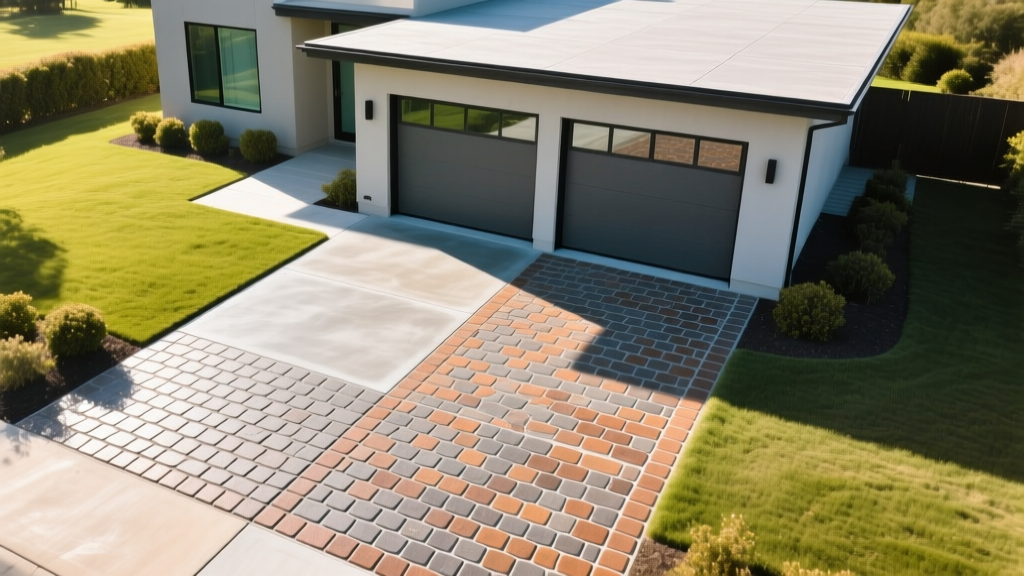
Deep Dive: Broom Finish (The Structural Baseline)
The broom finish is the industry standard for residential driveways. It involves dragging a stiff-bristled broom across the surface of freshly screeded concrete to create microscopic ridges. This texture provides essential traction during wet or icy conditions without compromising the structural integrity of the slab.
Engineering Specifications
- Mix Design: 4,000 PSI compressive strength with a maximum 0.45 water-to-cement (w/c) ratio.
- Air Entrainment: 4% to 8% microscopic air bubbles are mandatory in freeze-thaw climates to prevent surface scaling. The Portland Cement Association (PCA) strictly recommends air-entrained mixes for exterior flatwork in northern regions.
- Slump: 4 to 5 inches. Higher slumps weaken the surface crust and increase the risk of craze cracking.
Deep Dive: Stamped and Colored Concrete
Stamped concrete replicates the look of natural stone, brick, or slate using polyurethane mats. To achieve this, contractors use either integral color (pigment mixed into the truck) or broadcast color hardeners (dry powder troweled into the surface). For driveways, broadcast color hardeners are vastly superior because they increase surface compressive strength by up to 30% while providing dense, UV-stable coloration.
Failure Modes and Edge Cases
The most common failure in stamped driveways is delamination of the color hardener layer. This occurs when the underlying concrete is too dry, or when the hardener is not properly troweled into the paste. Another critical edge case is the antiquing release agent. If the powdered release agent is not thoroughly washed off with a pressure washer and stiff brush within 3 to 5 days of stamping, it will prevent the acrylic sealer from bonding, leading to premature peeling.
Deep Dive: Exposed Aggregate
Exposed aggregate driveways feature a textured surface where the top layer of cement paste is washed away to reveal the underlying stones (aggregate). This system offers exceptional traction and hides surface stains better than smooth finishes.
The Retarder Application Process
- Pour and Screed: The concrete is poured and finished flat. No brooming is performed.
- Apply Surface Retarder: A chemical retarder (such as Sika Rugasol) is sprayed onto the surface immediately after the bleed water evaporates. This chemical halts the hydration process in the top 1/4 inch of the slab.
- Wash and Expose: 12 to 24 hours later, contractors use a pressure washer and stiff broom to wash away the retarded surface paste, exposing the aggregate.
Crucial Timing: If the washing is delayed by even 4-6 hours past the optimal window, the retarder will fail to stop the deep hydration, and the aggregate will not expose properly, resulting in a patchy, inconsistent finish.
Deep Dive: Pervious (Porous) Concrete
Pervious concrete is engineered with a high void content (15% to 25%), allowing water to pass directly through the slab and into the subgrade. According to the EPA's permeable pavement guidelines, this system significantly reduces stormwater runoff and filters pollutants.
Structural Trade-offs
Because it lacks fine aggregates (sand), pervious concrete has a lower compressive strength, typically maxing out at 2,500 to 3,000 PSI. To compensate for this lower strength and the heavy hydrostatic loads from water passing through, pervious driveways must be poured thicker—usually 6 inches compared to the standard 4 inches. Furthermore, the subgrade must consist of a deep reservoir of clean, open-graded crushed stone (usually 3/4-inch to 1-inch aggregate) to store the infiltrated water before it percolates into the native soil.
Structural Engineering: Subgrade and Reinforcement
The surface finish is only as durable as the foundation beneath it. Regardless of the decorative type chosen, the structural base must adhere to the guidelines set forth by the American Concrete Institute (ACI) for residential flatwork.
Subgrade Preparation
Native topsoil must be completely removed. The subbase should consist of 4 to 6 inches of compacted Aggregate Base Course (ABC) or 3/4-inch crushed gravel. This layer must be mechanically compacted in 2-inch lifts using a vibratory plate compactor to achieve a minimum 95% Standard Proctor density. Pouring concrete directly over uncompacted clay or organic soil guarantees differential settlement and catastrophic slab cracking.
Reinforcement Strategies
- Welded Wire Mesh (WWM): 6x6 W1.4xW1.4 wire mesh is standard. It must be elevated on concrete 'dobies' (chairs) so it sits in the upper third of the slab to effectively hold shrinkage cracks together.
- Rebar: For driveways expecting heavy loads (e.g., RVs, dump trucks, or large boat trailers), upgrade to #4 (1/2-inch) steel rebar tied on a 16-inch grid.
- Fiber Reinforcement: Synthetic macro-fibers (added at the batch plant at a rate of 3 to 5 lbs per cubic yard) provide excellent secondary reinforcement against plastic shrinkage cracking but do not replace structural steel for load-bearing capacity.
Jointing and Curing Protocols
Concrete will crack; the goal of jointing is to force the cracking to occur in straight, hidden lines.
Control joints must be spaced at intervals (in feet) no greater than 2 to 3 times the slab thickness (in inches). For a standard 4-inch driveway, joints should be cut every 8 to 12 feet. The saw-cut depth must be exactly 25% of the slab thickness (1 inch deep for a 4-inch slab). Cutting too shallow will result in random cracking; cutting too deep compromises the aggregate interlock that transfers loads across the joint.
Curing: Immediately after final finishing, the slab must be cured to prevent rapid moisture loss. Apply a liquid membrane-forming curing compound or cover the slab with wet burlap and 6-mil polyethylene sheeting for a minimum of 3 to 7 days. Proper curing increases surface hardness and reduces permeability.
Sealing and Long-Term Maintenance
The type of sealer you choose dictates the maintenance cycle of your driveway.
- Acrylic Resin Sealers (Film-Forming): Required for stamped and colored concrete to enhance color and protect the surface from UV fading and deicing salts. These form a physical barrier that wears away from tire friction and UV exposure, requiring reapplication every 2 to 3 years.
- Silane/Siloxane Sealers (Penetrating): Ideal for broom finish and exposed aggregate. These sealers do not form a surface film; instead, they penetrate the pores and react chemically to repel water and chloride ions. They do not alter the slip resistance and last 5 to 7 years before reapplication is needed.
Deicing Chemical Restrictions
Never use calcium chloride or magnesium chloride on concrete that is less than one year old, and avoid them entirely on stamped or exposed aggregate surfaces. These salts cause severe osmotic pressure changes within the concrete pores, leading to rapid surface scaling. Use clean silica sand or non-clumping kitty litter for winter traction instead.
Written by
Elena RodriguezElena Rodriguez is a civil engineer and technical writer specializing in concrete technology, masonry systems, and ASTM/ACI compliance. She earned her B.S. in Civil Engineering from Texas A&M University and spent a decade at a materials testing laboratory, performing over 2,000 concrete compressive strength tests and masonry prism evaluations. Elena is an ACI-certified Field Testing Technician (Grade I) and a member of ASTM Committee C12 on Natural Building Stone. She currently consults on forensic engineering cases involving concrete failures and moisture intrusion. Based in San Antonio, TX, Elena is a proud member of the Society of Women Engineers (SWE) and coaches her daughter's FIRST Robotics team.
More from Elena Rodriguez
View all
Walls & Panels
Cost Analysis: Light Gauge Steel Framing Advantages and Disadvantages
Evaluate light gauge steel framing advantages and disadvantages through a strict cost analysis lens, comparing material, labor, and lifecycle expenses.
Aug 4, 2026

Walls & Panels
Gypsum Board Types: Exact Specifications, Thickness & Dimensions
Compare standard, Type X, and moisture-resistant gypsum board types. Get exact specifications, thicknesses, dimensions, and ASTM standards for your project.
Aug 4, 2026

Fire Resistance
Best Fire-Resistant Outdoor Decking Materials: 2026 Buyer Guide
Discover the best fire-resistant outdoor decking materials for 2026. Compare Class A PVC, aluminum, and hardwood options for WUI compliance and safety.
Aug 4, 2026