Fiberglass Swimming Pool vs Concrete: Cost, Lifespan, Build Guide
Compare fiberglass swimming pool vs concrete for your backyard. Discover real installation costs, structural lifespans, and long-term maintenance needs.

Structural Composition and Installation Methodology
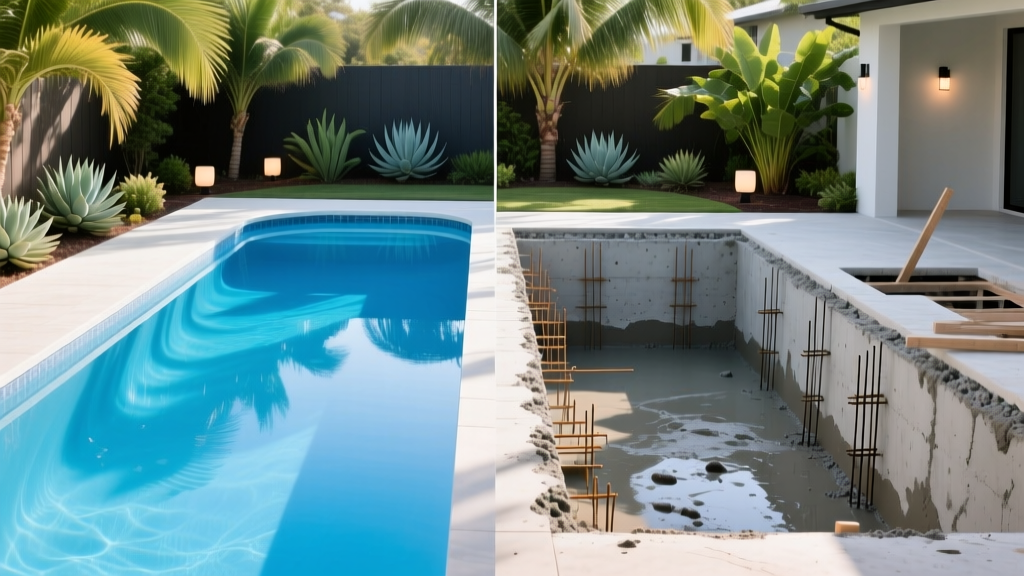
When evaluating a fiberglass swimming pool vs concrete for a residential or commercial application, the fundamental differences begin at the structural engineering level. Concrete pools, specifically those built using the gunite or shotcrete method, rely on a steel-reinforced matrix. Builders typically construct a grid of #3 or #4 steel rebar spaced on 10-inch to 12-inch centers. The pneumatically applied concrete mix is designed to achieve a compressive strength of 4,000 to 5,000 PSI at 28 days, creating a rigid, monolithic shell that is 8 to 12 inches thick.
Conversely, fiberglass pools are manufactured off-site as a single, continuous shell using Fiberglass Reinforced Plastic (FRP). The structural integrity relies on a layered composite: a 15 to 20-mil non-porous gel coat surface, followed by multiple layers of chopped fiberglass strand mat and woven roving bound with polyester or vinyl ester resin. While concrete derives its strength from mass and steel reinforcement, fiberglass utilizes tensile flexibility and structural ribbing to resist soil and hydrostatic loads.
Never use native soil or fine sand to backfill a fiberglass pool shell. Sand can liquefy under heavy rain, causing the shell to shift or float. Always specify clean, angular crushed gravel (typically 3/8-inch or 1/2-inch crushed stone) which locks together to create a stable, free-draining structural support wedge around the FRP shell.
Fiberglass Swimming Pool vs Concrete: Application Data Matrix
The choice between these materials drastically alters project timelines, budget allocations, and site logistics. The following matrix outlines the core operational differences for contractors and homeowners planning a 2026 installation.
| Feature | Fiberglass Shell | Concrete (Gunite/Shotcrete) |
|---|---|---|
| Base Installation Cost | $45,000 - $85,000 | $65,000 - $150,000+ |
| Excavation to Swim Timeline | 3 to 6 weeks | 3 to 6 months |
| Dimensional Limits | Max width ~16ft (transport limits) | Virtually unlimited |
| Surface Porosity | Non-porous (Gel coat) | Highly porous (Plaster/Pebble) |
| Crane Access Required | Yes (Heavy lift for shell drop) | No (Materials brought in via trucks) |
| Customization Capability | Limited to manufacturer molds | Fully bespoke (vanity edges, spas) |
Geotechnical Considerations: Soil Dynamics and Hydrostatic Pressure
Site soil conditions frequently dictate which material is structurally viable. According to guidelines referenced by the Portland Cement Association, expansive clay soils exert immense lateral pressure on retaining structures. A 10-inch thick gunite concrete shell possesses the sheer mass and rigidity to resist the swelling forces of active clay zones without structural deformation.
Fiberglass shells, while possessing high tensile strength, are susceptible to distortion if lateral loads are uneven. In regions with high water tables or expansive soils, fiberglass installations mandate rigorous groundwater management. This includes the installation of a perimeter French drain system tied to a daylight exit or sump pump, and the mandatory integration of hydrostatic relief valves in the main drain sump. If a fiberglass pool is drained for maintenance during a period of heavy rainfall without an active dewatering system, the buoyant force of the surrounding saturated soil can cause the empty shell to 'pop' out of the ground, catastrophic damaging the plumbing and deck interfaces.
Plumbing and Penetration Vulnerabilities
Concrete pools allow for post-forming plumbing adjustments and core drilling if errors occur during the rough-in phase. Fiberglass shells require absolute precision during the initial layout; cutting additional penetrations into the FRP shell after manufacturing compromises the structural ribbing and voids the manufacturer's warranty.
Long-Term Lifecycle and Surface Maintenance
The interior finish of a concrete pool typically consists of standard white marcite plaster or an exposed aggregate finish like PebbleTec. Because cementitious plasters are inherently porous, they provide a microscopic breeding ground for algae. Consequently, concrete pools require higher baseline chlorine levels and periodic acid washing. Industry data from the Pool & Hot Tub Alliance (PHTA) indicates that concrete pool surfaces generally require complete chipping and replastering every 10 to 15 years, an invasive renovation costing between $10,000 and $18,000 depending on regional labor rates and finish selection.
'The non-porous nature of a high-quality fiberglass gel coat reduces chemical consumption by up to 40% compared to traditional plaster finishes, fundamentally altering the 20-year total cost of ownership for the end user.'
Fiberglass gel coats are chemically inert and highly resistant to algae adhesion. While the initial material cost of a premium fiberglass shell can rival a basic concrete build, the elimination of decadal replastering costs and reduced chemical expenditures often makes fiberglass the more economical choice over a 25-year lifecycle.
Application Showcase: Matching Material to Site Constraints
Selecting between a fiberglass swimming pool vs concrete is rarely about which material is universally 'better'; it is about matching the material physics to the specific application and site constraints.
Scenario A: The Urban Infill and Tight Access Lots
For narrow urban lots where heavy machinery access is restricted, concrete is often the only viable application. Gunite can be pumped through narrow side-yards via hose lines, and excavation can be managed with mini-excavators. Fiberglass shells require a massive crane lift; if overhead power lines or mature tree canopies block the drop zone, a fiberglass installation becomes logistically impossible or prohibitively expensive due to crane permitting and road closure fees.
Scenario B: The Custom Infinity Edge and Integrated Spa
Architectural applications demanding negative edges, vanishing weirs, or complex integrated spas heavily favor concrete. While some fiberglass manufacturers offer molded spas, the hydraulic integration and visual continuity of a custom gunite shotcrete build allow for seamless transitions between the spa spillway and the main pool basin, tailored to the exact topography of the site.
Project Decision Framework
Use the following diagnostic checklist to finalize your material specification:
- Specify Fiberglass if: The project demands a rapid installation timeline (under 45 days), the site has clear overhead crane access, the homeowner prioritizes low chemical maintenance, and the desired pool dimensions fit within standard manufacturer molds (typically maxing out at 16 feet wide by 40 feet long).
- Specify Concrete if: The site features highly expansive soils requiring massive structural rigidity, the design includes complex bespoke features (beach entries, custom tanning ledges, negative edges), overhead crane access is obstructed, or the required footprint exceeds standard transport width limitations.
By aligning the structural properties of the material with the geotechnical realities of the site and the architectural vision of the client, builders can ensure a structurally sound and financially predictable application.
Written by
David NakamuraDavid Nakamura is a licensed architect (AIA) and construction technology writer focused on sustainable building methods, mass timber engineering, and high-performance building envelopes. He holds a Master of Architecture from the University of Washington and is a certified Passive House Consultant (CPHC). David spent eight years at the Seattle firm Mithun, where he led the design of three LEED Platinum projects, before founding his own practice specializing in net-zero residential design. He serves on the editorial advisory board of GreenBuilder Magazine and has authored peer-reviewed papers on cross-laminated timber (CLT) connections for the Journal of Structural Engineering. In his spare time, David teaches woodworking at Pratt Fine Arts Center and kayaks the Puget Sound.
More from David Nakamura
View all
Construction Cost
Labor Cost to Build a Deck Per Sq Ft: 2026 Installation Guide
Discover the exact labor cost to build a deck per sq ft in 2026. This installation guide breaks down contractor rates, complexity factors, and hidden fees.
Aug 4, 2026

Construction Cost
How Much Does It Cost to Build a 3 Bedroom House? Financing Guide
Learn exactly how much it costs to build a 3 bedroom house and explore 2026 financing options, construction loan types, and budget frameworks for your build.
Aug 4, 2026

Construction Cost
Cost to Build a Tennis Court: 2026 Guide
How much does it cost to build a tennis court in 2026? Breakdowns for asphalt, concrete, and synthetic surfaces plus fencing and lighting.
Jul 30, 2026