Rebar vs Fiber Concrete: Which Reinforcement is Best for Your Slab?
Compare rebar vs fiber concrete for slab reinforcement. Explore mix design adjustments, structural capacities, dosage rates, and current cost data.

The Core Debate: Structural Load vs. Shrinkage Control
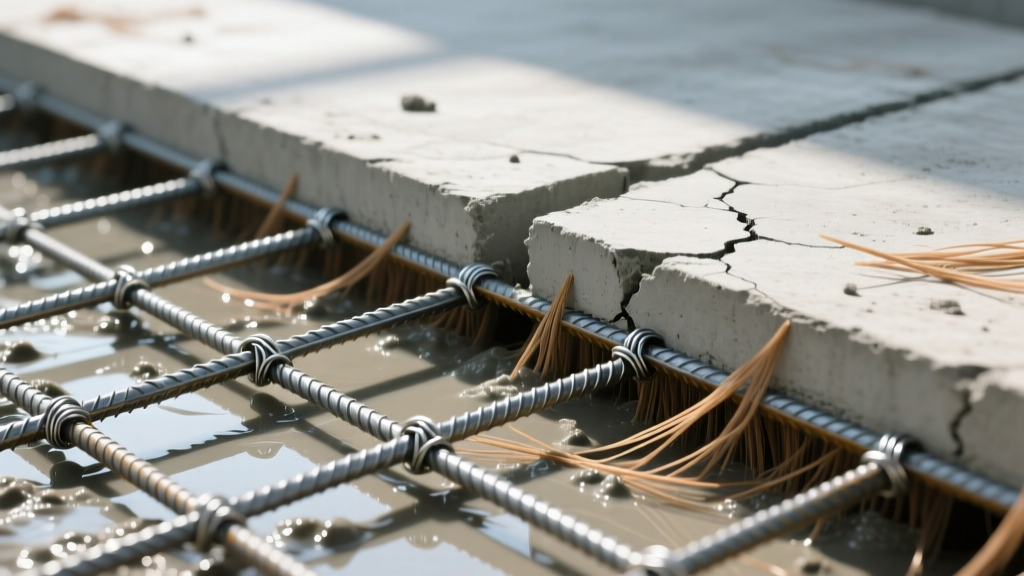
When designing a concrete slab on grade, suspended slab, or pavement, the choice of reinforcement fundamentally alters both the structural capacity and the rheology of the concrete mix. The debate of rebar vs fiber concrete is not a simple binary; it is a decision between localized tensile strength (rebar) and three-dimensional micro-crack mitigation (fibers). Understanding how each material interacts with your specific mix design is critical for preventing structural failure, plastic shrinkage cracking, and long-term durability issues.
Understanding Rebar (Steel Reinforcement) in Mix Design
Steel reinforcing bar (rebar), typically specified under ASTM A615 (Grade 60) or ASTM A706 (weldable), provides high tensile strength to resist bending moments and structural loads. In mix design, the presence of rebar dictates strict limitations on the Maximum Aggregate Size (MAS). According to ACI 318 guidelines, the MAS must not exceed one-half the clear distance between parallel reinforcing bars, nor three-quarters of the minimum clear cover. For a dense mat of #5 (5/8-inch) bars spaced at 8 inches on center, the MAS must be restricted to 1 inch or 3/4 inch to prevent aggregate interlock and subsequent honeycombing behind the steel grid.
Fiber Reinforced Concrete (FRC): Macro vs. Micro Fibers
Fiber reinforcement is dispersed uniformly throughout the concrete matrix, providing multi-directional crack control. However, not all fibers serve the same purpose:
- Micro-Synthetic Fibers (Polypropylene): Typically 3/4-inch to 1-inch in length, dosed at 0.5 to 1.5 lbs per cubic yard (cy). Their sole function is to mitigate plastic shrinkage cracking during the first 24 hours of hydration. They offer zero structural load-bearing capacity once the concrete cures.
- Macro-Synthetic Fibers (Polyolefin/Polypropylene blend): Ranging from 1.5 to 2.5 inches in length, dosed at 3.0 to 7.5 lbs/cy. These fibers are engineered with deformed profiles or fibrillated ends to provide mechanical anchorage. They can replace light rebar or welded wire mesh (WWM) for temperature and shrinkage reinforcement, and in some engineered pavements, provide residual flexural strength.
- Steel Fibers (Hooked-End): Dosages range from 30 to 100 lbs/cy. Used heavily in industrial floors and tunnel linings, they provide significant post-cracking ductility and impact resistance, often replacing traditional rebar mats entirely in jointless floor designs.
Decision Matrix: When to Specify Rebar vs. Fiber Concrete
Selecting the correct reinforcement requires matching the material to the primary stress profile of the slab. The following framework guides specification based on application and load type.
| Application | Primary Stress / Requirement | Recommended Reinforcement | Typical Specification |
|---|---|---|---|
| Residential Driveways | Light vehicular loads, temperature shrinkage | Macro-Synthetic Fibers | 4.0 lbs/cy polyolefin macro fibers |
| Suspended Structural Slabs | High bending moments, shear, dead/live loads | Steel Rebar | #4 or #5 Grade 60 rebar, engineered spacing |
| Industrial Warehouse Floors | Heavy point loads, forklift traffic, joint reduction | Steel Fibers or Hybrid | 60 lbs/cy hooked-end steel fibers + dowel baskets |
| Exterior Flatwork (Patios/Sidewalks) | Plastic shrinkage, minor thermal movement | Micro-Synthetic Fibers | 1.0 lbs/cy polypropylene micro fibers |
| Retaining Walls & Foundations | Lateral earth pressure, structural tension | Steel Rebar | Epoxy-coated or GFRP rebar (ASTM A775/A955) |
The Hybrid Approach: Using Both
In high-performance applications, engineers increasingly specify a hybrid design. Structural rebar is placed in the bottom third of the slab to resist positive bending moments, while micro-synthetic or macro-synthetic fibers are added to the batch mix to control plastic shrinkage and provide secondary reinforcement against temperature gradients. This approach eliminates the risk of 'rebar shadowing' (where bleed water trapped under horizontal bars causes surface cracking) while maintaining ultimate structural capacity.
Mix Design Adjustments for Fiber vs. Rebar
Adding fibers to a concrete mix fundamentally alters its rheological properties, specifically increasing both yield stress and plastic viscosity. If you simply add 5 lbs/cy of macro-synthetic fibers to a standard 5-inch slump mix, the slump will likely drop to 2 or 3 inches, making the mix unworkable for finishing.
Managing Slump Loss with Admixtures
To maintain workability without increasing the water-cement (w/c) ratio—which would compromise compressive strength and durability—batch plants must incorporate High-Range Water Reducers (HRWR), commonly known as superplasticizers. Polycarboxylate-based HRWRs are highly effective at dispersing cement particles and lubricating the fiber network. When specifying macro fibers, always instruct the batch plant to target a 1-inch to 2-inch higher initial slump than the final desired placement slump, utilizing HRWR to achieve the target w/c ratio of 0.40 to 0.45.
Rebar Constraints on Consolidation
While rebar does not change the chemical rheology of the mix, dense rebar mats severely impact mechanical consolidation. Internal vibration (using pencil vibrators) is required to ensure the paste fully encapsulates the steel. If the mix is too harsh or the MAS is too large for the bar spacing, voids will form beneath the rebar, leading to structural weak points and accelerated corrosion. For heavily reinforced elements, specifying a Self-Consolidating Concrete (SCC) mix design with a high powder content and viscosity-modifying admixture (VMA) is often necessary.
Cost Analysis: Material and Labor Breakdown
When evaluating rebar vs fiber concrete, the total installed cost reveals why fibers have gained market share in non-structural applications. The following estimates reflect current material and labor rates:
- Steel Rebar: Material costs range from $1.10 to $1.40 per pound. For a standard 4-inch thick slab reinforced with #4 bars at 18 inches on center each way, you need approximately 0.15 tons (300 lbs) per 1,000 sq ft, costing about $330 to $420 in materials. However, the labor to cut, place, and tie the rebar grid adds $200 to $300 per ton, bringing the total installed cost to roughly $400 to $550 per 1,000 sq ft.
- Macro-Synthetic Fibers: Material costs average $3.50 to $5.50 per pound. At a standard dosage of 5 lbs/cy, the added cost is $17.50 to $27.50 per cubic yard. For a 4-inch slab, one cubic yard covers 81 sq ft. The added material cost per 1,000 sq ft is roughly $215 to $340. Because fibers are added directly at the batch plant, the on-site labor cost for placement is zero.
For light-duty slabs, macro fibers offer a 20% to 40% reduction in total installed reinforcement costs while eliminating the risk of rebar being stepped on and pushed to the bottom of the slab during the pour.
Common Failure Modes and Edge Cases
Both reinforcement methods carry specific risks if the mix design or placement execution is flawed. Understanding these failure modes is critical for quality control.
Fiber Balling and Clumping
The most common failure in FRC is 'fiber balling,' where synthetic or steel fibers tangle into dense clumps during the batching process. This occurs when fibers are added too quickly or introduced into a mix with insufficient mortar volume. These clumps create weak zones in the slab and can jam concrete pump lines. To prevent this, fibers must be added to the aggregate conveyor belt before the cement and water are introduced, or dispensed via specialized automated hoppers at the batch plant. According to guidelines from the American Concrete Institute (ACI) Committee 544, thorough mixing for a minimum of 5 minutes at full drum speed after fiber addition is mandatory to ensure uniform dispersion.
Rebar Corrosion and Spalling
Steel rebar is highly susceptible to chloride ingress and carbonation, which destroy the passive oxide layer protecting the steel. When rebar corrodes, the resulting iron oxides expand to up to six times the volume of the original steel, causing the concrete cover to crack and spall. In exterior flatwork exposed to de-icing salts, or in marine environments, standard black rebar will fail prematurely. In these edge cases, the mix design must incorporate supplementary cementitious materials (SCMs) like slag cement or fly ash to reduce permeability, and the reinforcement should be upgraded to epoxy-coated rebar, stainless steel cladding, or non-corrosive Glass Fiber Reinforced Polymer (GFRP) rebar. The Portland Cement Association emphasizes that maintaining a low w/c ratio and adequate concrete cover depth are the primary defenses against embedded metal corrosion.
Rebar Shadowing (Bleed Water Trapping)
In flatwork with high slump mixes, bleed water rises to the surface during consolidation. Horizontal rebar mats trap this rising water directly beneath the steel bars. As the concrete settles, this trapped water creates a high w/c ratio zone directly above the rebar, resulting in a distinct map-cracking pattern on the surface that perfectly mirrors the rebar grid below. This is mitigated by using lower-slump mixes, incorporating micro-synthetic fibers to create a capillary network that distributes bleed water evenly, and ensuring proper vibration techniques that do not over-consolidate the paste.
Written by
James ThorntonJames Thornton is a construction industry veteran with 25 years of hands-on experience in wood framing, lumber grading, and residential building codes. He started as a framing carpenter in rural Oregon, earned his ICC Residential Building Inspector certification, and eventually became a senior plan reviewer for the City of Portland Bureau of Development Services. James holds a B.S. in Wood Science & Technology from Oregon State University and is a certified lumber grader through the West Coast Lumber Inspection Bureau (WCLIB). He has inspected over 3,000 residential construction sites and authored the city's internal guide on advanced framing techniques (2x6 at 24" O.C.). James lives in Bend, OR, where he builds custom timber-frame cabins and competes in lumberjack sports.
More from James Thornton
View all
Insulation
Best Home Insulation Materials: Complete 2026 Guide
Compare top home insulation materials for 2026. Find R-values, installed costs per square foot, and best uses for fiberglass, spray foam, and mineral wool.
Aug 4, 2026

Sustainable Building
Certify Your Green Building Material for LEED and WELL
Step-by-step guide to certifying a green building material for LEED v5 and WELL v2. Master EPDs, HPDs, and VOC limits for 2026 project specifications.
Aug 4, 2026

Stone & Masonry
Veneer Stacked Stone Panels: Interior Design & Style Showcase
Discover how veneer stacked stone panels transform interiors. Explore modern design profiles, material pairings, and technical installation specs.
Aug 4, 2026