White Cement Performance Ratings and ASTM Specifications
Compare white cement performance ratings, ASTM C150 specifications, compressive strength, and reflectance data for architectural concrete projects.
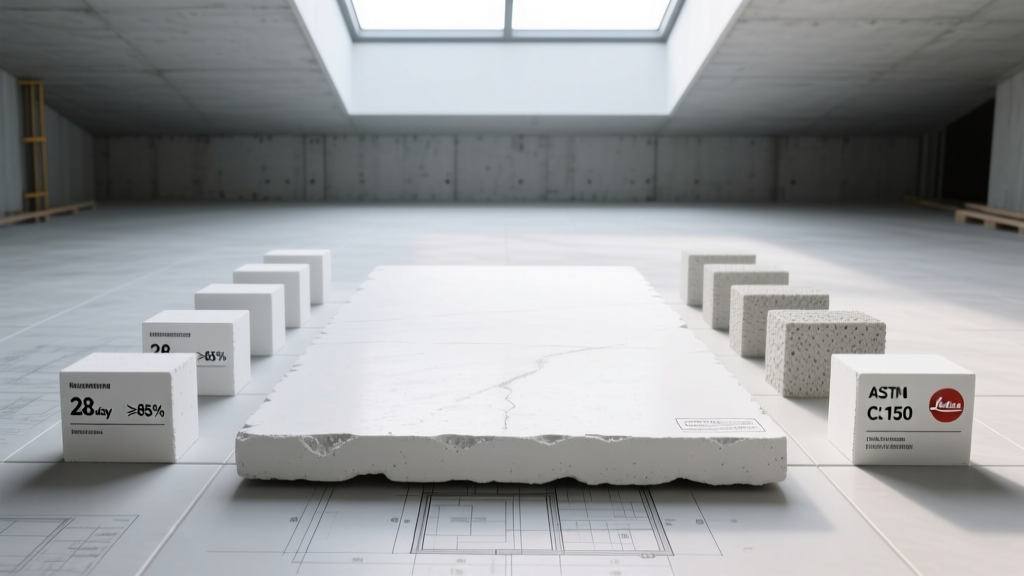
Chemical Baseline: Why White Cement is Not Just Dyed Gray
White Portland cement is fundamentally distinct from standard gray cement at the molecular level. It is not produced by adding bleaching agents or titanium dioxide to gray clinker; rather, it is manufactured from raw materials with strictly controlled, ultra-low concentrations of transition metals. The primary colorants in standard cement are iron oxide (Fe2O3) and manganese oxide (MnO). To achieve the required optical performance, white cement kiln feeds are sourced from high-purity limestone and kaolin clay, completely eliminating shale and iron-rich ores.
According to the ASTM C150 Standard Specification for Portland Cement, white cement must maintain an iron oxide content of less than 0.5% (compared to 2.5%–4.0% in gray Type I) and manganese oxide below 0.05%. This severe restriction alters the clinker phase chemistry, virtually eliminating the tetracalcium aluminoferrite (C4AF) phase, which drops from a typical 8%–12% in gray cement to less than 2% in white cement. This chemical shift necessitates higher kiln temperatures (often exceeding 1500°C) and finer grinding to maintain structural performance.
Optical Performance and Reflectance Ratings
Specifying white cement for architectural concrete requires verifying optical metrics beyond simple visual inspection. Performance is quantified using the CIE L*a*b* color space and the Hunter whiteness scale.
Key Optical Specifications for 2026 Procurement
- L* (Lightness): High-grade white cement must achieve an L* value between 92 and 95 on the CIE scale (where 100 is absolute white).
- a* and b* Axes: Values must hover near 0.0. A positive b* value indicates unwanted yellowing, often caused by iron contamination or improper kiln reduction atmospheres.
- Hunter Whiteness: Premium architectural grades specify a Hunter whiteness index of >88%. Standard masonry white cement may only reach 75%–80%.
When drafting project specifications, architects should explicitly mandate a minimum CIE L* value of 92 and require mill test reports (MTRs) for every batch delivered to the ready-mix plant, as optical consistency varies significantly between manufacturing runs.
ASTM C150 Comparative Matrix: Gray vs. White
Because the C4AF phase is eliminated, the remaining clinker phases (alite/C3S and belite/C2S) must compensate to ensure adequate hydration and strength development. White cement is typically ground significantly finer than gray cement to accelerate early hydration kinetics.
| Parameter | Gray Type I | White Type I | White Type III |
|---|---|---|---|
| C3S (Alite) % | 50% – 55% | 58% – 65% | 65% – 72% |
| C4AF (Ferrite) % | 8% – 12% | < 2.0% | < 2.0% |
| Fe2O3 (Iron Oxide) % | 2.5% – 4.0% | < 0.5% | < 0.5% |
| Fineness (m²/kg) | 300 – 340 | 360 – 400 | 420 – 460 |
| 28-Day Compressive Strength | 28 – 32 MPa | 35 – 42 MPa | 45 – 52 MPa |
As detailed in the Portland Cement Association's Architectural Concrete Guide, the higher fineness and elevated C3S content mean that White Type I often exhibits early strength gains comparable to Gray Type II or Type III, despite its classification.
Hydration Kinetics and SCM Compatibility
The near-total absence of C3A (tricalcium aluminate) and C4AF in white cement alters the hydration sequence. Gray cement relies on C3A for rapid early stiffening; without it, white cement can exhibit delayed initial setting times unless ground to a high fineness. Initial set typically occurs between 90 and 120 minutes, with final set between 150 and 180 minutes.
Critical SCM Selection Warning
Standard supplementary cementitious materials (SCMs) used to mitigate efflorescence and boost late-stage strength in gray concrete are optical disasters in white concrete. Class F fly ash introduces dark gray particulates; ground granulated blast-furnace slag (GGBFS) imparts a blue-green tint; and silica fume is nearly black. The only viable SCM for high-performance white concrete is highly calcined white metakaolin. Metakaolin consumes calcium hydroxide (reducing efflorescence) while maintaining an L* brightness above 90.
Real-World Failure Modes and Mitigation Protocols
Specifying the correct cement is only the first step. White architectural concrete is highly susceptible to aesthetic failure modes that do not affect structural integrity but result in costly panel rejection.
1. Tannin Bleeding from Formwork
Standard medium density overlay (MDO) plywood and unsealed timber forms leach tannic acid into the highly alkaline pore solution of fresh white concrete, causing severe brown mottling. Mitigation: Specify phenolic-overlaid birch plywood, ABS plastic forms, or urethane-coated steel. If wood must be used, apply a minimum of two coats of polyurethane sealer and use a non-staining, white-pigmented form release agent.
2. Secondary Efflorescence
While white cement masks primary efflorescence (which is white), secondary efflorescence caused by calcium carbonate deposition from external water ingress appears as a chalky, opaque crust that alters the surface light refraction, creating dull patches. Mitigation: Restrict the water-to-cement (w/c) ratio to 0.40 or lower using polycarboxylate ether (PCE) superplasticizers. Incorporate 10%–15% white metakaolin by weight of cement to convert soluble calcium hydroxide into insoluble calcium silicate hydrate.
3. Curing Compound Discoloration
Standard wax-based curing compounds are brown or translucent yellow, which will permanently stain white concrete. Mitigation: Mandate the use of clear, non-yellowing acrylic or alpha-methyl styrene resin curing compounds that meet ASTM C309 Type 1 (clear) or Type 2 (white-pigmented) specifications. For premium architectural precast, continuous wet curing using deionized or filtered water is preferred to prevent iron staining from municipal water supplies.
2026 Cost Analysis and Procurement Logistics
White Portland cement commands a significant premium over gray cement due to the cost of high-purity raw materials, the higher thermal energy required for clinkering, and the specialized grinding equipment needed to prevent iron contamination from mill liners.
| Material Metric | Gray Type I (Bulk) | White Type I (Bulk) | White Type I (Bagged 80-lb) |
|---|---|---|---|
| Average 2026 Price | $125 – $145 / ton | $290 – $360 / ton | $19.00 – $24.00 / bag |
| Lead Time / Availability | 1 – 3 Days | 14 – 28 Days | In Stock (Specialty Retail) |
Because white cement is produced in fewer kilns globally, supply chain bottlenecks are common. For large-scale architectural precast or cast-in-place projects exceeding 500 cubic yards, procurement teams must secure mill allocations at least 90 days in advance and require the batch plant to dedicate specific silos and mixers exclusively to white concrete to prevent cross-contamination with gray cement dust.