Concrete Floor Paint vs Epoxy: Chemical Mix & Cost Breakdown
Compare concrete floor paint vs epoxy coatings. Discover mix design differences, 100% solids vs acrylics, hot tire pickup resistance, and costs.

The Chemistry of the Mix: Acrylic Binders vs. Thermosetting Resins
The fundamental difference between concrete floor paint and epoxy lies in the chemical binder and the curing mechanism. Standard concrete floor paints are typically 100% acrylic or vinyl-acrylic emulsions. These are single-component, water-borne systems that cure through coalescence: as the water and co-solvents evaporate, the polymer particles are forced together and fuse into a continuous film. Because they dry rather than cure chemically, acrylic paints remain thermoplastic, meaning they can soften when exposed to heat or specific solvents.
Epoxy, conversely, is a thermosetting resin. A true epoxy system requires two distinct components: Part A (the epoxide resin) and Part B (the polyamine hardener). When mixed, an exothermic chemical reaction occurs, creating a rigid, three-dimensional cross-linked polymer network. Once cured, thermosetting epoxies cannot be melted or re-softened by heat, which dictates their superior performance in heavy-duty environments.
Many big-box store products are labeled as "epoxy paint" or "1-part epoxy." These are chemically acrylic or latex paints modified with trace amounts of epoxy resin to improve adhesion. Always check the Technical Data Sheet (TDS) for Solids by Volume (SBV). A standard acrylic paint has an SBV of 30-40%, meaning 60% of the wet film evaporates. A true 100% solids epoxy has an SBV of 98-100%, leaving behind a thick, durable dry film that matches the wet application thickness.
Concrete Floor Paint vs Epoxy: Technical Specification Matrix
Understanding the mix design parameters is critical for predicting how a coating will perform on a porous, alkaline concrete substrate. The matrix below contrasts standard acrylics, water-based epoxies, and 100% solids epoxies across critical engineering metrics.
| Property | Acrylic Floor Paint | Water-Based Epoxy | 100% Solids Epoxy |
|---|---|---|---|
| Binder Type | 100% Acrylic Emulsion | Epoxy Resin / Amine Adduct | Bisphenol-A / Cycloaliphatic Amine |
| Cure Mechanism | Evaporation / Coalescence | Coalescence + Chemical Cross-link | Chemical Cross-link (Thermoset) |
| Solids by Volume | 30% - 45% | 50% - 70% | 96% - 100% |
| Dry Film Thickness (DFT) | 1.5 - 2.5 mils per coat | 3.0 - 5.0 mils per coat | 10.0 - 20.0+ mils per coat |
| Taber Abrasion (CS-17) | High weight loss (poor) | Moderate weight loss | Very low weight loss (excellent) |
| VOC Content | < 100 g/L | < 150 g/L | 0 - 50 g/L |
For a deeper understanding of how volatile organic compounds impact indoor air quality and regulatory compliance during application, refer to the EPA guidelines on VOC emissions. Water-based epoxies and acrylics are generally preferred for interior, occupied spaces due to these strict environmental limits.
Substrate Interaction: Moisture Vapor and Adhesion Profiles
Concrete is a highly porous, capillary network that constantly transmits moisture vapor from the subgrade to the surface. The mix design of the coating dictates how it interacts with this moisture and the physical profile of the slab.
Concrete Surface Profile (CSP) Requirements
Acrylic paints rely primarily on chemical adhesion and microscopic surface penetration. They require a relatively smooth, clean surface, typically achieved via acid etching to a CSP 1 or CSP 2 (per International Concrete Repair Institute guidelines). True epoxies, however, require a mechanical interlock. The low viscosity of the epoxy resin allows it to flow deep into the pores of a shot-blasted or diamond-ground slab, anchoring the coating. Epoxies generally require a CSP 2 to CSP 4 profile. Testing this pull-off adhesion strength is standardized under ASTM D7234 Standard Test Method for Pull-Off Adhesion, where epoxies routinely achieve 400+ psi (often resulting in concrete substrate failure before coating failure), while acrylics typically fail cohesively at 150-200 psi.
The MVT Thresholds
Moisture Vapor Transmission (MVT) is the leading cause of coating delamination. Because acrylic paints are micro-porous, they allow moisture vapor to pass through the film without building hydrostatic pressure. Epoxies are essentially vapor-impermeable barriers. If an epoxy is applied over a slab with high MVT, the vapor pressure will exceed the adhesive bond strength, causing blisters and delamination.
Rule of Thumb for Epoxy Application: Never apply a standard 100% solids epoxy if the slab's internal relative humidity exceeds 75% (tested via ASTM F2170 in-situ probes) or if the calcium chloride emission rate exceeds 3 lbs per 1,000 sq. ft. per 24 hours (ASTM F1869). High-MVT slabs require a specialized moisture-mitigating epoxy primer before the topcoat.
Real-World Failure Modes: Hot Tires, Amine Blush, and UV Chalking
Understanding the chemical vulnerabilities of each mix design prevents catastrophic failures in the field.
- Hot Tire Pickup (Acrylic Vulnerability): Synthetic rubber tires contain plasticizers. When a vehicle is parked, the weight of the car combined with the heat retained in the tire causes these plasticizers to migrate into the coating. Because acrylic paints are thermoplastic, the plasticizers soften the binder, and the coating peels away when the car is moved. Highly cross-linked 100% solids epoxies are chemically resistant to this plasticizer migration.
- Amine Blush (Epoxy Vulnerability): If a standard polyamine epoxy is applied in high humidity and low temperatures, the amine hardener can react with carbon dioxide and moisture in the air before it reacts with the epoxy resin. This creates a waxy, greasy surface film called "amine blush" or carbamation, which prevents subsequent coats from bonding. Using a cycloaliphatic amine hardener or strictly controlling the dew point prevents this.
- UV Chalking (Shared Vulnerability): Neither standard acrylics nor standard epoxies possess high UV stability. Epoxies will undergo photo-oxidation, leading to severe chalking and yellowing (especially in clear coats over metallic pigments). For exterior slabs or sunrooms, an aliphatic polyurethane or polyaspartic topcoat is mandatory over the epoxy base.
2026 Cost Analysis and Coverage Metrics
When budgeting, contractors and homeowners must separate material costs from surface preparation costs. Preparing a slab for epoxy (diamond grinding) is significantly more labor-intensive and requires specialized dust-extraction equipment to comply with OSHA's Respirable Crystalline Silica Standard during concrete grinding.
| Cost Factor | Acrylic Floor Paint | Water-Based Epoxy | 100% Solids Epoxy (Pro Grade) |
|---|---|---|---|
| Material Cost (per sq. ft.) | $0.25 - $0.60 | $0.80 - $1.50 | $1.20 - $2.50 |
| Prep Cost (per sq. ft.) | $0.15 - $0.30 (Acid Etch) | $0.50 - $0.80 (Light Grind) | $0.80 - $1.50 (Shot Blast/Grind) |
| Total Installed Cost | $1.50 - $2.50 | $3.50 - $5.50 | $5.00 - $9.00+ |
| Expected Lifespan | 1 - 3 Years | 3 - 5 Years | 10 - 20+ Years |
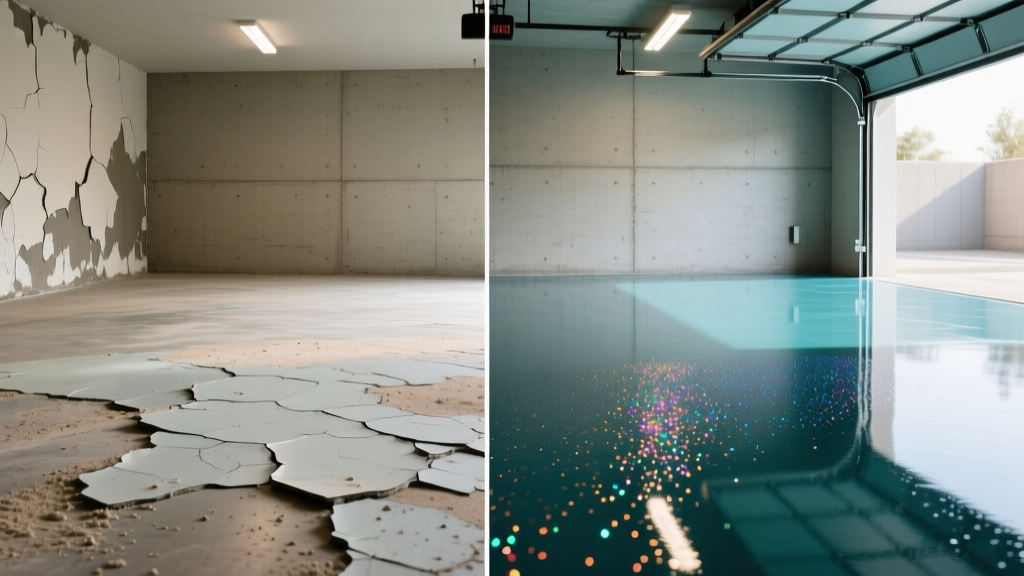
Decision Framework: Matching the Mix to the Slab
Selecting between concrete floor paint and epoxy requires evaluating the slab's condition, environmental exposure, and traffic load. Use this framework to finalize your specification:
- Assess the Traffic Load: If the floor will support vehicle traffic, forklifts, or heavy rolling loads, eliminate acrylic paint immediately. The thermoplastic nature of acrylic will result in hot tire pickup and rapid abrasion failure. Specify a 100% solids epoxy or a polyaspartic/polyurea hybrid.
- Test for Moisture: Perform an ASTM F2170 relative humidity test. If the slab reads above 75% RH and you cannot install a moisture mitigation system, do not use a vapor-impermeable epoxy. Opt for a high-quality, breathable acrylic concrete stain or a specialized moisture-tolerant water-based epoxy primer.
- Evaluate the Environment: For exterior patios, pool decks, or sunrooms exposed to direct UV radiation, standard epoxies will chalk and degrade within 12 months. Use a UV-stable acrylic, or apply an epoxy base coat sealed with an aliphatic polyurethane topcoat.
- Consider the Substrate Profile: If the concrete is heavily troweled, dense, or sealed with a curing compound, acid etching (sufficient for paint) will not open the pores. You must mechanically abrade the slab. If you are already investing in diamond grinding, it is economically inefficient to top it with a low-solids acrylic paint; upgrade to a high-solids epoxy to maximize the return on your preparation investment.
Written by
Priya KapoorPriya Kapoor is a real estate market analyst and construction economics researcher with expertise in housing affordability, development feasibility, and infrastructure investment. She holds a Master of Regional Planning from Cornell University and previously worked as a senior analyst at CBRE's Investment Properties group, where she modeled returns for $4B in mixed-use development pipelines. Priya now runs an independent research practice advising developers, municipalities, and REITs on construction cost forecasting and market timing. She publishes the quarterly "BuildMat Market Pulse" report tracking material price indices across 12 commodity categories. Based in Austin, TX, Priya serves on the board of Habitat for Humanity Austin and is a marathon runner.
More from Priya Kapoor
View all
Construction Cost
Cost to Build a 1600 Sq Ft Home in 2026: Full Breakdown
Accurate 2026 cost to build a 1600 sq ft home—material, labor, and regional pricing breakdowns included. Plan your budget with real-time estimates.
Aug 11, 2026

Wood & Lumber
Name the Types of Wood for Pressure Treatment and Preservation
Learn how to name the types of wood best suited for pressure treatment. Compare species treatability, chemical retention levels, and 2026 preservation costs.
Aug 4, 2026

Stone & Masonry
Stone Veneer Suppliers Lindenhurst: 2026 Cost Analysis
Analyze 2026 stone veneer costs in Lindenhurst, NY. Compare local supplier pricing, delivery fees, and Suffolk County installation labor rates.
Aug 4, 2026