HardieBacker vs Durock vs PermaBase: Cement Board Deep Dive
Compare HardieBacker, Durock, and PermaBase cement boards. Explore core compositions, 2026 pricing, installation failure modes, and ideal use cases.
The Big Three: Market Leaders in Cementitious Substrates
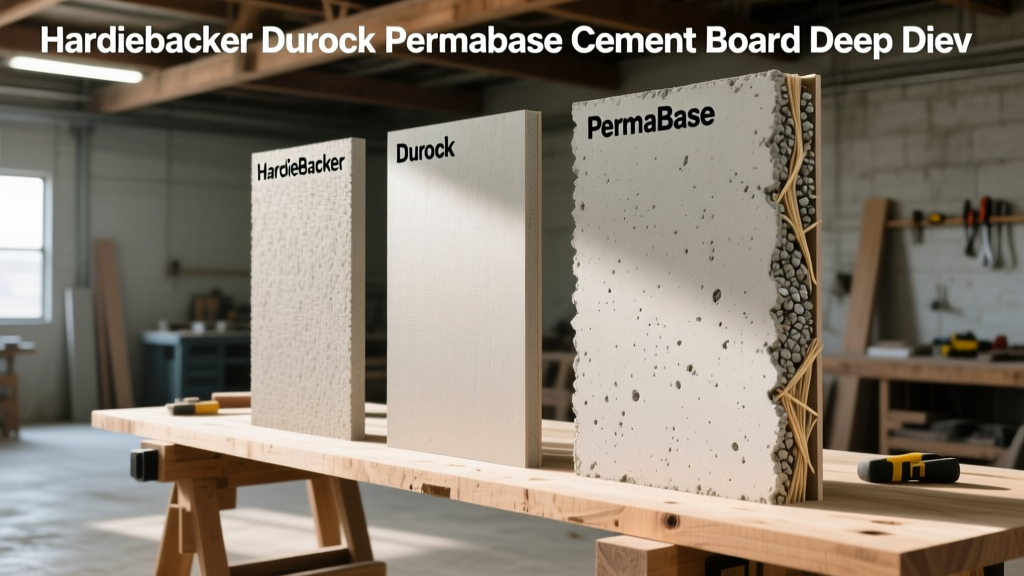
When specifying a tile substrate for wet areas, exterior cladding, or high-traffic floors, generic 'cement board' is an insufficient designation. The market is dominated by three distinct product lines, each engineered with proprietary core chemistries and reinforcement matrices that dictate their cutting behavior, structural rigidity, and moisture tolerance. James Hardie’s HardieBacker, USG’s Durock Next Gen, and National Gypsum’s PermaBase represent the industry standard, but they are not interchangeable. Understanding the microscopic differences in their Portland cement formulations is critical for preventing tile tenting, grout cracking, and substrate degradation.
Core Material Composition and Manufacturing Differences
While all three brands utilize a Portland cement base, the reinforcement and aggregate materials fundamentally alter the physical properties of the board.
HardieBacker 500 (James Hardie)
HardieBacker relies on a high-density cellulose fiber reinforcement matrix. This manufacturing process creates an exceptionally rigid, dense board with virtually no flex. The lack of fiberglass mesh means the board does not fray at the edges, but the cellulose-cement bond makes it notoriously difficult to score and snap. Installers must use a carbide-tipped scoring tool with significant downward pressure or a diamond-blade angle grinder. The density also provides superior screw-holding strength, making it ideal for heavy wall-mounted fixtures like grab bars or large-format porcelain slabs.
Durock Next Gen (USG)
USG formulates Durock with a polymer-modified cement core reinforced by a woven fiberglass mesh on both faces. This mesh encapsulation provides excellent tensile strength and allows the board to absorb minor subfloor deflection without transferring stress to the tile layer. Durock is significantly easier to cut than HardieBacker; a standard utility knife with a few passes will score the mesh and core cleanly. However, the exposed fiberglass mesh at cut edges can be abrasive and requires careful handling to prevent fraying before thin-set application.
PermaBase (National Gypsum)
PermaBase differentiates itself by incorporating expanded polystyrene (EPS) beads into the cement core, wrapped in a fiberglass mesh. This makes it the lightest cement board on the market—roughly 20% lighter than comparable HardieBacker sheets. Its standout feature is the EdgeTapered profile. Unlike the square, blunt edges of HardieBacker and Durock, PermaBase features tapered edges identical to standard drywall, allowing for flush taping and mudding at transitions where tile meets painted surfaces.
Head-to-Head Product Matrix
| Feature | HardieBacker 500 (1/2') | Durock Next Gen (1/2') | PermaBase (1/2') |
|---|---|---|---|
| Core Reinforcement | Cellulose Fiber | Fiberglass Mesh / Polymer | EPS Beads / Fiberglass Mesh |
| Weight (3x5 ft sheet) | ~52 lbs | ~45 lbs | ~38 lbs |
| Edge Profile | Square / Blunt | Square / Blunt | EdgeTapered (Long edges) |
| Cutting Method | Carbide Scoring / Diamond Blade | Utility Knife Score & Snap | Utility Knife Score & Snap |
| Water Absorption (ASTM C473) | < 8% (Highly Resistant) | < 12% (Standard) | < 12% (Standard) |
| Mold Resistance | MoldBlock Technology | Mold/Mildew Resistant Core | ProPanel Mold Resistance |
Installation Nuances and Critical Failure Modes
The most common cause of cement board failure is not the board itself, but the installer’s deviation from Tile Council of North America (TCNA) and ANSI guidelines. Below are the specific edge cases and failure modes associated with these substrates.
The Thin-Set Void Error
A pervasive myth is that thin-set mortar applied beneath cement board on a wood subfloor acts as an adhesive. Its actual purpose is to eliminate voids. If a 3x5 sheet of Durock is screwed directly to a plywood subfloor without a bedding layer of modified thin-set, microscopic gaps remain between the board and the wood. When a point load is applied (e.g., a heavy appliance or high heels), the board flexes into the void, transferring shear stress directly to the tile above and causing immediate cracking. Always use a 1/4-inch notched trowel to apply a bedding layer of ANSI A118.4 modified thin-set beneath the board before fastening.
Portland cement is highly alkaline (pH 12-13). Standard drywall screws or uncoated deck screws will corrode and bleed rust through the grout lines within months. You must use screws specifically rated for cementitious environments. Look for #8 or #9 gauge screws with a ceramic coating or hot-dipped galvanized finish. For floors, use 1-1/4 inch screws; for walls, use 1-5/8 inch screws. Fasten every 8 inches across the field and 6 inches along the perimeter, keeping fasteners at least 3/8 inch from the board edges to prevent blowout.
Seam Treatment and Alkali Degradation
Treating cement board seams with standard drywall paper tape or standard fiberglass mesh tape is a catastrophic error. The high alkalinity of the cement will degrade standard fiberglass within weeks, compromising the tensile strength of the joint. You must use alkali-resistant (AR) fiberglass mesh tape embedded in the same modified thin-set used to set the tile. Do not use drywall joint compound to finish these seams; it will dissolve when exposed to moisture.
2026 Cost Analysis and Yield Optimization
Pricing for cement board fluctuates based on regional freight costs, as the material is exceptionally heavy and expensive to ship. Based on early 2026 national averages at major big-box retailers and specialized lumber yards, here is the cost breakdown:
- HardieBacker 500 (3x5 ft): $14.50 - $16.00 per sheet ($0.96 - $1.06 per sq. ft.)
- Durock Next Gen (3x5 ft): $13.00 - $14.50 per sheet ($0.86 - $0.96 per sq. ft.)
- PermaBase (3x5 ft): $12.50 - $14.00 per sheet ($0.83 - $0.93 per sq. ft.)
Yield Strategy: For large bathroom floors or shower surrounds, purchasing 3x5 sheets results in a 15-20% waste factor due to off-cuts that are too small to span between floor joists or wall studs (building codes require all board edges to land on solid framing). For projects exceeding 50 square feet, special-order 4x8 foot sheets. While the upfront cost per sheet is roughly double, the reduced waste factor and fewer seams to tape lower the overall material and labor cost by approximately 12%.
Decision Framework: Which Board for Which Application?
Selecting the right board requires matching the substrate's physical properties to the environmental and structural demands of the specific project.
Scenario A: Continuous-Use Steam Showers
Winner: HardieBacker 500. Steam showers subject substrates to near-100% humidity and high thermal cycling. HardieBacker’s cellulose-reinforced core has the lowest water absorption rate of the three and maintains its structural rigidity even when saturated. When paired with a liquid-applied waterproofing membrane (like Schluter Kerdi or Laticrete Hydro Ban), it provides the most dimensionally stable base for heavy stone or large-format porcelain in high-moisture environments.
Scenario B: Large Format Tile over Marginal Subfloors
Winner: Durock Next Gen. Large format tiles (edges exceeding 15 inches) are highly susceptible to lippage and cracking if the subfloor deflects. Durock’s polymer-modified core and fiberglass mesh provide a slight degree of flexural forgiveness that HardieBacker lacks. It absorbs micro-deflections from the wood subfloor below, preventing the transfer of shear stress to the rigid porcelain tile above.
Scenario C: Wall Installations and Painted Transitions
Winner: PermaBase. Hauling 52-pound sheets of HardieBacker up stairwells and holding them plumb against wall studs is a labor-intensive process. PermaBase’s lightweight EPS core reduces installer fatigue and speeds up wall applications. Furthermore, if the shower surround transitions directly into a painted drywall wall, PermaBase’s EdgeTapered long edges allow the drywall finisher to tape and mud the transition seamlessly, eliminating the visible bump caused by the square edges of competing brands.
Final Technical Considerations
Regardless of the brand selected, cement board is a tile substrate, not a waterproofing layer. Water will pass through all three of these boards and reach the wood framing behind them if left untreated. In any wet application, a secondary waterproofing barrier—either a sheet membrane, a liquid-applied elastomeric coating, or a 4-mil polyethylene sheet placed behind the board—must be integrated into the assembly to meet modern building codes and ensure the longevity of the installation.