8 Types of Concrete Explained: Structural, Decorative, and Modern
Discover 8 types of concrete, from standard reinforced to UHPC and pervious. Compare PSI ratings, 2026 costs, and ideal applications for your build.

The Engineering Spectrum of Concrete Mixes
Concrete is not a monolithic material; it is a highly engineered composite. When evaluating the various types of concrete for a construction project, the decision extends far beyond basic gray slabs. Modern batching plants manipulate water-to-cement (w/c) ratios, supplementary cementitious materials (SCMs), and chemical admixtures to produce mixes with radically different structural, permeable, and aesthetic properties.
This comprehensive guide dissects eight primary concrete classifications, providing exact compressive strength metrics, 2026 market pricing, and specific ASTM standards to ensure your material selection aligns with structural demands and local building codes.
- Standard Load-Bearing: Normal Strength (2,500–4,000 PSI)
- High-Rise / Heavy Industrial: High-Strength (6,000+ PSI) or Self-Consolidating
- Extreme Load / Thin Overlays: Ultra-High-Performance (UHPC)
- Stormwater Management: Pervious / Permeable
- Architectural Facades: Glass Fiber Reinforced (GFRC)
Standard & Structural Concrete Classifications
1. Normal Strength Concrete (2,500 to 4,000 PSI)
Normal strength concrete forms the backbone of residential and light commercial construction. Batched primarily with ASTM C150 Type I or II Portland cement, it achieves a 28-day compressive strength between 2,500 and 4,000 PSI. The typical mix design maintains a w/c ratio of 0.45 to 0.55. While highly versatile, it is susceptible to freeze-thaw scaling if not properly air-entrained (targeting 5-8% air content per ASTM C260) in colder climates.
- 2026 Cost: $135 to $155 per cubic yard (CY).
- Primary Use: Residential foundations, sidewalks, standard driveways, and slab-on-grade floors.
2. High-Strength & High-Performance Concrete (6,000 to 10,000+ PSI)
High-strength concrete (HSC) is engineered for multi-story buildings, bridges, and heavy industrial floors. To achieve 6,000+ PSI, mix designers drastically lower the w/c ratio to 0.30–0.40 and introduce high-range water reducers (HRWR), commonly known as superplasticizers (e.g., Master Builders MasterGlenium). Silica fume (ASTM C1240) is frequently added to densify the interfacial transition zone (ITZ) between the cement paste and aggregate, dramatically reducing permeability and boosting late-stage strength.
- 2026 Cost: $170 to $210 per CY.
- Primary Use: High-rise columns, transfer girders, and heavy-duty warehouse floors.
3. Reinforced & Prestressed Concrete
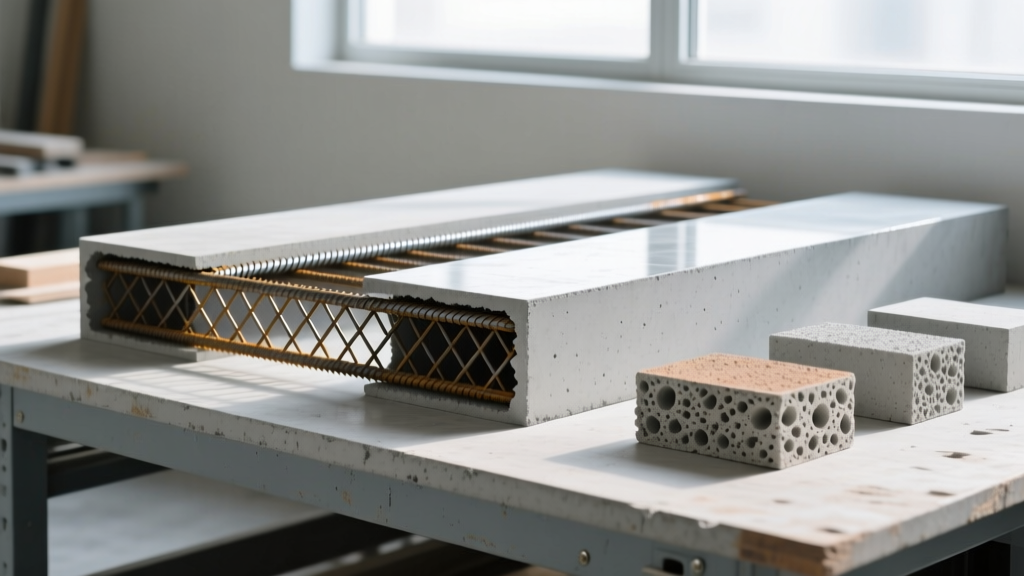
Concrete possesses exceptional compressive strength but inherently low tensile strength. Reinforced concrete integrates steel rebar (ASTM A615) or welded wire mesh to absorb tensile and shear forces. Prestressed and post-tensioned concrete take this further by introducing compressive stresses into the member before service loads are applied, effectively neutralizing tensile cracking under heavy spans. This technique allows for significantly thinner slabs and longer unsupported spans in commercial parking structures and bridge decks.
Advanced & Specialty Concrete Types
4. Ultra-High-Performance Concrete (UHPC)
UHPC represents the pinnacle of cementitious engineering. By completely eliminating coarse aggregate and utilizing a precise matrix of fine sand, silica fume, and steel micro-fibers, UHPC achieves compressive strengths exceeding 21,000 PSI and exceptional flexural ductility. Products like Holcim’s Ductal® can be cast in remarkably thin sections (as thin as 0.5 inches) without traditional rebar. According to the Federal Highway Administration, UHPC is increasingly specified for bridge deck overlays and prefabricated connection joints due to its near-zero permeability and resistance to chloride ingress.
- 2026 Cost: $1,800 to $2,500+ per CY (typically procured in specialized 50 lb bags at $150–$220 per bag).
- Primary Use: Bridge connections, architectural cladding, thin structural overlays, and blast-resistant structures.
5. Pervious & Permeable Concrete
Pervious concrete is a zero-slump, open-graded mixture containing little to no fine aggregate (sand). This creates a network of interconnected voids (typically 15% to 25% by volume), allowing water to pass through at rates of 3 to 8 gallons per minute per square foot. It is a critical component of modern green infrastructure for stormwater management. Installation requires specialized vibration and immediate curing with thick plastic sheeting to prevent rapid moisture loss. The Portland Cement Association notes that proper sub-base preparation is critical; a minimum 6-inch layer of clean, washed aggregate is required beneath the slab to act as a reservoir for infiltrating water.
- 2026 Cost: $160 to $190 per CY (excluding specialized aggregate base).
- Primary Use: Parking lots, low-speed roadways, and LEED-certified stormwater retention zones.
6. Self-Consolidating Concrete (SCC)
Also known as self-leveling concrete, SCC flows under its own weight, completely filling formwork and encapsulating dense rebar networks without the need for mechanical vibration. Tested via the slump flow method (ASTM C1611), SCC requires a delicate balance of high-range water reducers and viscosity-modifying admixtures (VMAs) to prevent aggregate segregation. It is indispensable in complex architectural forms or heavily congested structural nodes where internal vibration is impossible.
- 2026 Cost: $150 to $185 per CY.
- Primary Use: Architectural walls with complex form liners, heavily reinforced columns, and precast elements.
Decorative & Architectural Concrete
7. Stamped and Stained Concrete
Decorative concrete transforms standard gray slabs into high-end aesthetic surfaces. Stamped concrete utilizes integral liquid colors (iron oxide pigments) and textured polyurethane mats to mimic natural stone, slate, or brick. A critical step is the application of a powdered or liquid release agent, which prevents the stamping mats from bonding to the concrete while adding secondary color accents. Acid staining, conversely, uses metallic salts to react with the hydrated lime in the concrete, producing permanent, translucent, marble-like color variations.
8. Glass Fiber Reinforced Concrete (GFRC)
GFRC replaces traditional steel reinforcement with alkali-resistant (AR) glass fibers, typically comprising 5% to 8% of the mix by weight. Because it does not require a thick cover of concrete to protect steel from corrosion, GFRC can be sprayed onto molds to create lightweight, incredibly thin (3/4-inch) architectural panels. It boasts high tensile strength and is highly resistant to cracking, making it the premier choice for complex 3D facades, interior feature walls, and custom fireplace surrounds.
Cost, Strength, and Application Matrix
| Concrete Type | Compressive Strength | Avg. 2026 Cost (Per CY) | Key Admixture / SCM |
|---|---|---|---|
| Normal Strength | 2,500 - 4,000 PSI | $135 - $155 | Air-Entraining Agents |
| High-Strength | 6,000 - 10,000 PSI | $170 - $210 | Silica Fume, HRWR |
| UHPC | 21,000+ PSI | $1,800+ (Specialty) | Steel Micro-fibers |
| Pervious | 600 - 1,500 PSI | $160 - $190 | None (Zero fine aggregate) |
| SCC | 4,000 - 8,000 PSI | $150 - $185 | VMAs, Superplasticizers |
| GFRC | 4,000 - 6,000 PSI | Custom (Per Sq. Ft.) | AR Glass Fibers |
Critical Failure Modes & Edge Cases
Selecting the right type of concrete is only half the battle; understanding how specific mixes fail in the field is what separates standard contractors from expert builders.
When using reactive aggregates in high-strength concrete, the dense matrix can trap moisture and alkalis, accelerating ASR—a chemical reaction that forms a swelling gel, leading to severe map cracking and structural spalling. Mitigation: Always mandate the inclusion of Class F fly ash (minimum 20% replacement) or slag cement to lower the alkalinity of the pore solution, and test aggregates per ASTM C1293 prior to batching.
- Plastic Shrinkage in Pervious Concrete: Because pervious concrete lacks fine aggregate, its surface area is highly exposed. If wind speeds exceed 15 mph or ambient humidity drops below 40% during placement, the surface can dry out before hydration occurs, leading to raveling (surface aggregate dislodging). Fix: Apply a liquid evaporation retarder immediately after screeding and cover with 6-mil polyethylene within 20 minutes.
- Segregation in SCC: If the VMA dosage is miscalibrated at the batch plant, the coarse aggregate can settle to the bottom of the formwork while the paste bleeds to the top. Fix: Always perform a J-Ring test (ASTM C1621) on-site before pumping to verify passing ability and stability.
- De-icing Salt Scaling on Stamped Concrete: Stamped concrete relies on a topical acrylic sealer. When exposed to magnesium chloride or calcium chloride de-icers in freeze-thaw cycles, the sealer can trap moisture, causing the surface to blister and peel. Fix: Specify breathable, penetrating silane/siloxane sealers for exterior stamped applications in northern climates.
Sourcing and ASTM Compliance
When specifying these materials, rely on standardized testing rather than supplier marketing claims. Compressive strength must be verified via standard cylinder testing (ASTM C39) at 7 and 28 days. For architectural and decorative applications, require mock-up samples cured under the exact same ambient conditions as the job site to ensure color consistency. For comprehensive mix design standards and local code adaptations, consult the American Concrete Institute (ACI) standards database and ensure your ready-mix supplier is NRMCA-certified for the specific classification you are procuring.
Expert Insight: In 2026, the integration of CarbonCure and similar CO2-injection technologies is becoming standard in normal and high-strength ready-mix. This process injects captured carbon dioxide into the mix during batching, where it mineralizes into calcium carbonate. This not only reduces the carbon footprint of the concrete by up to 10% but actually increases early-stage compressive strength by 5-8%, allowing for slight reductions in cement content without sacrificing structural integrity.
Written by
Elena RodriguezElena Rodriguez is a civil engineer and technical writer specializing in concrete technology, masonry systems, and ASTM/ACI compliance. She earned her B.S. in Civil Engineering from Texas A&M University and spent a decade at a materials testing laboratory, performing over 2,000 concrete compressive strength tests and masonry prism evaluations. Elena is an ACI-certified Field Testing Technician (Grade I) and a member of ASTM Committee C12 on Natural Building Stone. She currently consults on forensic engineering cases involving concrete failures and moisture intrusion. Based in San Antonio, TX, Elena is a proud member of the Society of Women Engineers (SWE) and coaches her daughter's FIRST Robotics team.
More from Elena Rodriguez
View all
Walls & Panels
Cost Analysis: Light Gauge Steel Framing Advantages and Disadvantages
Evaluate light gauge steel framing advantages and disadvantages through a strict cost analysis lens, comparing material, labor, and lifecycle expenses.
Aug 4, 2026

Walls & Panels
Gypsum Board Types: Exact Specifications, Thickness & Dimensions
Compare standard, Type X, and moisture-resistant gypsum board types. Get exact specifications, thicknesses, dimensions, and ASTM standards for your project.
Aug 4, 2026

Fire Resistance
Best Fire-Resistant Outdoor Decking Materials: 2026 Buyer Guide
Discover the best fire-resistant outdoor decking materials for 2026. Compare Class A PVC, aluminum, and hardwood options for WUI compliance and safety.
Aug 4, 2026