How Much Concrete Do I Need? Thickness, Volume & Lifespan Guide
Learn how to calculate exactly how much concrete you need, balancing volume, slab thickness, and mix design to maximize your project's structural lifespan.
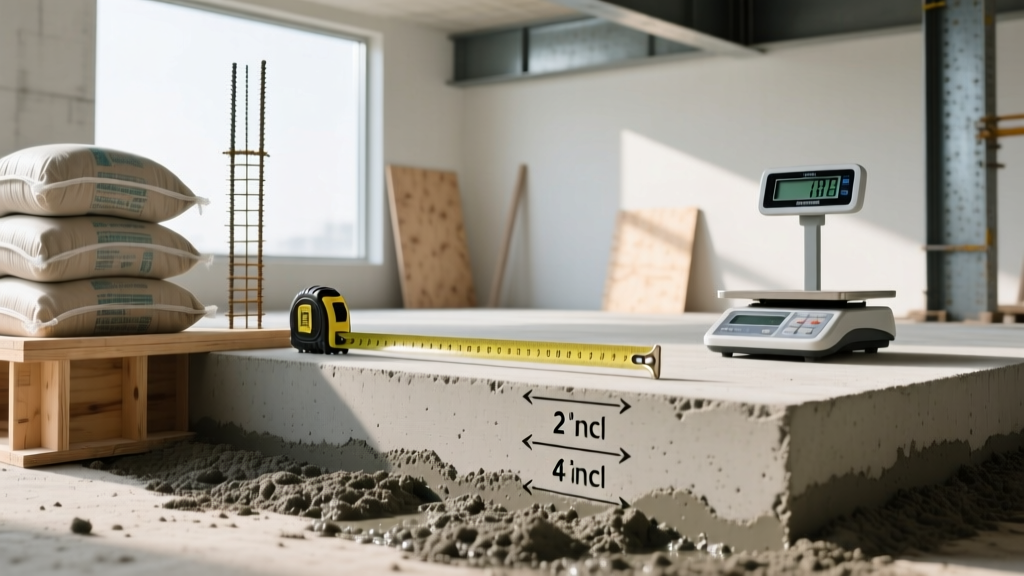
The Hidden Link Between Concrete Volume and Structural Lifespan
When homeowners and contractors ask, 'how much concrete do I need,' they are usually looking for a simple volume calculation to order a truck. However, from a structural engineering and durability perspective, calculating concrete volume is inextricably linked to the lifespan of the finished slab. Under-ordering leads to rushed pours and catastrophic cold joints, while miscalculating the required depth for specific load-bearing scenarios guarantees premature cracking, spalling, and structural failure.
In 2026, with ready-mix concrete prices averaging between $145 and $165 per cubic yard, the financial temptation to order the bare minimum is high. Yet, a slab that fails after 12 years due to inadequate thickness or a compromised pour sequence will cost three times as much to demolish and replace. To ensure a 40-to-50-year lifespan, your volume calculation must account for structural depth requirements, subgrade compaction variables, and batch plant overage tolerances.
If you calculate exactly 3.0 cubic yards for a patio and the truck delivers 2.8 yards due to plant miscalibration or spillage, you will be forced to order a second 'short load' truck. By the time the second truck arrives 45 to 90 minutes later, the first batch has begun its initial set. The boundary where the wet concrete meets the stiffening concrete forms a 'cold joint.' This joint is a permanent structural weakness where water infiltrates, freeze-thaw cycles pry the slab apart, and underlying rebar is exposed to corrosion. Always order an overage to prevent this lifespan-killing scenario.
Calculating Baseline Volume: The Structural Formula
To determine the baseline yardage, you must convert your project dimensions into cubic feet, then divide by 27 (the number of cubic feet in a cubic yard). The formula is straightforward, but the depth variable is where lifespan is won or lost.
- Measure Length and Width: Record dimensions in feet (e.g., 20 ft x 24 ft).
- Determine Structural Depth: Convert inches to feet by dividing by 12. A 4-inch slab is 0.333 feet; a 6-inch slab is 0.5 feet.
- Calculate Cubic Feet: Multiply Length x Width x Depth.
- Convert to Cubic Yards: Divide the total cubic feet by 27.
- Add the 10% Durability Overage: Multiply the final yardage by 1.10 to account for subgrade settling, formwork bowing, and spillage.
Example Calculation: A 20 ft x 24 ft driveway requiring a 6-inch depth for vehicular longevity.
20 x 24 x 0.5 = 240 cubic feet.
240 / 27 = 8.88 cubic yards.
8.88 x 1.10 (10% overage) = 9.76 cubic yards ordered.
How Thickness Dictates Durability (The Depth-to-Lifespan Matrix)
Asking how much concrete you need requires defining what the concrete must support. Pouring a 3-inch slab to save on material costs in a driveway application will result in severe transverse cracking within five years under the weight of modern SUVs and EVs, which are significantly heavier than legacy vehicles. According to the Portland Cement Association's durability guidelines, matching slab thickness to the anticipated live load is the primary defense against tensile failure.
| Application Type | Minimum Thickness | Required PSI Mix | Expected Lifespan |
|---|---|---|---|
| Garden Walkways / Patios | 4 Inches | 3,000 PSI | 25 - 30 Years |
| Standard Residential Driveways | 5 to 6 Inches | 4,000 PSI | 40 - 50+ Years |
| RV Pads / Heavy Truck Aprons | 6 to 8 Inches | 4,500 - 5,000 PSI | 50+ Years |
| Garage Floors (Standard) | 4 to 5 Inches | 3,500 - 4,000 PSI | 40+ Years |
The Economics of Overage: Avoiding Short-Load Fees
When determining how much concrete to order, you must factor in the batch plant's pricing structure. In 2026, most ready-mix suppliers impose a 'short-load fee' for orders under 10 cubic yards. This fee typically ranges from $50 to $75 per missing yard. Furthermore, if you under-order and need a second truck dispatched, you will pay the short-load fee again, plus a secondary delivery surcharge, and risk the aforementioned cold joint.
'Ordering 9.5 yards instead of 8.8 yards might cost an extra $100 upfront, but it guarantees a continuous pour. A continuous pour ensures uniform hydration, consistent curing, and eliminates the weak planes where water and de-icing salts eventually destroy the slab from the inside out.' — Regional Dispatch Manager, National Ready Mixed Concrete Association (NRMCA) member facility. For more on ordering best practices, consult the NRMCA Concrete FAQ.
Edge Case: Subgrade Compaction and Volume Loss
A frequently overlooked variable in volume calculation is the subgrade. If you are pouring over a base of crushed aggregate (like 3/4-inch minus gravel), a poorly compacted subgrade will absorb the concrete slurry and settle under the weight of the screed. A 4-inch planned slab can easily become a 3-inch slab in areas where the gravel base was not mechanically tamped. This localized thinning creates stress concentrators that will crack under the first freeze-thaw cycle. Always factor in an extra 5% volume if the subgrade compaction is unverified.
Mix Design Adjustments for Maximum Longevity
Volume and thickness are only half the battle. The chemical makeup of the concrete you order dictates its resistance to environmental degradation. When calling the batch plant to order your calculated yardage, you must specify the following durability parameters based on your climate:
- Air Entrainment (5% to 8%): Mandatory for any region experiencing freezing temperatures. Microscopic air bubbles give expanding freezing water room to expand without spalling the surface. According to the Federal Highway Administration, proper air entrainment is the single most critical factor in preventing surface scaling on exterior flatwork.
- Water-Cement Ratio (w/c): Demand a maximum w/c ratio of 0.45. Higher water content makes the concrete easier to pour but drastically increases capillary porosity, allowing chlorides (from road salt) to penetrate and corrode embedded steel reinforcement.
- Slump Specifications: Order a 4-inch slump. If the crew needs it wetter to move it, use a mid-range water reducer (plasticizer) rather than adding water on-site, which destroys the engineered durability of the mix.
FAQ: Common Volume & Durability Questions
Q: Can I just order 8.88 yards and have the driver wash out the remaining 0.12 yards in the chute?
A: No. Batch plants calibrate by weight, and minor discrepancies occur. Always round up to the nearest quarter-yard (e.g., 9.0 yards) and plan to use the excess for pre-cast stepping stones or a small footer, rather than risking a short-load.
Q: Does adding fiber mesh reinforcement change how much concrete I need?
A: No, synthetic or steel micro-fibers do not alter the volumetric displacement of the mix. However, fibers significantly reduce plastic shrinkage cracking during the first 24 hours of curing, preserving the structural integrity of the slab's surface layer.
Q: How does hot weather affect my volume and pour strategy?
A: In temperatures above 85°F, concrete sets up to 30% faster. You must order retarders in the mix design and potentially reduce the total yardage per truck to ensure you can finish the slab before it undergoes its initial set, preventing the need for emergency cold-joint patches.
Final Verification Before the Truck Arrives
Before finalizing your order with the dispatch office, physically re-measure your formed area. Formwork can shift during staking, altering the internal dimensions by an inch or two. Verify that your depth stakes are pulled tight and that your 10% overage is factored in. By treating the question of 'how much concrete do I need' as a comprehensive structural strategy rather than a simple math equation, you secure a foundation that will outlast the structures built upon it.