Evaluating Concrete on Concrete Repair: Bond Specs & Ratings
Compare concrete on concrete repair materials by bond strength, shrinkage, and ASTM specs to ensure lasting structural adhesion.
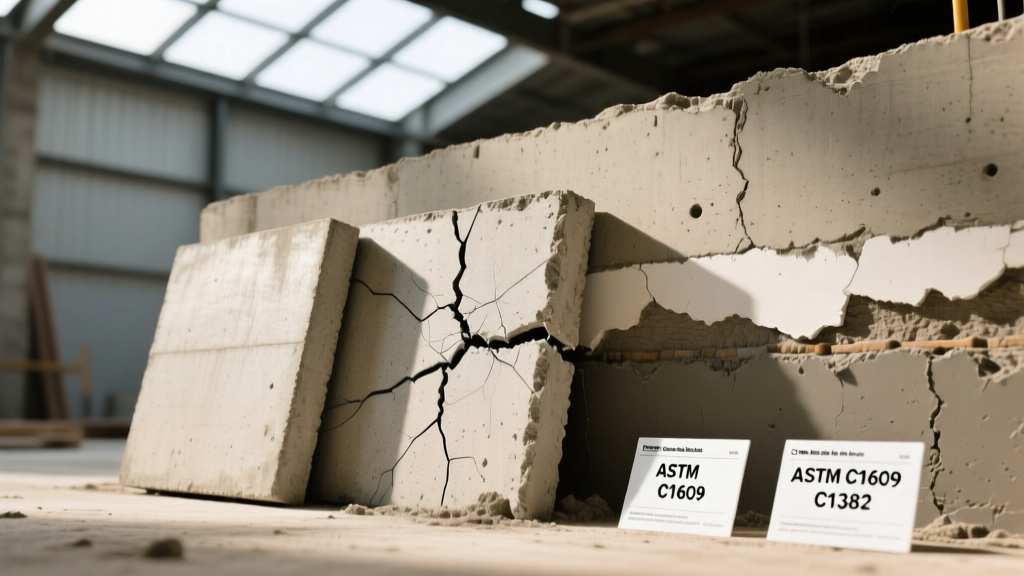
The Hidden Mechanics of Repair Failures
Most concrete on concrete repair failures do not occur because the repair material lacked compressive strength; they fail due to bond degradation, modulus mismatch, and unrestrained shrinkage. When specifying a repair mortar, overlay, or patching compound, reading the Technical Data Sheet (TDS) requires looking past the headline 28-day compressive strength. A 10,000 psi repair mortar is useless if it delaminates from a 3,000 psi substrate under thermal cycling. To ensure lasting structural adhesion, specifiers and contractors must evaluate materials based on rigorous bond performance ratings, surface preparation profiles, and elastic compatibility.
Decoding Bond Strength Specifications
The American Society for Testing and Materials (ASTM) provides two primary testing standards to quantify the adhesive performance of repair materials. Understanding the distinction between these tests is critical for selecting the right product for your specific structural demands.
ASTM C882: Slant Shear Bond Strength
This test measures the shear bond strength of a repair material to a hardened concrete substrate. A standard 3x6 inch cylinder is cast at a 45-degree angle, creating a diagonal bond line. The cylinder is then subjected to compressive loading until failure. According to the ASTM C882 standard, the failure should ideally occur within the substrate concrete (cohesive failure) rather than at the bond line (adhesive failure).
- Non-Structural Patches: Minimum 1,000 psi at 28 days.
- Structural Repairs: Minimum 1,500 to 2,000 psi at 28 days.
- High-Performance Epoxies: Routinely exceed 2,500 psi, often resulting in substrate failure before bond failure.
ASTM C1583: Pull-Off Tensile Strength
While slant shear tests compressive-induced shear, ASTM C1583 measures direct tensile pull-off strength. Metal discs are epoxied to the cured repair surface and pulled using a portable adhesion tester. This metric is vital for overhead repairs and vertical wall applications where gravity and tensile stresses dominate.
Specifier Note: A pull-off strength of 200 psi is generally considered the absolute minimum for non-structural cosmetic patches. For load-bearing structural repairs, specify materials that achieve a minimum of 400 psi direct tension, ensuring the failure mode is cohesive within the substrate.
Material Performance Matrix
Selecting the correct chemistry depends on the environmental exposure, application thickness, and structural requirements. The following matrix compares the three primary categories of concrete repair materials based on standard TDS performance ratings.
| Material Category | ASTM C882 Bond (psi) | Modulus of Elasticity (psi) | Drying Shrinkage (in/in) | Optimal Application Scenario |
|---|---|---|---|---|
| 100% Epoxy Mortars | 2,500 - 3,500+ | 1.5M - 3.0M | Negligible | Thin structural bonding, active crack injection, heavy impact zones. |
| Polymer-Modified Cementitious (PMC) | 1,500 - 2,200 | 2.5M - 4.0M | < 0.05% | Vertical/overhead spall repairs, form-and-pour structural columns. |
| Shrinkage-Compensated Cementitious | 1,000 - 1,500 | 3.5M - 5.0M | Expansive (+0.02%) | Deep foundation patches, large volume slab replacements, bearing plates. |
The Modulus Mismatch Trap
A frequent engineering error in concrete on concrete repair is specifying a material with a Modulus of Elasticity (E-modulus) significantly higher than the existing substrate. The E-modulus dictates how much a material deforms under load. If a rigid, high-modulus repair patch is placed adjacent to a flexible, low-modulus substrate, the differential strain under traffic or thermal loading will concentrate shear stresses exactly at the bond line.
The Rule of Modulus Compatibility
For structural repairs, the repair material’s E-modulus should ideally be within +/- 30% of the substrate’s E-modulus. You can estimate the substrate’s modulus using the ACI formula: E = 57,000 × √(f′c). For a standard 4,000 psi normal-weight concrete substrate, the E-modulus is approximately 3.6 million psi. Therefore, your repair mortar should target an E-modulus between 2.5 million and 4.7 million psi. Using a 6 million psi mortar on this substrate invites edge spalling.
Surface Preparation & ICRI CSP Ratings
Bond strength specifications are entirely void if the Concrete Surface Profile (CSP) is inadequate. The International Concrete Repair Institute (ICRI) utilizes a visual comparator chip system (CSP 1 through 9) to quantify surface roughness. According to the Federal Highway Administration’s Bridge Repair Manual, proper substrate profiling is the single highest determinant of long-term repair adhesion.
- CSP 1-2 (Acid Etching / Light Sanding): Only suitable for thin, non-structural acrylic or silane sealers. Never use for cementitious repair mortars.
- CSP 3-5 (Shot Blasting / Scarification): The standard requirement for most polymer-modified cementitious repair mortars (e.g., SikaTop Armatec, MasterEmaco S 488). Provides adequate mechanical keying without micro-fracturing the substrate.
- CSP 6-9 (Heavy Scabbling / Hydrodemolition): Required for thick structural overlays, epoxy mortars, and areas where the substrate surface is heavily contaminated with laitance or chlorides. Hydrodemolition is preferred over mechanical scabbling as it leaves a highly fractured, porous surface that dramatically increases the mechanical interlock without inducing micro-cracks in the sound concrete below.
Shrinkage Specifications and Curling
When a repair patch shrinks as it cures, it pulls away from the edges of the substrate, creating a ‘curling’ effect that breaks the perimeter bond. This is particularly devastating in slab overlays and shallow spall repairs. When reviewing a TDS, look for testing under ASTM C157 (Length Change of Hardened Hydraulic-Cement Mortar and Concrete) or ASTM C1581 (Restrained Shrinkage).
Standard Portland cement mortars can exhibit drying shrinkage of 0.08% to 0.10%. High-performance repair materials utilize expansive admixtures (like calcium sulfoaluminate) or internal curing agents (like pre-wetted lightweight aggregates) to offset this. Specify materials that list a net 28-day shrinkage of less than 0.04%, or ideally, materials classified as ‘shrinkage-compensated’ that exhibit a slight net expansion (e.g., +0.01% to +0.03%) to maintain tight edge contact. The Portland Cement Association emphasizes that controlling early-age plastic shrinkage is just as critical as mitigating long-term drying shrinkage to prevent micro-cracking at the bond interface.
Decision Framework for Specifiers
Use this logic flow to match the repair scenario with the correct material chemistry and specification requirements:
- Scenario: Active structural crack repair (width > 0.010 inches).
Action: Do not use cementitious mortars. Specify a low-viscosity, high-modulus epoxy injection resin (ASTM C881 Type I, Grade 1). The goal is to restore structural continuity, not just fill the void. - Scenario: Overhead spall repair (depth 1 to 3 inches).
Action: Specify a high-build, polymer-modified, non-sag cementitious mortar. Require a minimum ASTM C1583 pull-off strength of 400 psi and a wet density that allows for 1-inch thick vertical trowel applications without slumping. - Scenario: Large-volume bearing plate grouting or deep column repair.
Action: Specify a flowable, shrinkage-compensated cementitious grout. Require hard-bearing expansion (ASTM C807) to ensure the material expands against the formwork and substrate, eliminating air voids and ensuring 100% bearing contact. - Scenario: Thin wearing course overlay (depth < 0.5 inches).
Action: Specify a silica-fume modified, latex-bonded concrete overlay. Demand a maximum water-cementitious ratio of 0.40 and mandate a 7-day wet-curing protocol to prevent plastic shrinkage cracking.
Summary of Best Practices
Successful concrete on concrete repair relies on a triad of compatibility: chemical adhesion, mechanical interlock, and elastic modulus matching. By mandating specific ASTM C882 and C1583 bond thresholds, enforcing strict ICRI surface profiling, and verifying shrinkage data on the TDS, engineers and contractors can eliminate the vast majority of premature delamination failures. Always prioritize the bond line performance over the sheer compressive strength of the repair material itself.