Material Calculator for Concrete Slab: Exact Yardage & Cost Guide
Master your material calculator for concrete slab projects. Learn exact yardage formulas, waste factors, rebar spacing, and 2026 pricing for flatwork.
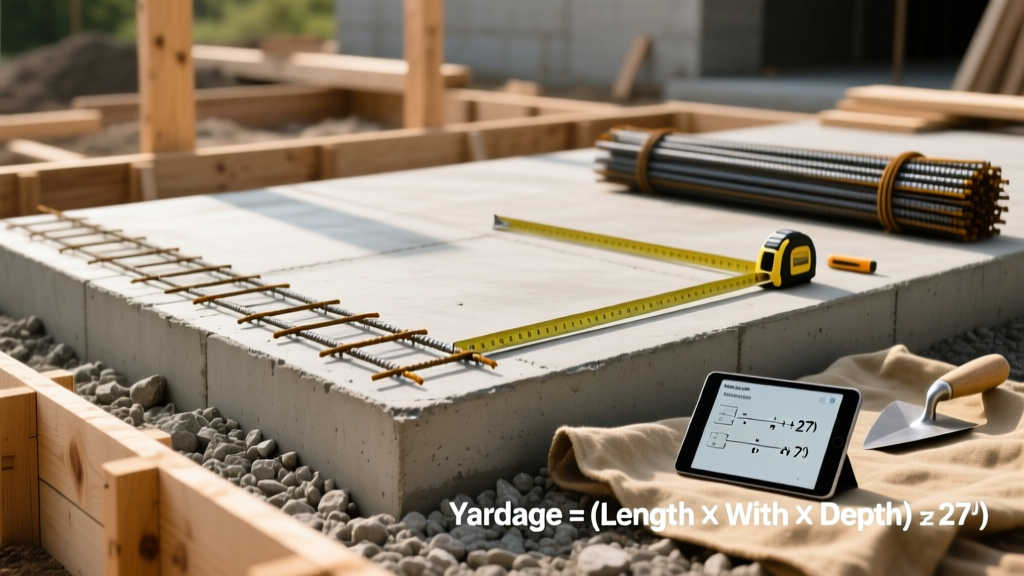
The Core Formula: Calculating Base Yardage
Ordering ready-mix concrete requires precision. Under-ordering results in cold joints and expensive short-load fees, while over-ordering wastes money and creates disposal headaches. When using a material calculator for concrete slab projects, the fundamental math relies on converting square footage and thickness into cubic yards.
The Magic Number: 324
To calculate cubic yards directly from feet and inches, use this streamlined formula:
(Length in feet × Width in feet × Thickness in inches) ÷ 324 = Cubic Yards
Example: For a 24-foot by 30-foot driveway poured at 5 inches thick:
(24 × 30 × 5) ÷ 324 = 11.11 cubic yards.
This base number represents the exact geometric volume of your forms. However, a professional material calculator for concrete slab estimation must account for real-world variables before you call the batch plant.
Adjusting for Real-World Variables: Waste and Subgrade
Earth is rarely perfectly level, and wooden forms flex under the hydrostatic pressure of wet concrete. According to guidelines from the National Ready Mixed Concrete Association (NRMCA), contractors must apply a waste and over-excavation factor to the base geometric volume.
| Slab Application | Recommended Waste Factor | Primary Cause of Variance |
|---|---|---|
| Standard Patios & Walkways | 5% - 7% | Minor subgrade unevenness, form flex |
| Driveways & Garage Floors | 8% - 10% | Thicker edges, keyways, subgrade settling |
| Pumped Concrete (Long Lines) | 10% - 12% | Material left in pump hopper and hoses |
| Complex Footings & Grade Beams | 12% - 15% | Trench over-excavation, soil sloughing |
Calculating the Aggregate Base Course (ABC)
Concrete requires a stable, well-draining foundation. A standard specification calls for 4 inches of compacted Aggregate Base Course (gravel). To calculate the tonnage of gravel needed:
- Calculate the square footage of the slab.
- Multiply by 0.33 (which represents 4 inches in feet).
- Multiply by 0.05 (the approximate weight of compacted gravel per cubic foot in tons).
Formula: Sq Ft × 0.33 × 0.05 = Tons of Gravel. For a 720 sq ft slab, you need roughly 11.8 tons of 3/4-inch minus crushed rock.
Reinforcement Material Calculator for Concrete Slab
The American Concrete Institute (ACI) provides strict guidelines on reinforcement to control shrinkage cracking and provide structural tensile strength. Your material calculator for concrete slab projects must include either Welded Wire Mesh (WWM) or steel rebar.
Welded Wire Mesh (WWM) vs. Rebar
For standard 4-inch residential flatwork, 6x6 W1.4xW1.4 (10-gauge) welded wire mesh is the industry standard. WWM is sold in 150-foot rolls (covering roughly 750 square feet) or flat sheets. Always order 10% extra to account for the mandatory 6-inch lap splices at the seams.
For 5-inch or 6-inch driveways and garage floors, #4 (1/2-inch) rebar on a 16-inch or 18-inch grid is required. Here is the exact math to calculate rebar sticks:
Rebar Stick Calculation Framework
Scenario: 20 ft × 20 ft slab, #4 rebar at 18 inches on center.
- Find the number of lines: (Width in inches ÷ Spacing) + 1.
(240 ÷ 18) + 1 = 14.33. Round up to 15 lines in each direction. - Calculate total linear feet: 15 lines × 20 ft = 300 LF (Direction A).
300 LF × 2 directions = 600 Total Linear Feet. - Convert to 20-foot sticks: 600 LF ÷ 20 ft = 30 sticks.
- Add lap splice waste: Add 10% for overlapping ends and edge trimming.
30 + 3 = 33 total sticks of #4 rebar.
2026 Concrete Flatwork Cost Breakdown
Material costs fluctuate based on regional aggregate availability, cement production energy costs, and local trucking rates. When running your material calculator for concrete slab budgets in 2026, use the following baseline pricing for ready-mix and supplementary materials.
| Material / Service | Unit | 2026 Estimated Cost |
|---|---|---|
| 3,000 PSI Ready-Mix (Standard) | Per Cubic Yard | $145 - $165 |
| 4,000 PSI Ready-Mix (Driveway) | Per Cubic Yard | $155 - $175 |
| Macro-Synthetic Fiber Admixture | Per Cubic Yard | $9 - $14 |
| Short Load Fee (Under 7 Yards) | Flat Fee | $75 - $120 |
| Concrete Pump Truck (Boom) | Hourly + Minimum | $160/hr ($600 min) |
| #4 Rebar (1/2" x 20ft) | Per Stick | $16 - $22 |
Advanced Mix Designs: Selecting the Right PSI and Slump
A common error when using a material calculator for concrete slab projects is ignoring the mix design specifications. Ordering the cheapest 2,500 PSI or 3,000 PSI mix for a heavy-duty application guarantees premature scaling and structural cracking.
- 3,000 PSI (3/4" Aggregate, 4" Slump): Ideal for standard 4-inch patios, sidewalks, and non-structural shed pads. Provides adequate compressive strength for foot traffic and light furniture.
- 4,000 PSI (3/4" Aggregate, 4" to 5" Slump): The mandatory standard for 5-inch residential driveways, garage floors, and interior basement slabs. Handles vehicular loads and resists de-icing salt scaling significantly better than 3,000 PSI mixes.
- 5,000 PSI + Fly Ash (1" Aggregate, 5" Slump): Reserved for commercial shop floors, heavy equipment pads, and agricultural environments. The larger aggregate reduces the water-cement ratio, increasing long-term durability.
Pro Tip on Fiber Mesh: Instead of relying solely on welded wire mesh for secondary temperature and shrinkage reinforcement, specify macro-synthetic fibers (such as Fibermesh 150 or Helix) at the batch plant. These fibers are mixed directly into the truck drum, providing 3D reinforcement throughout the entire depth of the slab and eliminating the risk of contractors stepping the wire mesh down into the subgrade during the pour.
Common Calculation Mistakes to Avoid
Even with a precise material calculator for concrete slab estimation, field errors can derail a pour. Watch out for these specific pitfalls:
- Ignoring the Thickened Edge: Many driveway and garage slab designs require a 12-inch wide, 12-inch deep thickened edge (integral footing) around the perimeter. Failing to calculate the extra volume for this perimeter trench will leave you 1 to 2 yards short on the truck.
- Forgetting the Pump Hose Primer: If you are using a boom pump, the first 1/2 yard of concrete is used to prime the hose and is often pushed out into a waste bucket or form void. Always add 0.5 yards to your total when a pump is on site.
- Miscalculating Slump Loss: In high heat (above 85°F), concrete loses slump rapidly. If your transit time from the batch plant to the site exceeds 45 minutes, order a slump-retarding admixture or specify a 1-inch higher initial slump to ensure the material remains workable for your finishing crew.
Accurate material estimation bridges the gap between a profitable, smooth pour and a chaotic, over-budget jobsite. By applying the 324 volume formula, adjusting for specific waste factors, and calculating exact reinforcement metrics, you ensure your flatwork project is fully prepared for the arrival of the ready-mix trucks.