How to Get Oil Out of Concrete and Prevent Long-Term Degradation
Learn how to get oil out of concrete using targeted poultices and degreasers to prevent capillary degradation and extend your slab's lifespan.
The Durability Tax: How Oil Degrades Concrete Over Time
Motor oil, transmission fluid, and hydraulic leaks are often treated as mere cosmetic nuisances on garage floors and driveways. However, from a structural longevity perspective, petroleum-based hydrocarbons act as a silent catalyst for concrete degradation. While oil does not chemically dissolve the calcium silicate hydrate (C-S-H) binder in the way that acidic compounds do, it fundamentally alters the moisture dynamics of the slab.
Concrete is a highly porous material, featuring a network of capillary pores ranging from 10 nanometers to 10 micrometers in diameter. When oil spills occur, its low surface tension allows it to wick deep into these capillaries. Once inside, the oil creates a hydrophobic barrier that traps internal moisture. According to durability guidelines from the Portland Cement Association (PCA), when this trapped moisture undergoes freeze-thaw cycles, the water expands by 9% upon freezing. Because the oil prevents the moisture from evaporating outward, the hydraulic pressure builds internally, leading to micro-spalling, surface scaling, and a drastically reduced slab lifespan.
Assessing the Spill: Surface Stain vs. Deep Capillary Penetration
Before selecting an extraction method, you must determine the depth of penetration. The viscosity of the oil and the cure time of the concrete dictate how deep the contaminant has traveled.
- Fresh Spills (Under 24 Hours): The oil sits primarily in the top 1/16 inch of the surface pores. Extraction requires physical absorption and light alkaline cleaning.
- Cured Stains (1 to 7 Days): Capillary action has drawn the oil up to 1/4 inch deep. The hydrocarbons have begun to oxidize and bind to the pore walls, requiring chemical saponification.
- Deep-Set Penetration (Months to Years): The oil has saturated the upper 1/2 inch or more. Surface scrubbing will fail; you must use a solvent-based poultice to reverse the capillary draw.
Step-by-Step Extraction Protocols for Maximum Slab Lifespan
Protocol A: Fresh Spills (Under 24 Hours)
- Deploy Absorbents: Cover the spill immediately with a calcium chloride-based clay absorbent (like Oil-Dri) or crushed corn cob granules. The U.S. EPA notes that granular absorbents are most effective when left undisturbed.
- Crush and Wait: Use a flat piece of wood to crush the absorbent into the concrete texture, increasing surface area contact. Leave for 24 hours.
- Sweep and Degrease: Sweep up the saturated clay. Follow with a light application of an alkaline degreaser (e.g., Zep Heavy-Duty Citrus Degreaser, approx. $12 per gallon) to lift the residual surface sheen.
Protocol B: Cured Stains (1 to 7 Days)
- Apply Alkaline Degreaser: Use a high-pH concrete-specific cleaner like Simple Green Oxy Solve Concrete and Driveway. The high alkalinity triggers saponification, converting the petroleum lipids into a water-soluble soap.
- Agitate and Dwell: Scrub the area with a stiff poly-bristle brush. Never use a wire brush, as it leaves behind microscopic iron filings that will oxidize and create secondary rust stains. Allow the solution to dwell for 20 minutes, keeping it wet with a spray bottle.
- Extract: Rinse thoroughly with low-pressure hot water (minimum 140°F) to flush the saponified oil out of the capillaries.
Protocol C: Deep-Set Penetration (Months to Years)
For oil that has deeply saturated the slab, liquid degreasers will only push the contaminant deeper. You must use a solvent poultice to draw the oil out via evaporation.
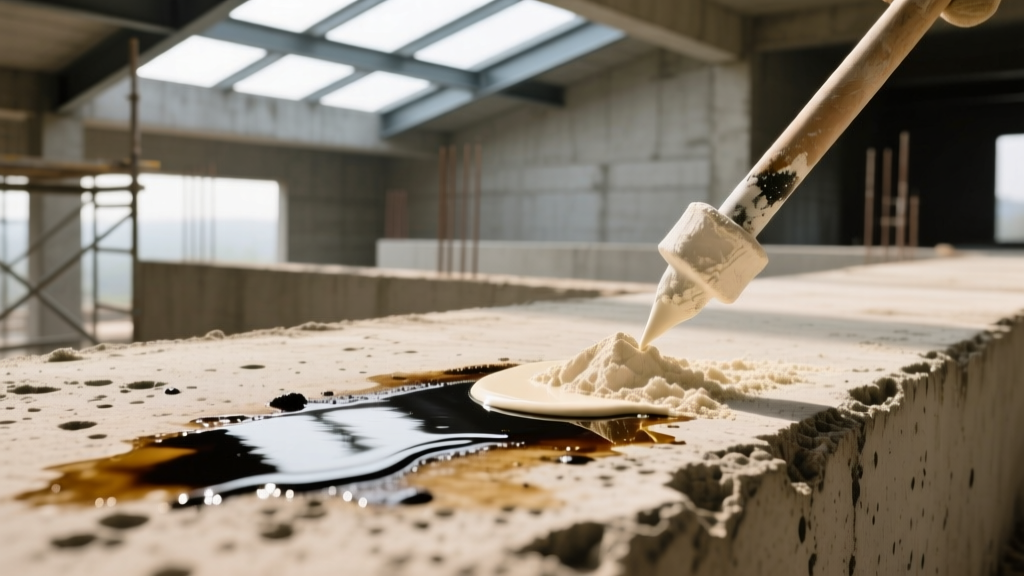
- Mix the Poultice: Combine a fast-evaporating solvent (100% pure acetone) with an absorbent powder (diatomaceous earth or kaolin clay) until it forms a paste with the consistency of peanut butter.
- Apply and Seal: Trowel the paste over the stain at a thickness of 1/4 inch. Cover the paste with 6-mil polyethylene plastic sheeting and tape the edges down with painter's tape.
- The Extraction Phase: Leave the poultice sealed for 48 hours. The acetone breaks down the oil's viscosity, and as the solvent slowly evaporates through micro-perforations in the plastic, it pulls the dissolved oil up into the clay matrix.
- Remove: Peel back the plastic and let the clay dry completely to a white powder. Scrape it off and vacuum the residue.
Never use a pressure washer above 1,500 PSI on an untreated oil stain. High-pressure water does not remove oil; it atomizes the hydrocarbons and drives them deeper into the concrete's capillary network, permanently ruining the slab's internal moisture barrier and accelerating freeze-thaw spalling.
Chemical Solvents vs. Alkaline Degreasers: Efficacy Matrix
Choosing the wrong chemical can damage the concrete matrix or fail to remove the stain. Refer to this matrix based on current 2026 product formulations and structural safety.
| Treatment Type | Best For | Dwell Time | Cost per Sq Ft | Impact on Concrete pH |
|---|---|---|---|---|
| Alkaline Degreasers (pH 11-13) | Cured stains (1-7 days) | 15-20 mins | $0.04 | Temporarily raises pH; requires acid-neutralizing rinse if sealing immediately. |
| Solvent Poultice (Acetone/Clay) | Deep penetration (Months+) | 48 hours | $0.15 | Neutral; does not alter C-S-H binder or concrete pH. |
| Enzymatic Cleaners | Light sheen / Maintenance | 12-24 hours | $0.08 | Neutral; safe for all finishes and integral color concrete. |
| Muriatic Acid (Hydrochloric) | NEVER USE FOR OIL | N/A | N/A | Destroys surface paste; does not dissolve hydrocarbons. |
Post-Extraction Sealing: Restoring the Capillary Barrier
Once the oil is fully extracted and the concrete has dried (minimum 72 hours of low humidity), the capillary pores remain vulnerable. To restore the slab's durability and prevent future hydrocarbon ingress, you must apply a penetrating sealer.
Surface acrylic sealers will trap residual moisture and peel within months if applied over previously oiled concrete. Always use a penetrating silane-siloxane sealer that chemically bonds within the pores.
For maximum lifespan extension, apply a water-based silane-siloxane sealer such as Armor SX5000 WB. Priced at approximately $65 to $80 per gallon in 2026, it covers roughly 400 square feet per gallon (approx. $0.16 to $0.20 per square foot). Unlike film-forming sealers, silane-siloxane molecules are small enough to penetrate up to 4 inches into the concrete matrix. They react with the free lime and calcium to form a hydrophobic resin deep below the surface, ensuring that future oil spills remain on the surface where they can be easily wiped away without degrading the slab.
Frequently Asked Questions on Concrete Oil Extraction
Will extracting oil damage the structural integrity of my driveway?
No. The extraction protocols outlined above target the capillary pores without altering the structural aggregate or the C-S-H binder. The American Concrete Institute (ACI) emphasizes that proper chemical cleaning is a standard maintenance procedure that preserves, rather than harms, structural integrity. The real damage comes from leaving the oil in place to trap moisture during winter freeze-thaw cycles.
How can I tell if the oil is completely gone before sealing?
Perform the water-drop test. Sprinkle clean water over the previously stained area. If the water beads up, residual oil or hydrophobic contaminants remain in the pores, and you must repeat the poultice extraction. If the water darkens the concrete and absorbs evenly at the same rate as the surrounding untreated slab, the pores are clean and ready for a silane-siloxane sealer.
Can I use dish soap instead of a commercial alkaline degreaser?
Standard dish soaps (pH 7-9) lack the alkalinity required to trigger saponification of heavy motor oils and transmission fluids. While they may remove the surface sheen, they will not break the molecular bond of the oil inside the capillary pores. You must use a high-pH (11+) concrete-specific degreaser to achieve deep extraction and protect the slab's long-term durability.