Concrete Vibrator Lifespan: Durability Analysis and Maintenance Guide
Analyze the lifespan, failure modes, and maintenance costs of concrete vibrators. Learn field-tested protocols to maximize equipment durability.
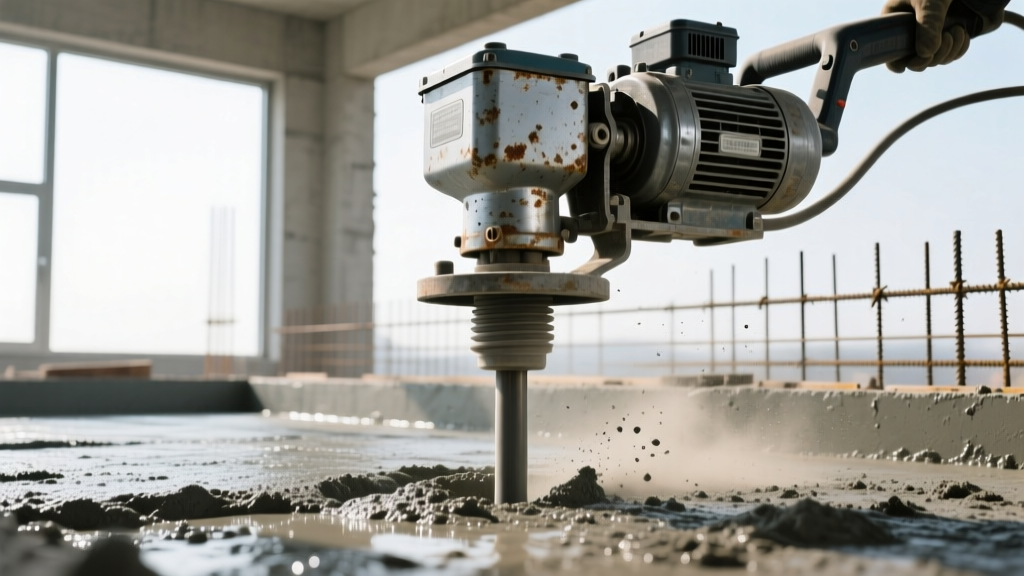
The True Lifespan of Concrete Vibrators by Type
The operational lifespan of a concrete vibrator is rarely dictated by the motor alone. In demanding commercial pours, the primary points of failure are the flexible shaft, the eccentric weight bearings in the poker head, and the carbon brushes in universal electric motors. Understanding the baseline durability of different vibrator configurations allows site supervisors to forecast replacement costs and minimize mid-pour equipment failures.
| Vibrator Type | Avg. Motor Lifespan | Avg. Shaft/Head Lifespan | Primary Wear Component | 2026 Avg. Replacement Cost |
|---|---|---|---|---|
| Electric Internal (Flex Shaft) | 2,500 - 4,000 hrs | 300 - 600 hrs | Flexible shaft core / Carbon brushes | $180 - $350 (Shaft/Head kit) |
| Pneumatic Internal | 8,000 - 12,000 hrs | 1,500 - 3,000 hrs | Air rotor vanes / Sealed bearings | $120 - $250 (Rebuild kit) |
| Gasoline Backpack | 1,500 - 2,500 hrs | 400 - 800 hrs | Centrifugal clutch / Flex shaft | $250 - $450 (Full assembly) |
| External Form Vibrator | 5,000 - 10,000 hrs | N/A (Direct mount) | Mounting bracket bolts / Motor windings | $400 - $900 (Full unit) |
According to Portland Cement Association (PCA) guidelines on consolidation, proper tool selection directly impacts both the structural integrity of the concrete and the mechanical wear on the equipment. Overworking a low-amplitude electric vibrator in high-slump mixes drastically accelerates bearing degradation.
Primary Failure Modes: Why Equipment Dies Early
Most concrete vibrator failures are not the result of manufacturing defects, but rather field abuse and improper handling. Identifying these failure modes is the first step in extending equipment longevity.
The most common cause of flexible shaft failure is bending the casing past its minimum radius. For standard 1.25-inch to 2-inch diameter shafts, the minimum bend radius is 12 inches. Forcing the shaft into a tighter 'U' shape causes the high-carbon steel inner core to unwind, delaminate, or snap, instantly destroying the shaft and potentially seizing the motor.
1. Eccentric Weight Bearing Seizure
The poker head operates at extreme speeds, typically between 10,000 and 15,000 RPM. The eccentric weight inside the head is supported by sealed ball bearings. If the outer casing is dented or the rubber boot is torn, cement slurry infiltrates the head. The alkaline slurry acts as an abrasive lapping compound, grinding the bearing races until the eccentric weight seizes. Once seized, the immense torque transfer will shear the flexible shaft core at the coupling point.
2. Motor Carbon Brush Depletion and Commutator Arcing
Electric internal vibrators utilize universal motors equipped with carbon brushes. These brushes are consumable. If operators fail to inspect the brushes every 250 hours, the brush material will completely wear away. The metal brush spring will then make direct contact with the spinning copper commutator, causing severe electrical arcing. This arcs melts the commutator bars and destroys the armature, turning a $40 brush replacement into a $400 motor replacement.
3. Reverse Rotation Core Unwinding
Flexible shaft cores are wound in a specific helical direction (usually clockwise). If a 3-phase electric motor is wired with reversed polarity, or a gas engine is modified to run in reverse, the shaft core will actively unwind under load. This causes the core to expand radially inside the casing, creating massive friction, overheating, and catastrophic casing rupture within minutes of operation.
Field-Tested Maintenance Protocols for Maximum Durability
Implementing a strict, interval-based maintenance schedule reduces unplanned downtime by up to 60%. The following protocols are derived from Wacker Neuson technical documentation and field-tested on heavy civil projects.
- Daily (Pre-Pour): Inspect the rubber coupling boot between the shaft and the poker head. Ensure the locking pin is fully seated and the cotter pin is intact. Check the power cord for exposed copper, specifically at the strain relief where the cord enters the motor housing.
- Every 50 Hours: Lubricate the flexible shaft core. Disconnect the shaft from the motor and pull the core out of the casing by approximately 12 inches. Apply a generous coating of NLGI Grade 2 lithium-complex grease. Do not use standard WD-40 or light machine oil, as these will wash out the existing heavy grease and accelerate wear.
- Every 250 Hours: Inspect motor carbon brushes. Remove the brush caps on the motor housing. If the carbon block is worn down to less than 1/4 inch (6mm) from the spring, replace both brushes simultaneously. Clean the commutator with electrical contact cleaner and a non-abrasive Scotch-Brite pad.
- Every 500 Hours: Rebuild the poker head. Disassemble the eccentric weight housing. Flush out any residual concrete dust with mineral spirits. Repack the sealed bearings with high-temperature synthetic bearing grease (such as Mobilgrease XHP 222) and replace the rubber sealing boot.
Troubleshooting Decision Tree: Diagnosing Field Failures
When a concrete vibrator stops mid-pour, rapid diagnosis is critical to save the batch. Use this diagnostic framework to identify the root cause without unnecessarily scrapping components.
- Symptom: Motor runs, but poker head does not vibrate.
- Check 1: Is the flexible shaft core sheared at the motor coupling? (Fix: Replace shaft core).
- Check 2: Is the eccentric weight seized inside the head? (Fix: Rebuild head or replace head assembly).
- Symptom: Poker head vibrates weakly and makes a grinding noise.
- Check 1: Has concrete slurry breached the head seal? (Fix: Disassemble, clean, and repack bearings).
- Check 2: Is the motor running at reduced RPM due to voltage drop? (Fix: Check generator output and extension cord gauge. A 100ft cord must be 10 AWG or thicker for a 1.5HP motor).
- Symptom: Motor hums but will not start, or trips the breaker.
- Check 1: Are the carbon brushes stuck in their holders due to concrete dust? (Fix: Clean brush tubes and replace brushes).
- Check 2: Has the flexible shaft core unwound and jammed inside the casing? (Fix: Extract core; if it cannot be pulled out, replace the entire shaft assembly).
Cost of Ownership vs. Replacement: A 5-Year Projection
Purchasing decisions for concrete vibrators are often made based on initial capital expenditure (CapEx). However, analyzing the total cost of ownership (TCO) over a 5-year period reveals that premium-grade equipment significantly outperforms budget alternatives in high-volume applications.
| Cost Metric (5-Year / 5,000 Hours) | Budget Electric Vibrator (e.g., Generic Import) | Premium Electric Vibrator (e.g., Wacker Neuson M-Series) |
|---|---|---|
| Initial CapEx (Motor + 6ft Shaft + Head) | $350 | $850 |
| Replacement Shafts/Heads (Consumables) | $900 (Requires 6 replacements) | $450 (Requires 2 replacements) |
| Motor Rebuilds / Brush Replacements | $600 (2 motor replacements) | $120 (Brush and bearing kits only) |
| Downtime Cost (Est. $500/hr delay) | $2,500 (Avg 5 hours lost to failures) | $500 (Avg 1 hour lost to maintenance) |
| Total 5-Year TCO | $4,350 | $1,920 |
As demonstrated by Federal Highway Administration (FHWA) standards on paving and structural consolidation, equipment reliability is paramount. A single vibrator failure during a continuous bridge deck pour can result in cold joints, structural rejection, and tens of thousands of dollars in remediation costs.
When to Repair vs. Replace: The 40% Rule
Site mechanics often struggle with the decision to rebuild a failed concrete vibrator or purchase a new unit. Apply the 40% Rule to make an objective, financially sound decision.
If the cost of the required replacement parts (shaft, head, brushes, bearings) plus the estimated labor time (billed at your shop rate) exceeds 40% of the cost of a brand-new, equivalent unit, scrap the old motor and buy new. Universal motors suffer from cumulative heat degradation in the stator windings. Rebuilding a motor that has experienced multiple thermal overloads will result in a unit that fails again within 200 hours.
Brand Durability Tier List for 2026 Procurement
When specifying equipment for upcoming bids, categorize your procurement based on the intensity of the pour schedule:
- Tier 1 (Heavy Civil / Daily Pours): Wacker Neuson M-Series, Minnich Flex Shafts, MBW Pneumatic. These units feature sealed, oil-bathed eccentric heads and heavy-duty universal motors designed for 10,000+ hour lifespans.
- Tier 2 (Commercial / Weekly Pours): Multiquip, Wyrick. Excellent balance of CapEx and durability. Readily available replacement parts at most regional rental yards.
- Tier 3 (Residential / Infrequent Use): Budget imports (e.g., generic 1HP 115V units). Acceptable for footings and small slabs where a mid-pour failure can be mitigated by hand-rodding or waiting for a replacement unit from a local hardware store.
Maximizing the lifespan of a concrete vibrator requires shifting the site culture from reactive replacement to proactive maintenance. By enforcing the 12-inch bend radius, adhering to the 50-hour greasing intervals, and applying the 40% repair rule, contractors can cut their consolidation equipment costs in half while ensuring every cubic yard of concrete achieves its design density.