Driveway Cost Concrete vs Asphalt: 2026 Pricing Guide
Compare 2026 driveway cost: concrete vs asphalt. Analyze upfront pricing, 30-year lifecycle costs, material specs, and climate suitability.

The Core Financial Breakdown: Upfront vs. Lifetime Costs
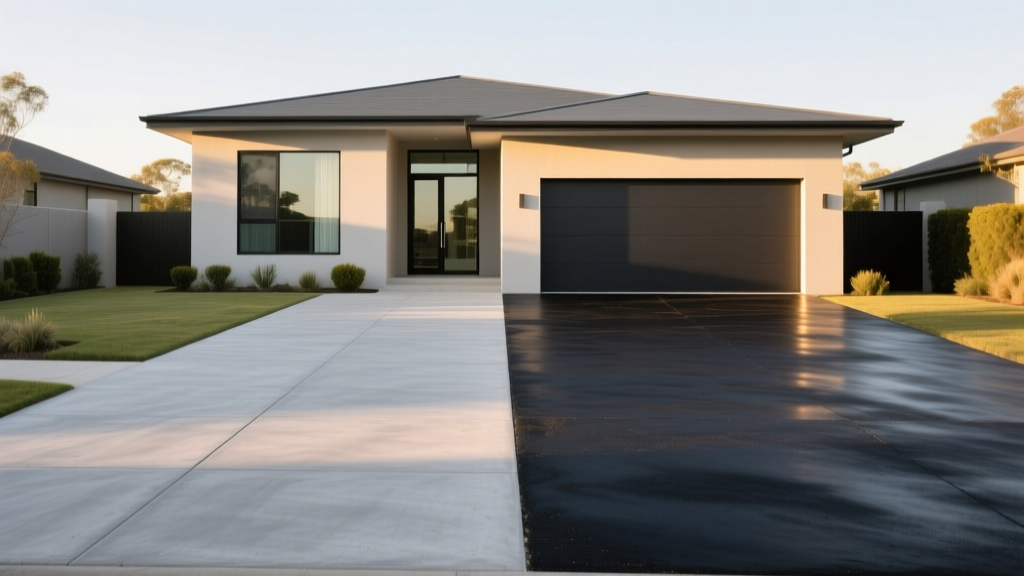
When calculating the total driveway cost, concrete vs asphalt remains the primary decision matrix for homeowners balancing immediate budgets against long-term property value. Asphalt is a flexible, petroleum-based pavement, while concrete is a rigid, cementitious structure. This fundamental difference dictates not only the initial installation price but the entire 30-year financial lifecycle of the driveway.
For a standard 600-square-foot residential driveway (approximately 10x60 feet), the 2026 national average pricing reflects recent stabilizations in raw material and fuel surcharges. Below is the comprehensive 30-year cost of ownership, assuming standard 4000 PSI concrete and PG 64-22 Hot Mix Asphalt.
| Cost Factor (600 sq ft) | Concrete (4000 PSI Broom Finish) | Asphalt (Hot Mix, 2" Surface) |
|---|---|---|
| Initial Installation | $5,400 - $8,400 ($9-$14/sq ft) | $3,000 - $4,800 ($5-$8/sq ft) |
| Sealing & Coating (30 yrs) | $1,200 - $1,800 (Every 3-5 yrs) | $3,500 - $5,000 (Every 3-5 yrs) |
| Crack & Joint Repair | $400 - $800 | $1,500 - $2,500 |
| Resurfacing / Replacement | $0 (Lasts 30-50 years) | $4,500 - $7,000 (Full replacement at yr 20) |
| 30-Year Total Cost | $7,000 - $11,000 | $12,500 - $19,300 |
Subgrade Preparation: The Hidden Equalizer
Homeowners often focus on the visible surface, but 70% of premature driveway failures stem from subgrade neglect. Both concrete and asphalt require a meticulously compacted aggregate base, though their structural demands differ.
- Concrete Base Requirements: A 4-inch layer of compacted crushed stone (typically 3/4-inch minus gravel) is standard. The rigid nature of concrete allows it to bridge minor subgrade soft spots, but it requires a uniform moisture barrier (6-mil polyethylene sheeting) beneath the slab to prevent uneven curing and curling.
- Asphalt Base Requirements: Asphalt is a flexible pavement; it relies entirely on the base for structural integrity. It requires a minimum 4-inch to 8-inch compacted aggregate base. If the base shifts, the asphalt surface will immediately mirror the depression, leading to pooling water and rapid deterioration.
Material Engineering & Performance Specifications
To accurately compare the driveway cost, concrete vs asphalt must be evaluated on engineering merit, not just surface aesthetics. Specifying the correct mix design is critical for longevity.
Concrete Driveway Engineering
A durable residential concrete driveway must be specified as a 4000 PSI (pounds per square inch) compressive strength mix. For regions experiencing freezing temperatures, the mix must be air-entrained (5% to 7% air content). This creates microscopic voids within the cement paste, giving expanding ice crystals room to grow without spalling the surface.
Reinforcement should consist of 6x6 W2.9xW2.9 welded wire mesh placed in the upper third of the slab, or #4 (1/2-inch) steel rebar on a 2-foot grid. Crucially, control joints must be saw-cut to a depth of 1 inch every 10 feet to force the concrete to crack in straight, hidden lines rather than randomly across the surface.
Asphalt Driveway Engineering
Modern asphalt driveways utilize Performance Graded (PG) binders. For most of the continental United States, a PG 64-22 binder is specified, meaning the asphalt will not rut at pavement temperatures up to 64°C (147°F) and will resist thermal cracking down to -22°C (-8°F). The surface course should be a minimum of 2 inches of Hot Mix Asphalt (HMA), compacted to at least 92% of its theoretical maximum density using a multi-ton vibratory roller. Hand-tamped edges without roller compaction will unravel within three years.
Climate & Environmental Decision Matrix
The local microclimate heavily influences which material provides the best return on investment. The EPA Heat Island Effect data highlights how surface albedo (reflectivity) impacts both the material's lifespan and the surrounding environment.
| Climate Factor | Concrete Performance | Asphalt Performance | Winner |
|---|---|---|---|
| Severe Freeze-Thaw | Excellent (if air-entrained and sealed) | Poor (becomes brittle, prone to frost heave) | Concrete |
| Extreme Summer Heat | Excellent (maintains rigidity) | Poor (softens, susceptible to tire rutting) | Concrete |
| Snow & Ice Melting | Poor (high albedo reflects sun, melts slower) | Excellent (low albedo absorbs heat, melts fast) | Asphalt |
| De-icing Salt Exposure | Poor (chlorides cause surface spalling) | Excellent (immune to chemical salt damage) | Asphalt |
| Urban Heat Island | Mitigates (reflects solar radiation) | Exacerbates (absorbs and radiates heat) | Concrete |
Maintenance Schedules & Chemical Vulnerabilities
The long-term driveway cost of concrete vs asphalt is heavily skewed by maintenance intervals and chemical vulnerabilities. Asphalt requires frequent, labor-intensive upkeep, while concrete requires less frequent but highly specific care.
The Asphalt Maintenance Timeline
- Month 6: Initial sealcoating. Asphalt is petroleum-based and begins oxidizing immediately upon installation. Waiting 6 months allows residual oils to evaporate before applying a coal tar or asphalt emulsion sealer.
- Years 1-30: Re-seal every 3 to 5 years. Annual crack filling using hot-pour rubberized crack sealant is mandatory to prevent water infiltration into the aggregate base.
- Vulnerability: Gasoline and oil drips will dissolve the asphalt binder, causing the surface to unravel and pit.
The Concrete Maintenance Timeline
- Day 28: Apply a penetrating silane/siloxane sealer after the concrete has fully cured and released its excess moisture.
- Years 1-30: Re-seal every 3 to 5 years. Control joints must be cleaned and re-caulked with self-leveling polyurethane sealant every 5 to 7 years to prevent incompressible debris (rocks, dirt) from entering the joint and causing spalling during thermal expansion.
- Vulnerability: Magnesium chloride and calcium chloride de-icers will chemically attack the cement paste. If you live in a heavy snow region, use sand for traction or potassium acetate, which is concrete-safe.
Installation Timelines: Curing vs. Cooling
Project scheduling is a critical, often overlooked factor in the driveway cost equation, particularly regarding labor minimums and property access.
Asphalt Timeline: Paving takes 1 day. Because asphalt relies on thermal cooling rather than a chemical hydration reaction, it can typically support passenger vehicle traffic within 48 to 72 hours, provided ambient temperatures are below 85°F. Heavy RVs or dump trucks should wait 14 days to prevent surface indentation.
The Final Verdict: Decision Framework
Selecting between these materials requires aligning your specific property constraints with the material's engineering strengths. According to guidelines from the American Concrete Institute (ACI) and the Asphalt Institute, neither material is universally superior; they are simply tools designed for different environments.
Choose Concrete If:
- You plan to stay in the home for 15+ years and want to minimize lifetime maintenance.
- Your region experiences extreme summer heat where asphalt rutting is a known issue.
- You park heavy vehicles (RVs, boat trailers) that exert high point-loads on the pavement.
- You want to increase the immediate appraised value and curb appeal of the property.
Choose Asphalt If:
- Your upfront budget is strictly capped, and you need a functional, paved surface immediately.
- You live in a region with heavy winter snowfall, where the black surface's thermal absorption aids in snowmelt and salt usage is high.
- Your property is heavily wooded; tree roots will eventually crack both materials, but asphalt is significantly cheaper and easier to patch and repair than concrete.
- You need garage access restored within 48 hours of installation.
Written by
Sarah WhitfieldSarah Whitfield is a chartered quantity surveyor (MRICS) and construction cost analyst with 15 years of experience in material pricing, procurement strategy, and project budgeting. She earned her degree in Construction Management from the University of Reading (UK) and has worked on projects ranging from $2M custom homes to $180M mixed-use developments across North America and Europe. Sarah currently leads cost estimating for BuildMat Insight, maintaining a proprietary database of 4,000+ material price points updated quarterly. She is a frequent contributor to RSMeans cost data panels and has presented at the International Cost Engineering Council (ICEC) congress. Based in Denver, CO, Sarah is an avid trail runner and volunteer mentor for Women in Construction.
More from Sarah Whitfield
View all
Wood & Lumber
What Are the Different Types of Wood? A Builder's Guide
Compare structural softwoods, finish hardwoods, and engineered lumber. Analyze Janka ratings, MOE values, and 2026 pricing for construction.
Aug 4, 2026

Walls & Panels
Steel Framing vs Wood Framing: Corrosion and Moisture Defense
Compare steel framing vs wood framing for moisture resistance. Learn about galvanized coatings, condensation risks, and corrosion protection strategies.
Jul 21, 2026

Stone & Masonry
How to Cut Stone Veneer: Wet Saw vs Grinder Comparison
Compare the best tools for cutting stone veneer. We review wet saws, angle grinders, and chop saws to help you achieve clean, chip-free cuts.
Jul 21, 2026