Mortar Mix vs Concrete Mix: How to Choose the Right Binder
Compare mortar mix vs concrete mix for your next project. Learn the chemical differences, ASTM standards, PSI ratings, and when to use each binder.
The Core Chemistry: Why They Aren't Interchangeable
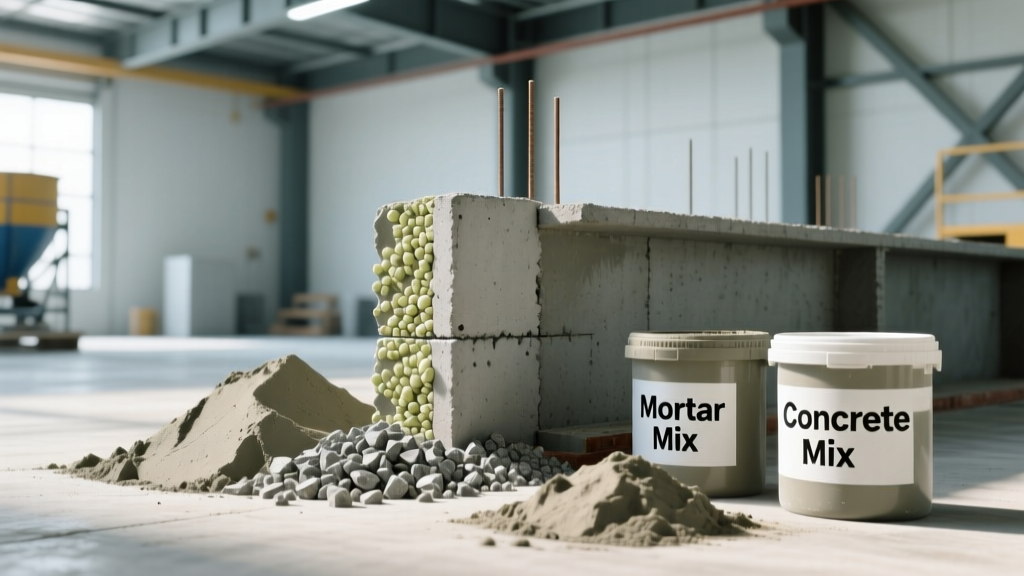
The distinction between mortar and concrete fundamentally comes down to aggregate sizing and binder composition. While both rely on Portland cement as a primary hydraulic binder, their structural roles demand entirely different physical properties. Concrete is engineered for compressive mass and structural load-bearing, requiring coarse aggregate (gravel or crushed stone up to 3/4 inch) to provide bulk and reduce shrinkage. Mortar, conversely, is designed for adhesion, flexibility, and moisture accommodation between masonry units. It omits coarse aggregate entirely, relying instead on fine sand and often hydrated lime to create a sticky, workable paste that can withstand minor structural shifts without cracking the masonry it binds.
Mortar Mix vs Concrete Mix: A Direct Comparison Matrix
Understanding the technical specifications helps clarify why these materials behave differently under load and environmental stress. The following matrix outlines the core differences based on industry standards.
| Feature | Mortar Mix | Concrete Mix |
|---|---|---|
| Primary Aggregate | Fine sand only (passing No. 4 sieve) | Fine sand + Coarse gravel (up to 3/4') |
| Secondary Binder | Hydrated lime (for workability/healing) | Fly ash or slag (optional for durability) |
| Compressive Strength | 350 PSI to 2,500 PSI | 2,500 PSI to 10,000+ PSI |
| Water-Cement Ratio | Higher (0.50 - 0.60) for stickiness | Lower (0.40 - 0.50) for strength |
| Governing Standard | ASTM C270 | ASTM C150 / ACI 318 |
Deep Dive: Mortar Mix Applications and Failure Modes
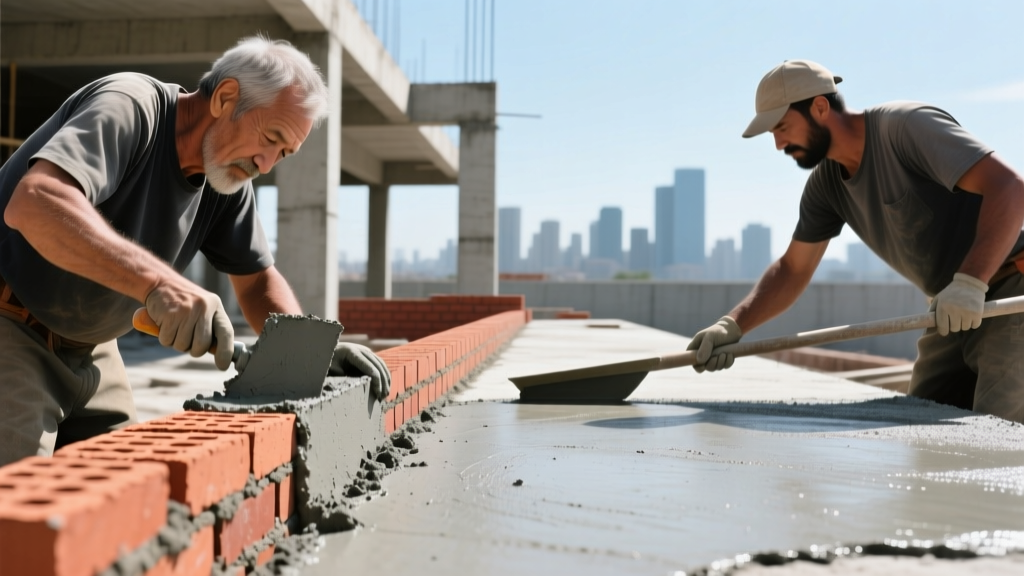
According to the Brick Industry Association (BIA), selecting the correct mortar type is dictated by the balance of compressive strength and flexural bond strength required for the specific masonry unit. Mortar is categorized by ASTM C270 into four primary types:
Type N (Normal)
A general-purpose mix containing 1 part Portland cement, 1 part lime, and 6 parts sand. It achieves a 28-day compressive strength of roughly 750 PSI. Type N is the default choice for exterior, above-grade walls exposed to normal weathering, as its moderate flexibility prevents the mortar from being stronger than the brick itself—a scenario that causes brick spalling during freeze-thaw cycles.
Type S (Special)
Formulated with 2 parts Portland cement, 1 part lime, and 9 parts sand, yielding approximately 1,800 PSI. Type S provides higher tensile bond strength, making it mandatory for below-grade masonry, retaining walls, and pavements where lateral soil pressure is a factor.
Type M (Masonry)
The strongest standard mortar (2,500 PSI), utilizing 3 parts Portland cement, 1 part lime, and 12 parts sand. It is strictly reserved for heavy-load bearing masonry, foundations, and driveways. Its high rigidity makes it unsuitable for soft, historic brick or standard veneer applications.
Deep Dive: Concrete Mix Applications and Aggregate Grading
Concrete relies on the interlocking of coarse aggregates to achieve its massive compressive strength. The National Ready Mixed Concrete Association (NRMCA) emphasizes that the water-cement (w/c) ratio is the single most critical factor in concrete durability. A standard residential mix targets a 0.45 w/c ratio, achieving a 4-inch to 5-inch slump for workability without sacrificing structural integrity.
2,500 PSI to 3,000 PSI Concrete
Used for non-structural applications such as sidewalk paths, shed slabs, and fence post footings. This mix typically utilizes 3/4-inch gravel and a standard 6% air-entrainment admixture to survive freeze-thaw cycles in northern climates.
4,000 PSI Concrete
The industry standard for residential driveways, garage floors, and structural foundations. The lower water content and higher cementitious material ratio (often supplemented with Class F fly ash) reduce permeability, protecting the internal steel rebar from chloride-induced corrosion.
The Alternative Binders: When to Use Thinset, Grout, or Masonry Cement
When comparing mortar mix vs concrete mix, it is vital to recognize the specialized alternatives that bridge the gap between structural mass and surface adhesion:
- Thinset Mortar: A polymer-modified, cement-based adhesive used exclusively for bonding tile to concrete backer boards. Unlike standard mortar, thinset contains water-retention agents (like cellulose ethers) that allow it to cure properly in thin layers (1/8 to 3/16 inch) without shrinking away from the tile.
- Cementitious Grout: Often confused with mortar, grout is designed to flow into the narrow joints between tiles. It contains no coarse aggregate but features a much higher water content and fine silica sand. It provides zero structural bonding; its sole purpose is to fill voids and prevent moisture ingress.
- Masonry Cement (ASTM C91): A pre-blended alternative to mixing Portland cement and lime separately on-site. It contains plasticizers and air-entraining agents pre-mixed at the plant. While convenient for small jobs, professional masons often avoid it for large commercial projects because it lacks the precise flexural bond strength of site-mixed Portland-lime mortars.
Real-World Cost and Yield Breakdown
Budgeting accurately requires understanding the yield differences. Because concrete contains dense, heavy gravel, it yields less volume per pound of dry mix compared to the sand-only composition of mortar.
| Product Type (Example) | Bag Weight | Yield per Bag | Avg. Retail Price |
|---|---|---|---|
| Quikrete Concrete Mix (1101) | 80 lbs | 0.60 cu. ft. | $6.50 - $7.50 |
| Quikrete Mortar Mix (1136) | 80 lbs | 0.85 cu. ft. | $8.50 - $9.50 |
| Ready-Mix Concrete (Truck) | 4,000 lbs/yd | 27.0 cu. ft. (1 yd) | $135 - $150 / yd |
Note: For projects requiring more than 1 cubic yard of concrete, ordering a ready-mix truck is exponentially more cost-effective and ensures consistent PSI batching, though short-load fees (typically $50-$75 per missing yard) will apply for partial loads.
Troubleshooting: What Happens When You Swap Them?
Misapplication of these binders leads to specific, predictable failure modes. Use this diagnostic guide to identify and rectify on-site errors.
Symptom: Brick joints are crumbling and showing white powdery residue.
Cause: The mason used concrete mix instead of mortar. The high Portland cement content without the buffering capacity of lime leads to massive efflorescence. Furthermore, the rigid concrete lacks the flexibility to absorb thermal expansion, causing micro-fractures in the joint.
Fix: Rake out the joints to a depth of 2x the joint width using a diamond blade grinder and repoint with a proper Type N or Type S lime-Portland mortar.
Symptom: A poured concrete footing is severely cracked and shrinking.
Cause: Mortar mix was used to pour a structural footing. Because mortar lacks coarse aggregate to act as a dimensional stabilizer, the high cement-to-sand ratio results in catastrophic volumetric shrinkage as the water evaporates during the curing process.
Fix: The footing must be demolished and repoured with a minimum 3,000 PSI concrete mix incorporating 3/4-inch coarse aggregate and a 0.45 w/c ratio.
Written by
Marcus ChenMarcus Chen is a licensed structural engineer (PE) and building materials analyst with over 12 years of experience across residential, commercial, and industrial construction. He holds a Master of Science in Civil Engineering from UC Berkeley and spent six years at Thornton Tomasetti before transitioning to independent consulting and technical writing. Marcus specializes in material selection for seismic-prone regions, concrete reinforcement strategies, and lifecycle cost analysis. His work has been cited by the American Concrete Institute (ACI) and the Structural Engineers Association of California (SEAOC). When he is not on a job site or at his desk, you will find him hiking the Sierra Nevada or restoring a 1920s craftsman bungalow in Oakland, CA.
More from Marcus Chen
View all
Construction Cost
How Much Did the Eiffel Tower Cost to Build?
How much did the Eiffel Tower cost to build in 1889? We adjust for inflation and compare its budget to modern skyscraper construction.
Aug 4, 2026

Fire Resistance
What Is a Fire Resistant Material? Testing & Certification Guide
Discover what is a fire resistant material through ASTM and UL testing. Learn how fire ratings, certifications, and assemblies work in construction.
Aug 4, 2026

Construction Cost
How Much Did the Burj Khalifa Cost to Build?
How much did the Burj Khalifa cost to build? We break down the $1.5B project and extract 5 money-saving strategies for your next build.
Jul 30, 2026