Types of Concrete Trucks: Matching the Right Mixer to Your Project
Explore the main types of concrete trucks and learn how to match the right mixer, from standard transit to volumetric, to your specific construction project.

Standard Transit Mixers: The High-Volume Workhorse
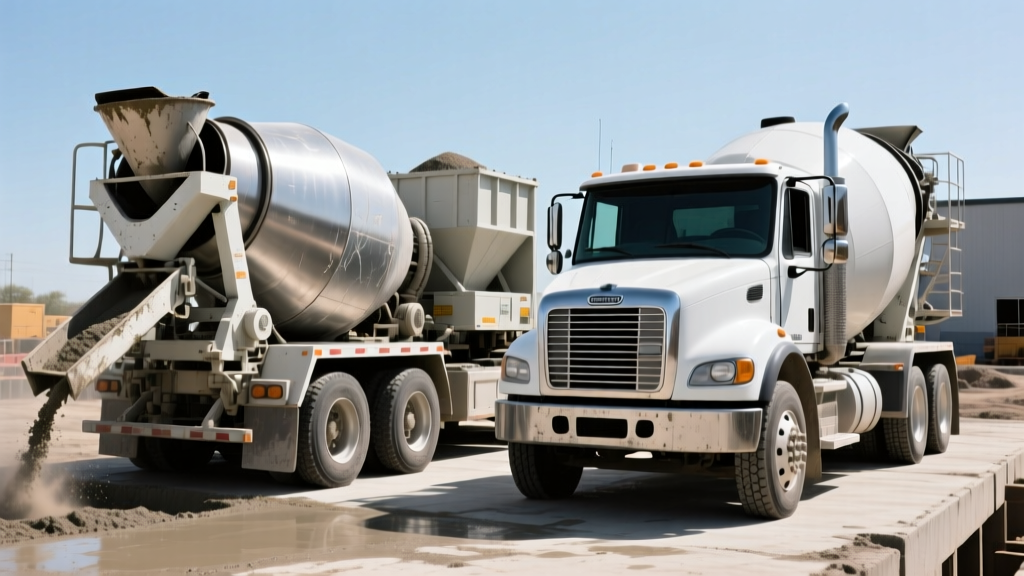
When evaluating the different types of concrete trucks, the rear-discharge transit mixer is the industry default for high-volume commercial and residential pours. These trucks feature a rotating drum that agitates the concrete during transit, preventing segregation and initial set. Standard transit mixers typically carry between 8 and 10 cubic yards of concrete, though specialized 10x4 (ten wheels, four steering) configurations with booster axles can legally haul up to 12 cubic yards depending on state bridge laws.
Application Showcase: Large-Scale Flatwork and Foundations
Transit mixers excel in continuous, high-volume applications such as commercial slab-on-grade pours, mat foundations, and highway paving. Because the concrete is batched at a central plant, quality control for compressive strength (e.g., 4,000 PSI to 5,000 PSI mixes) and slump consistency is highly precise. However, project managers must strictly adhere to the 90-minute discharge window mandated by ASTM C94 standards. If traffic delays push the transit time beyond this limit, the batch may experience severe slump loss, requiring unauthorized water addition at the site, which compromises the water-cement ratio and ultimate structural integrity.
Volumetric Concrete Mixers: On-Demand Precision Batching
Volumetric mixers are essentially mobile batch plants mounted on a truck chassis. Instead of carrying pre-mixed concrete, these trucks carry separate compartments for sand, stone, cement, and water. The materials are proportioned and mixed on-site via a continuous auger system, discharging only the exact amount of concrete required.
Application Showcase: Remote Sites and Multi-Phase Pours
The primary advantage of volumetric trucks is the elimination of the 90-minute transit clock. This makes them the mandatory choice for remote rural builds, military installations, or sites located more than 45 minutes from the nearest batch plant. They are also highly cost-effective for projects requiring multiple small pours throughout the day, such as setting fence posts, pouring isolated footings, or executing phased sidewalk replacements. Because you only pay for the exact yardage mixed, volumetric trucks completely eliminate the "short-load" penalties associated with standard transit mixers.
Mini Mixers and Rough-Terrain Trucks: Navigating Tight Access
Standard transit mixers require wide turning radii and stable, heavy-duty access roads. A fully loaded 10-yard truck can exert a Gross Vehicle Weight (GVW) of up to 80,000 lbs, which will easily crush standard residential driveways or sink into uncompacted subgrades. For constrained environments, mini mixers (carrying 1 to 4 cubic yards) and rough-terrain concrete trucks provide critical access solutions.
Application Showcase: Residential Retrofits and Off-Grid Terrain
Mini mixers, often built on single-axle or compact 4x4 chassis, are designed to navigate narrow alleyways, pass through standard 8-foot residential gates, and drive over existing landscaping without causing catastrophic soil compaction. Rough-terrain mixers feature articulated steering, heavy-lug tires, and all-wheel drive, allowing them to deliver 4 to 6 cubic yards of concrete to steep hillside builds, agricultural sites, and unpaved rural properties where standard highway trucks would immediately lose traction.
Concrete Pump Trucks: Overcoming Elevation and Reach Barriers
While not mixers themselves, concrete pump trucks are an essential category when specifying delivery equipment for complex geometries. Pump trucks receive concrete from a transit mixer and push it through a pipeline to the exact placement location.
- Boom Pumps: Feature a remote-controlled, multi-section robotic arm (boom) mounted on a truck chassis. Booms range from 20 meters to over 60 meters in reach. They are ideal for high-rise cores, elevated decks, and deep basement walls where crane-and-bucket methods are too slow.
- Line Pumps (Trailer Pumps): Use flexible steel or rubber hoses laid manually across the ground. According to the American Concrete Pumping Association, line pumps can push concrete horizontally up to 150 meters or vertically up to 50 meters, making them perfect for swimming pools, ground-level slabs behind existing structures, and low-rise masonry grouting.
Equipment Comparison Matrix
| Truck Type | Typical Capacity | Ideal Application | Primary Limitation |
|---|---|---|---|
| Standard Transit Mixer | 8 - 10 cu. yds. | Commercial flatwork, continuous foundations | 90-minute discharge limit; high GVW |
| Volumetric Mixer | 10 - 12 cu. yds. | Remote sites, multi-phase pours, exact yardage | Requires strict on-site calibration oversight |
| Mini Mixer | 1 - 4 cu. yds. | Residential backyards, narrow access, interior floors | High cost per cubic yard; slow discharge rate |
| Rough-Terrain Mixer | 4 - 6 cu. yds. | Steep grades, unpaved rural sites, agricultural | Lower top speed; limited highway transit range |
Decision Framework: Specifying the Right Equipment
Choosing the correct truck requires a systematic evaluation of site constraints, structural requirements, and financial variables. Use the following framework during the pre-construction planning phase.
1. Evaluate Ground Bearing Capacity and Access
Before ordering a standard transit mixer, verify the subgrade bearing capacity of the access route. The Federal Highway Administration Bridge Formula dictates weight distribution, but local soils dictate reality. A fully loaded 10-yard truck exerts roughly 12,000 lbs per axle. If the truck must cross a newly backfilled trench, a septic field, or soft clay, specify a mini mixer or plan for temporary steel road plates (minimum 1-inch thick) to distribute the point loads and prevent the truck from becoming high-centered.
2. Calculate Short-Load and Washout Fees
Standard batch plants operate on a minimum order volume, typically 4 to 5 cubic yards. If your project requires 3 yards, you will be hit with a "short-load fee," which can range from $50 to $150 per missing yard. Furthermore, transit mixers must wash their drums after discharge. If your site lacks a designated, EPA-compliant washout pit, the supplier will charge a washout fee (often $50 to $100) to take the residual slurry back to the plant. In these scenarios, switching to a volumetric mixer instantly eliminates both fees, as they mix only what is needed and wash out directly into your formed work area.
3. Factor in Pump Integration for Complex Formwork
If your application involves deep elevator pits, narrow retaining walls, or elevated decks, the transit mixer's chute (which typically only reaches 8 to 10 feet) will be insufficient. Budget for a concrete pump truck in addition to the mixer. Boom pumps require significant setup space (outrigger pads extend up to 24 feet wide) and must be positioned on stable, level ground. If site footprint is restricted, specify a line pump and allocate labor for manually dragging and cleaning the heavy steel hoses post-pour.
Written by
Marcus ChenMarcus Chen is a licensed structural engineer (PE) and building materials analyst with over 12 years of experience across residential, commercial, and industrial construction. He holds a Master of Science in Civil Engineering from UC Berkeley and spent six years at Thornton Tomasetti before transitioning to independent consulting and technical writing. Marcus specializes in material selection for seismic-prone regions, concrete reinforcement strategies, and lifecycle cost analysis. His work has been cited by the American Concrete Institute (ACI) and the Structural Engineers Association of California (SEAOC). When he is not on a job site or at his desk, you will find him hiking the Sierra Nevada or restoring a 1920s craftsman bungalow in Oakland, CA.
More from Marcus Chen
View all
Construction Cost
How Much Did the Eiffel Tower Cost to Build?
How much did the Eiffel Tower cost to build in 1889? We adjust for inflation and compare its budget to modern skyscraper construction.
Aug 4, 2026

Fire Resistance
What Is a Fire Resistant Material? Testing & Certification Guide
Discover what is a fire resistant material through ASTM and UL testing. Learn how fire ratings, certifications, and assemblies work in construction.
Aug 4, 2026

Construction Cost
How Much Did the Burj Khalifa Cost to Build?
How much did the Burj Khalifa cost to build? We break down the $1.5B project and extract 5 money-saving strategies for your next build.
Jul 30, 2026