Crushed Concrete vs Crushed Asphalt: Base Material Comparison
Compare crushed concrete vs crushed asphalt for driveway and pad bases. Expert analysis on load-bearing, drainage, and 2026 pricing.

The Recycled Aggregate Showdown: Core Material Profiles
When engineering a stable sub-base for driveways, commercial pads, or access roads, specifying the right recycled aggregate dictates the lifespan of the surface above it. The debate of crushed concrete vs crushed asphalt centers on two distinct recycled materials: Recycled Concrete Aggregate (RCA) and Recycled Asphalt Pavement (RAP). While both divert waste from landfills and reduce reliance on virgin quarried stone, their mechanical behaviors, chemical properties, and installation requirements differ drastically.
Material Definitions
- Crushed Concrete (RCA): Sourced from demolished structures, pavements, and footings. It is crushed, screened, and typically passed through a magnetic separator to remove rebar. It behaves similarly to virgin crushed limestone but retains residual cementitious properties.
- Crushed Asphalt (RAP): Sourced from milled road surfaces. It consists of stone aggregates coated in asphalt binder (bitumen). Unlike RCA, RAP is temperature-sensitive and can partially re-bond when compacted under heat and pressure.
Head-to-Head Matrix: Crushed Concrete vs Crushed Asphalt
The following matrix contrasts the physical and economic properties of RCA and RAP against a baseline of virgin crushed stone (typically #57 or #304 limestone) for base course applications.
| Property / Metric | Crushed Concrete (RCA) | Crushed Asphalt (RAP) | Virgin Crushed Stone (Baseline) |
|---|---|---|---|
| Average Cost (2026) | $18 - $28 per ton | $12 - $22 per ton | $35 - $50 per ton |
| California Bearing Ratio (CBR) | 85 - 110+ | 70 - 95 | 90 - 120 |
| Max Dry Density (ASTM D1557) | 135 - 145 pcf | 110 - 125 pcf | 130 - 140 pcf |
| Permeability / Drainage | High (Excellent drainage) | Low to Moderate (Water-resistant) | High |
| Compaction Behavior | Mechanical interlock; rigid | Viscoelastic; heat-assisted bonding | Mechanical interlock; rigid |
| pH Impact on Surroundings | Highly alkaline (pH 9-12) | Neutral to slightly acidic | Neutral (pH 7-8) |
Structural Performance and Load-Bearing Capacities
The primary function of a base layer is to distribute surface loads into the subgrade without excessive deflection. Here, crushed concrete holds a distinct mechanical advantage. Because RCA consists of fractured, highly angular faces, it achieves exceptional mechanical interlock when compacted. According to guidelines published by the Environmental Protection Agency (EPA) regarding construction and demolition debris recycling, properly graded RCA meets or exceeds the structural requirements of ASTM D2940 for highway bases.
Crushed asphalt, conversely, relies on a combination of mechanical friction and bituminous cohesion. The residual asphalt cement (typically comprising 3% to 7% of the RAP mix) acts as a lubricant during initial compaction but stiffens upon cooling. In high-load scenarios—such as commercial truck aprons or heavy equipment pads—RAP's viscoelastic nature can lead to rutting under static loads, especially when ambient temperatures exceed 85°F. However, for standard residential driveways and light agricultural access roads, the CBR values of RAP (typically 70-95) are more than sufficient to prevent subgrade failure.
The Compaction Variable
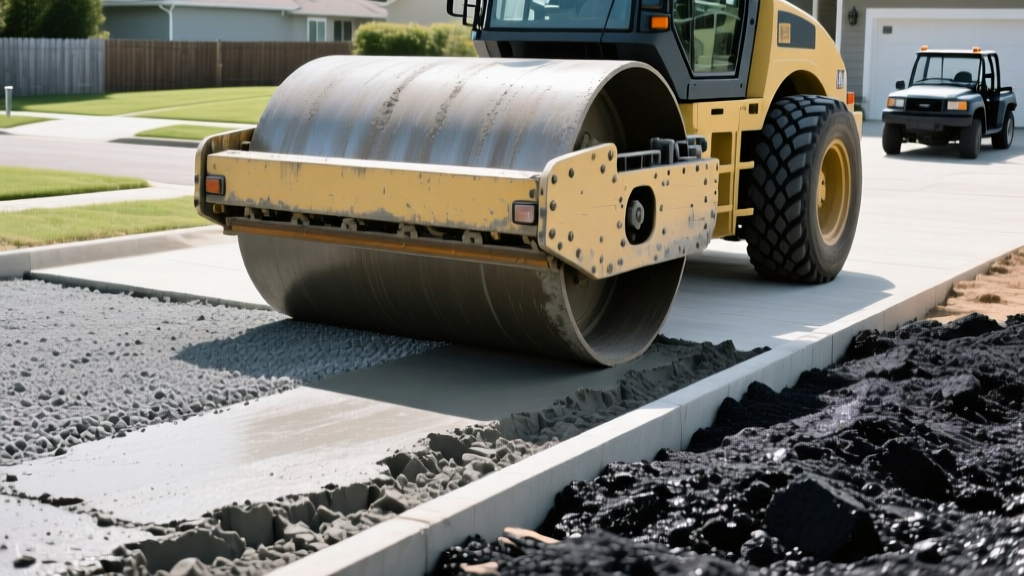
Contractors must adjust their rolling patterns based on the material. RCA requires high-amplitude vibratory rollers to shatter minor high-points and force the angular aggregate into a dense matrix. RAP requires static or low-amplitude vibratory rolling; excessive vibration can fracture the existing asphalt coating, turning the material into loose, unbound sand. Furthermore, RAP achieves its highest density when rolled during the heat of the day, allowing the bitumen to soften slightly and re-seal the aggregate matrix.
Cost Analysis: 2026 Pricing and Lifecycle Economics
Material costs for recycled aggregates fluctuate based on regional availability, proximity to demolition sites, and local landfill tipping fees. In 2026, the national average pricing for delivered materials (within a 20-mile radius of the recycler) breaks down as follows:
- Crushed Asphalt (RAP): $12 to $22 per ton. RAP is generally cheaper because the milling process is continuous and tied to municipal road resurfacing schedules, creating massive, consistent stockpiles.
- Crushed Concrete (RCA): $18 to $28 per ton. RCA requires more intensive processing, including primary jaw crushing, secondary impact crushing, and magnetic separation to remove steel reinforcements, driving up the processing cost.
- Installation & Spreading: Expect to pay $1.50 to $3.00 per square foot for professional grading, spreading, and compaction of either material, assuming a standard 6-inch compacted depth.
Volume vs. Weight Purchasing
Always verify whether your supplier is quoting by the ton or by the cubic yard. Because RAP is significantly lighter (approx. 115 lbs per cubic foot) than RCA (approx. 140 lbs per cubic foot), a cubic yard of RAP will yield less structural mass. For base courses, always specify and purchase by the ton to ensure you receive the required structural weight.
Environmental Impact and Site Chemistry
Both materials score high on sustainability metrics, reducing the need for virgin aggregate extraction. The National Asphalt Pavement Association (NAPA) consistently reports that asphalt is the most recycled material in the United States by volume. However, site-specific chemistry must dictate your choice.
The Alkalinity Factor: Crushed concrete contains unhydrated Portland cement. When exposed to moisture, it leaches calcium hydroxide, raising the pH of surrounding soil and runoff water to levels between 9 and 12. If your base course is adjacent to sensitive landscaping, acidic-soil-loving plants, or natural wetlands, RCA can cause severe root burn and ecological disruption. Crushed asphalt does not exhibit this alkalinity, making it safer for heavily landscaped environments, though it can leach trace amounts of polycyclic aromatic hydrocarbons (PAHs) if placed directly over unprotected aquifers.
Application-Specific Decision Framework
Use the following conditional logic to select the correct material for your specific project parameters:
Scenario A: Heavy-Duty Commercial Pad or RV Storage
- Requirement: High CBR, resistance to point-loads (e.g., RV jacks, forklift wheels), zero rutting in summer heat.
- Verdict: Crushed Concrete (RCA). Specify a 1.5-inch minus gradation with a minimum of 80% fractured faces. Compact in 4-inch lifts to achieve a 12-inch total base depth.
Scenario B: Rural Driveway with Poor Subgrade Drainage
- Requirement: Material must resist washing out, shed surface water, and remain stable in muddy conditions.
- Verdict: Crushed Asphalt (RAP). The residual bitumen makes RAP highly hydrophobic. Water will sheet off the compacted surface rather than infiltrating and softening the clay subgrade below. Grade the surface with a 2% cross-slope to encourage runoff.
Scenario C: Retaining Wall Backfill or French Drain Bedding
- Requirement: High permeability, no chemical leaching, no fines that can clog drainage pipes.
- Verdict: Neither. Both RCA and RAP contain fines that can migrate and clog geotextiles or perforated pipes. Furthermore, RCA's high pH can degrade certain drainage components. Use clean, washed #57 or #67 virgin limestone or washed river gravel instead.
Common Installation Pitfalls and Mitigation Strategies
Even with the correct material selected, improper handling leads to base failure. Watch for these specific edge cases:
- Contamination in RCA: Not all recyclers use overhead magnetic separators. Inspect your RCA delivery for drywall chunks, wood splinters, and wire mesh. Organic matter trapped in the base will decompose, creating voids that lead to surface sinkholes. Reject loads containing more than 1% visible non-mineral debris.
- Summer Tracking of RAP: If crushed asphalt is used as a final surface course (rather than a base beneath paving), the bitumen softens in direct sunlight. Tires will pick up the material and track it onto garage floors or carpets. Mitigate this by applying a 1-inch top-dressing of clean, sharp sand or stone dust and rolling it into the surface to lock the binder.
- Moisture Content During Compaction: RCA requires optimal moisture content (typically 8% to 12%) to achieve maximum Proctor density. If delivered bone-dry in the summer, the contractor must introduce water via a water truck during the spreading phase. Attempting to compact dry RCA results in a loose, unstable layer that will consolidate unevenly under traffic.
Selecting between crushed concrete and crushed asphalt is not a matter of finding a universally 'better' product, but rather matching the material's intrinsic mechanical and chemical properties to the load, drainage, and environmental demands of the specific site.
Written by
Elena RodriguezElena Rodriguez is a civil engineer and technical writer specializing in concrete technology, masonry systems, and ASTM/ACI compliance. She earned her B.S. in Civil Engineering from Texas A&M University and spent a decade at a materials testing laboratory, performing over 2,000 concrete compressive strength tests and masonry prism evaluations. Elena is an ACI-certified Field Testing Technician (Grade I) and a member of ASTM Committee C12 on Natural Building Stone. She currently consults on forensic engineering cases involving concrete failures and moisture intrusion. Based in San Antonio, TX, Elena is a proud member of the Society of Women Engineers (SWE) and coaches her daughter's FIRST Robotics team.
More from Elena Rodriguez
View all
Walls & Panels
Cost Analysis: Light Gauge Steel Framing Advantages and Disadvantages
Evaluate light gauge steel framing advantages and disadvantages through a strict cost analysis lens, comparing material, labor, and lifecycle expenses.
Aug 4, 2026

Walls & Panels
Gypsum Board Types: Exact Specifications, Thickness & Dimensions
Compare standard, Type X, and moisture-resistant gypsum board types. Get exact specifications, thicknesses, dimensions, and ASTM standards for your project.
Aug 4, 2026

Fire Resistance
Best Fire-Resistant Outdoor Decking Materials: 2026 Buyer Guide
Discover the best fire-resistant outdoor decking materials for 2026. Compare Class A PVC, aluminum, and hardwood options for WUI compliance and safety.
Aug 4, 2026