Dry Pour vs Wet Pour Concrete: Complete Selection Guide
Compare dry pour vs wet pour concrete mixes. Discover structural strengths, ideal applications, cost differences, and placement techniques for projects.

The fundamental distinction between dry pour and wet pour concrete lies in the water-to-cement (w/c) ratio and the resulting workability, or 'slump.' While both utilize the same core binders and aggregates, their physical states dictate entirely different mixing equipment, placement techniques, structural outcomes, and cost profiles. Selecting the wrong consistency for a specific application leads to catastrophic failure modes, ranging from honeycombing in structural elements to plastic shrinkage cracking in flatwork.
This guide provides a technical breakdown of dry pour (zero-slump/dry-pack) and wet pour (plastic/high-slump) concrete, equipping contractors and engineers with the precise specifications required for material selection.
The Science of Slump: Defining the Mixes
Dry Pour (Zero-Slump / Dry-Pack)
Dry pour concrete is characterized by a remarkably low w/c ratio, typically between 0.30 and 0.38. When tested per ASTM C143 (Standard Test Method for Slump of Hydraulic-Cement Concrete), these mixes exhibit a slump of 0 to 1 inch. The mixture holds its shape when formed and relies on mechanical interlock rather than fluid flow to fill voids. Because water is the primary driver of capillary porosity, restricting it yields exceptionally high compressive strengths (often exceeding 6,000 psi) and minimal drying shrinkage.
Wet Pour (Plastic / High-Slump)
Wet pour concrete features a higher w/c ratio, generally ranging from 0.40 to 0.55, yielding a slump of 4 to 8 inches. This fluidity allows the mix to flow around complex rebar configurations and fill deep, narrow forms under its own weight or with minimal vibration. Modern wet pours frequently utilize High-Range Water Reducers (HRWRs), or superplasticizers, to achieve high flowability without proportionally increasing the water content, thereby maintaining structural integrity while maximizing workability.
Structural & Performance Matrix
| Property | Dry Pour (Zero-Slump) | Wet Pour (Plastic/High-Slump) |
|---|---|---|
| Water-Cement Ratio | 0.30 – 0.38 | 0.40 – 0.55 |
| ASTM C143 Slump | 0 – 1 inch | 4 – 8 inches |
| Compressive Strength | 5,000 – 8,000+ psi | 3,000 – 5,000 psi |
| Drying Shrinkage | Very Low (Excellent dimensional stability) | Moderate to High (Requires jointing/curing) |
| Mixing Equipment | Pan mixers, planetary mixers (forced action) | Transit drum mixers, gravity mixers |
| Placement Method | Vibratory pressing, heavy tamping, roller compaction | Chute placement, pumping, internal vibration |
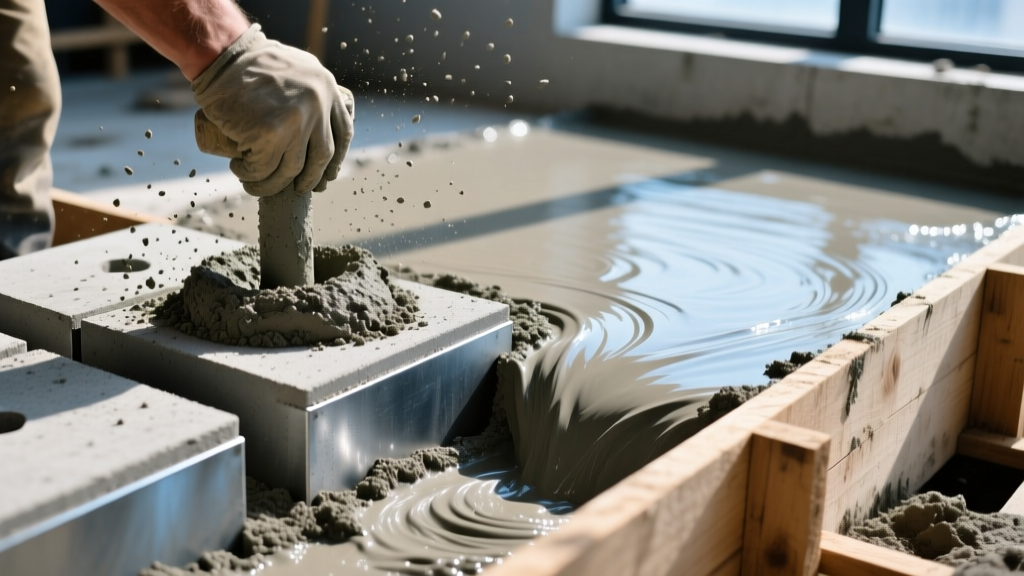
Equipment & Placement Mechanics
The physical state of the mix dictates the machinery required on-site. Attempting to mix a dry pour in a standard revolving drum mixer will result in unmixed clumps and severe segregation.
Dry Pour Compaction Requirements
Dry mixes require forced-action mixers (such as pan or planetary mixers) that use high-shear blades to coat aggregates with the minimal available water. During placement, dry pour cannot be consolidated with standard pencil vibrators. It requires heavy-duty mechanical compaction: hydraulic vibratory presses (for pavers and blocks), heavy plate compactors, or intensive manual tamping. Failure to apply sufficient compactive energy results in honeycombing—large, unfilled voids that destroy the element's load-bearing capacity.
Wet Pour Consolidation Protocols
Wet mixes are designed for gravity-fed drum mixers and transit trucks. Placement relies on internal vibrators (spud vibrators) to liquefy the mix temporarily, allowing entrapped air to escape. Over-vibration is a critical risk; vibrating a wet pour for too long causes aggregate segregation, where heavy stones sink to the bottom and a weak, watery layer of cement paste (laitance) rises to the surface, creating a highly dust-prone and weak wearing surface.
Cost & Labor Analysis (2026 Baselines)
Pricing varies based on regional aggregate availability and admixture costs. The following table outlines average commercial baselines for 2026.
| Cost Factor | Wet Pour (Ready-Mix) | Dry Pour (Batch/Mixed) |
|---|---|---|
| Material Cost (per CY) | $145 – $175 | $160 – $210 (Higher cement content & admixtures) |
| Delivery/Transit | Standard transit mixer rates apply | Often mixed on-site or delivered via specialized hoppers |
| Labor Intensity | Low to Moderate (Screeding and floating) | High (Requires heavy tamping, machine pressing) |
| Equipment Rental | Vibrators, power screeds ($150-$250/day) | Pan mixers, hydraulic tampers ($400-$800/day) |
Application Decision Framework
Use the following parameters to determine the correct mix consistency for your project scope.
When to Specify Dry Pour
- Precast Manufacturing: Concrete masonry units (CMUs), paving stones, and retaining wall blocks require zero-slump mixes so they can be immediately stripped from molds without collapsing.
- Steep Slopes & Grade Beams: When pouring on inclines greater than 15 degrees, wet concrete will slump and segregate. Dry-pack concrete stays in place while being tamped.
- Mortar Beds & Topping Slabs: Thick-bed shower pans and heavy-duty industrial topping slabs utilize dry-pack to minimize shrinkage and prevent curling at the edges.
- Post-Setting: Setting structural posts or fence poles directly in the earth often utilizes dry pour, where the mix absorbs ambient ground moisture to cure slowly and lock the post in place without the mess of wet mud.
When to Specify Wet Pour
- Cast-in-Place Foundations: Footings, stem walls, and deep piers require fluid mixes to flow around dense rebar cages and fill deep, narrow trenches.
- Flatwork & Slabs: Driveways, patios, and interior floors require a 4-to-5-inch slump to allow for laser screeding, bull floating, and trowel finishing.
- Pumped Applications: High-rise columns or inaccessible backyard pools require highly flowable wet mixes (often pumped via boom pumps) that can travel through 4-inch steel lines without clogging.
Common Failure Modes & Edge Cases
Understanding how these mixes fail in the field is critical for quality assurance.
- The 'Adding Water on Site' Trap (Wet Pour): Field crews frequently add water to the back of the transit truck to make the wet pour easier to rake. Adding just one gallon of water per cubic yard to a 0.45 w/c mix can reduce compressive strength by up to 200 psi and increase shrinkage cracking by 10%. Solution: Mandate the use of HRWR admixtures at the batch plant if higher flowability is needed, strictly prohibiting site-added water.
- Lamination and Cold Joints (Dry Pour): Because dry pour lacks fluidity, it does not naturally bond to a previous lift if there is a delay in placement. If a dry-pack topping slab is placed over a base layer that has begun its initial set, a structural delamination (cold joint) will occur. Solution: Apply a neat cement grout bond coat immediately before placing the dry mix, and maintain continuous placement operations.
- Plastic Shrinkage Cracking (Wet Pour): Wet pours are highly susceptible to rapid surface evaporation on hot, windy days. If the rate of evaporation exceeds 0.2 pounds per square foot per hour, microscopic plastic shrinkage cracks will form before the concrete even hardens. Solution: Deploy windbreaks, apply evaporation retardants (monomolecular films), and initiate wet curing immediately after final set.
Quality Control & Sourcing Standards
Procurement and testing must align with established industry benchmarks. For wet pours, always verify the batch ticket to confirm the w/c ratio and ensure slump tests are conducted per National Ready Mixed Concrete Association (NRMCA) guidelines upon truck arrival. For dry mixes utilized in precast or block manufacturing, compressive strength validation via ASTM C39 cylinder testing is mandatory to verify the compaction energy applied by the machinery is sufficient.
When designing custom mix proportions, engineers should consult the Portland Cement Association's mix design protocols to balance the competing demands of workability, durability, and ultimate strength. Furthermore, adherence to the American Concrete Institute (ACI) 318 Building Code ensures that the specified mix consistency aligns with the structural demands and environmental exposure classes of the project.
Ultimately, the choice between dry pour and wet pour is not a matter of preference, but a strict engineering decision dictated by the geometry of the formwork, the density of the reinforcement, and the required mechanical properties of the hardened matrix.
Written by
David NakamuraDavid Nakamura is a licensed architect (AIA) and construction technology writer focused on sustainable building methods, mass timber engineering, and high-performance building envelopes. He holds a Master of Architecture from the University of Washington and is a certified Passive House Consultant (CPHC). David spent eight years at the Seattle firm Mithun, where he led the design of three LEED Platinum projects, before founding his own practice specializing in net-zero residential design. He serves on the editorial advisory board of GreenBuilder Magazine and has authored peer-reviewed papers on cross-laminated timber (CLT) connections for the Journal of Structural Engineering. In his spare time, David teaches woodworking at Pratt Fine Arts Center and kayaks the Puget Sound.
More from David Nakamura
View all
Construction Cost
Labor Cost to Build a Deck Per Sq Ft: 2026 Installation Guide
Discover the exact labor cost to build a deck per sq ft in 2026. This installation guide breaks down contractor rates, complexity factors, and hidden fees.
Aug 4, 2026

Construction Cost
How Much Does It Cost to Build a 3 Bedroom House? Financing Guide
Learn exactly how much it costs to build a 3 bedroom house and explore 2026 financing options, construction loan types, and budget frameworks for your build.
Aug 4, 2026

Construction Cost
Cost to Build a Tennis Court: 2026 Guide
How much does it cost to build a tennis court in 2026? Breakdowns for asphalt, concrete, and synthetic surfaces plus fencing and lighting.
Jul 30, 2026