Polished Concrete vs Epoxy Floor: Ultimate Durability & Cost Guide
Compare polished concrete vs epoxy floor systems. Explore 2026 costs, MVT failure modes, diamond grinding specs, and the best choice for your space.

The Core Difference: Metallurgical vs. Chemical Bonding
When evaluating polished concrete vs epoxy floor systems, facility managers and homeowners often conflate two fundamentally different technologies. Polished concrete is a metallurgical process that alters the physical surface of the existing slab using mechanical diamond abrasives and chemical densifiers. Epoxy flooring is a chemical coating system that relies on a topical, sacrificial resin layer bonded to the concrete substrate. Understanding this distinction is critical, as it dictates the failure modes, maintenance cycles, and ultimate lifespan of the installation.
• Choose Polished Concrete for: High-traffic warehouses, retail showrooms, forklift aisles, and spaces requiring low-VOC, zero-delamination risk.
• Choose Epoxy/Polyaspartic for: Residential garages, commercial kitchens, chemical processing areas, and spaces requiring seamless cove bases or specific chemical resistance.
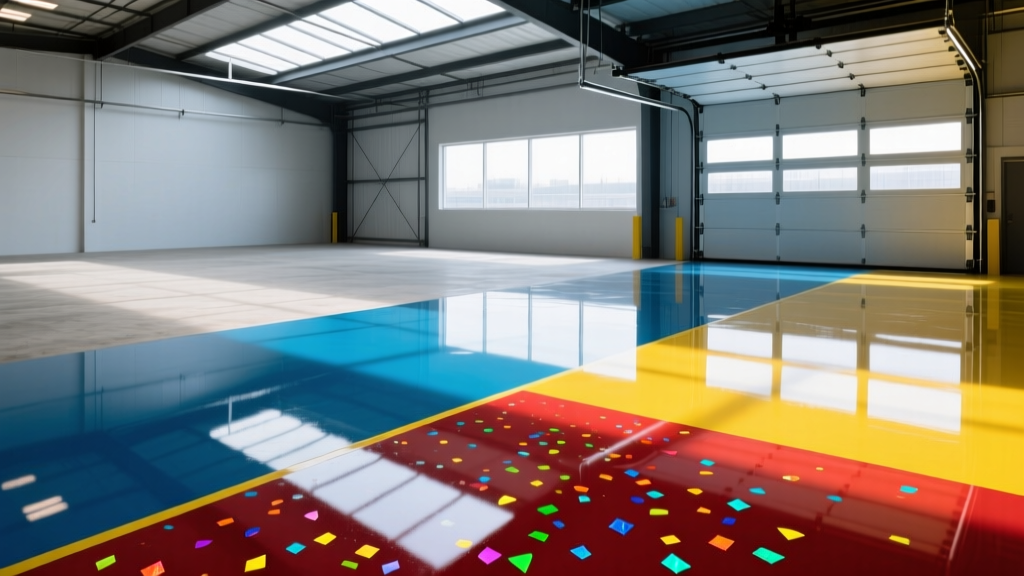
Polished Concrete: Performance, Chemistry, and Failure Modes
Modern concrete polishing is not simply buffing the floor. It requires a multi-step grinding sequence, typically starting with 30- or 40-grit metal-bond diamonds to cut the surface and expose the desired aggregate level (ranging from Level 1 'Cream' to Level 4 'Large Aggregate'). The process concludes with resin-bond diamonds up to 3000-grit to achieve the specified gloss reading.
The Densification Process: Lithium vs. Sodium Silicate
The structural integrity of a polished floor relies heavily on the chemical densifier applied during the 200- to 400-grit stages. Densifiers react with the free lime (calcium hydroxide) in the concrete to form calcium silicate hydrate (CSH), filling the microscopic pores. According to guidelines from the Concrete Polishing Council (CPC), lithium silicate densifiers are now the industry standard over older sodium silicate formulas. Lithium penetrates deeper, reacts more completely, and does not require extensive water rinsing, which prevents the floor from experiencing Alkali-Silica Reaction (ASR) or surface efflorescence later in its lifecycle.
Real-World Failure: Acid Etching and Tire Marks
While polished concrete is incredibly durable against physical abrasion, it is highly vulnerable to chemical etching. Concrete is naturally alkaline (pH 11-13). When acidic substances—such as battery acid, citrus juices, vinegar, or harsh acidic cleaners—are spilled, they chemically burn the CSH matrix, leaving permanent dull, etched spots. Additionally, in unsealed or poorly densified environments, plasticizer migration from rubber tires can leave stubborn black scuff marks that require aggressive stripping to remove.
Epoxy Flooring: Resin Types, Surface Prep, and Delamination
Epoxy floors offer superior chemical resistance and aesthetic versatility, including metallic pigments and quartz-flake broadcasts. However, because epoxy is a topical coating, its success is entirely dependent on surface preparation and moisture management.
Surface Preparation: The CSP Standard
The most common cause of epoxy failure is inadequate surface profiling. Acid etching is considered an obsolete and unreliable preparation method in professional settings. The International Concrete Repair Institute (ICRI) mandates mechanical shot blasting or diamond grinding to achieve a Concrete Surface Profile (CSP) of 2 or 3 for standard 100% solids epoxy systems. This creates the necessary microscopic peaks and valleys for the resin to mechanically lock into the substrate.
The Moisture Vapor Transmission (MVT) Trap
Concrete is a porous sponge that constantly wicks moisture from the soil below. If the Moisture Vapor Emission Rate (MVER) exceeds the coating manufacturer's limits, hydrostatic pressure will build up beneath the impermeable epoxy layer, causing catastrophic blistering and delamination. Before any epoxy is applied, installers must perform relative humidity testing per ASTM F2170 standards using in-situ probes. If the internal relative humidity of the slab exceeds 75-80%, a specialized moisture-mitigating epoxy primer must be applied, adding $2.50 to $4.00 per square foot to the project cost.
2026 Cost & Lifespan Comparison Matrix
Pricing fluctuates based on regional labor rates, slab condition, and aggregate exposure. The table below reflects current national averages for commercial and high-end residential installations.
| Feature | Polished Concrete | 100% Solids Epoxy / Polyaspartic |
|---|---|---|
| Installed Cost (Basic) | $4.00 - $7.00 / sq ft | $6.00 - $9.00 / sq ft |
| Installed Cost (Premium) | $8.00 - $14.00 / sq ft (Dyed/Level 4) | $12.00 - $18.00 / sq ft (Metallic/Quartz) |
| Expected Lifespan | 20+ Years | 10 - 15 Years (Traffic dependent) |
| Maintenance Cycle | Burnish every 3-5 years ($0.50/sq ft) | Recoat topcoat every 5-7 years ($3.00/sq ft) |
| UV Stability | 100% UV Stable | Requires Aliphatic Polyurethane Topcoat |
| Impact Resistance | High (Substrate itself) | Moderate (Can chip from heavy impacts) |
Application-Specific Decision Framework
- Automotive Garages & Dealerships: Epoxy (specifically a polyaspartic topcoat over an epoxy base) is mandatory. It resists oil, brake fluid, and hot tire pickup. Polished concrete will stain heavily from automotive fluids and etch from battery acid.
- Warehouses & Distribution Centers: Polished concrete is the undisputed winner. Hard plastic forklift wheels will rapidly scratch and delaminate epoxy coatings. Polished concrete actually burnishes and becomes smoother under heavy forklift traffic, reducing rolling resistance and saving energy.
- Retail Showrooms & Offices: Polished concrete offers superior aesthetics with exposed aggregate and integral dyes. It also contributes to LEED certification by utilizing the existing slab without adding VOC-heavy topical coatings.
- Commercial Kitchens & Food Processing: Neither standard polished concrete nor standard epoxy is ideal. Polished concrete becomes dangerously slippery when wet and porous to fats. Epoxy degrades under thermal shock (hot grease spills). For these environments, specify a Urethane Cement (Poly-Crete) system, which withstands thermal shock up to 250°F and provides an integral antimicrobial cove base.
Expert Troubleshooting & Edge Cases
Dealing with Slab Cracks: If your existing concrete has structural cracks, both systems will present challenges. Epoxy can bridge hairline shrinkage cracks if a flexible membrane is used, but active structural cracks will eventually telegraph through the coating. For polished concrete, cracks must be routed out and filled with a semi-rigid polyurea or tinted epoxy paste prior to the final polishing stages to ensure a uniform gloss reflection.
The 'Old Slab' Dilemma: If you are retrofitting a 40-year-old slab, polished concrete may yield unpredictable aggregate exposure due to inconsistent historical pouring practices. In these scenarios, a self-leveling epoxy mortar or a micro-topping overlay provides a more uniform, predictable canvas than attempting to grind an unknown substrate.
Written by
James ThorntonJames Thornton is a construction industry veteran with 25 years of hands-on experience in wood framing, lumber grading, and residential building codes. He started as a framing carpenter in rural Oregon, earned his ICC Residential Building Inspector certification, and eventually became a senior plan reviewer for the City of Portland Bureau of Development Services. James holds a B.S. in Wood Science & Technology from Oregon State University and is a certified lumber grader through the West Coast Lumber Inspection Bureau (WCLIB). He has inspected over 3,000 residential construction sites and authored the city's internal guide on advanced framing techniques (2x6 at 24" O.C.). James lives in Bend, OR, where he builds custom timber-frame cabins and competes in lumberjack sports.
More from James Thornton
View all
Insulation
Best Home Insulation Materials: Complete 2026 Guide
Compare top home insulation materials for 2026. Find R-values, installed costs per square foot, and best uses for fiberglass, spray foam, and mineral wool.
Aug 4, 2026

Sustainable Building
Certify Your Green Building Material for LEED and WELL
Step-by-step guide to certifying a green building material for LEED v5 and WELL v2. Master EPDs, HPDs, and VOC limits for 2026 project specifications.
Aug 4, 2026

Stone & Masonry
Veneer Stacked Stone Panels: Interior Design & Style Showcase
Discover how veneer stacked stone panels transform interiors. Explore modern design profiles, material pairings, and technical installation specs.
Aug 4, 2026