Types and Causes of Concrete Deterioration vs Steel and Timber
Explore the types and causes of concrete deterioration and compare its lifespan and vulnerabilities against steel, timber, and masonry alternatives.

The Core Types and Causes of Concrete Deterioration
Selecting a primary structural material requires a forensic understanding of how that material fails over a 50- to 100-year lifecycle. While concrete is often mistakenly classified as a permanent, maintenance-free material, it is a porous, chemically active composite. Understanding the specific types and causes of concrete deterioration is the first step in deciding whether to utilize cast-in-place concrete, precast panels, or pivot to structural alternatives like mass timber, masonry, or structural steel.
1. Chloride-Induced Corrosion
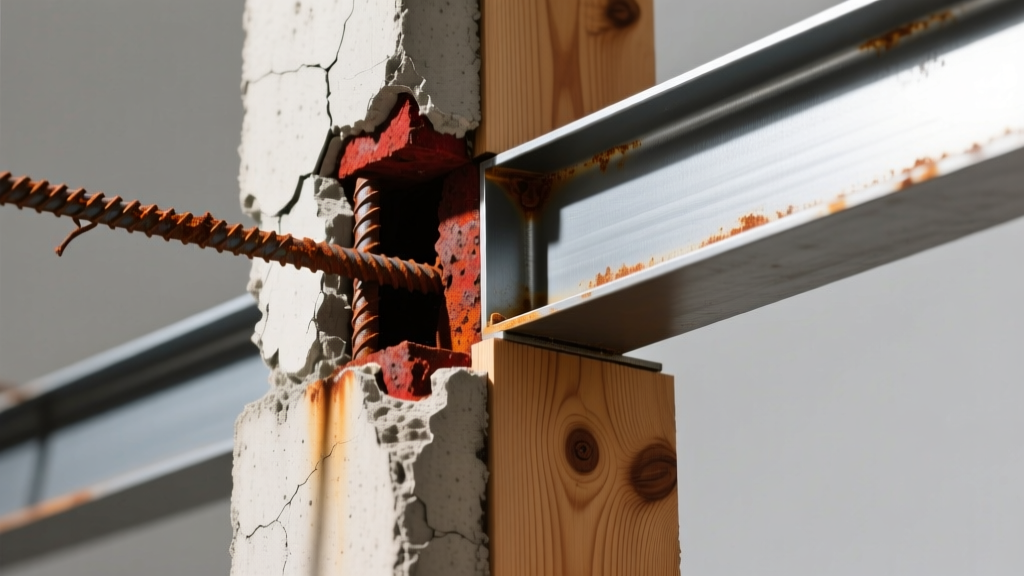
The most destructive deterioration vector in marine and de-iced environments is chloride ingress. When chlorides from seawater or de-icing salts penetrate the concrete matrix and reach the steel reinforcement, they destroy the passive oxide layer protecting the steel. The critical chloride threshold for black steel rebar is typically between 0.60 and 1.20 kg/m³ of acid-soluble chloride. Once corrosion initiates, the resulting iron oxides (rust) occupy up to six times the original volume of the steel. This internal tensile stress exceeds concrete's low tensile capacity (usually 300-500 psi), resulting in delamination and spalling.
2. Carbonation
Carbon dioxide from the atmosphere diffuses into concrete pores and reacts with calcium hydroxide to form calcium carbonate. This reaction lowers the concrete's alkalinity from a protective pH of 13 down to below 9. Once the carbonation front reaches the rebar depth, the steel depassivates and corrodes, even in the absence of chlorides. The depth of carbonation follows a square-root-of-time law ($x = k \sqrt{t}$), meaning high-permeability concrete with a high water-to-cement (w/c) ratio will carbonates exponentially faster.
3. Alkali-Silica Reaction (ASR)
Often termed 'concrete cancer,' ASR occurs when reactive silica in certain aggregates (like chert, strained quartz, or volcanic glass) reacts with alkali hydroxides in the cement pore solution. This forms a hygroscopic sodium-silicate gel that absorbs water and expands, causing severe map-cracking and structural loss of stiffness. According to the Portland Cement Association, ASR can be mitigated by limiting the alkali content of the cement or replacing a minimum of 25% of the Portland cement with Class F fly ash or 40% with ground granulated blast-furnace slag (GGBFS).
4. Freeze-Thaw Scaling and D-Cracking
Water expands by approximately 9% upon freezing. If the concrete's pore system is saturated and lacks a proper air-void network, the hydraulic pressure generated during freezing exceeds the tensile strength of the paste, causing surface scaling. Furthermore, certain coarse aggregates (like some limestones and dolomites) are inherently porous and will fracture internally during freezing, a phenomenon known as D-cracking. Mitigation strictly requires an air-entrainment admixture targeting 4% to 8% total air content with a spacing factor of less than 0.20 mm.
Material Vulnerability Matrix: Concrete vs. Alternatives
To make an informed structural decision, engineers must weigh concrete's specific deterioration modes against the failure profiles of alternative materials. The matrix below compares the primary structural materials across critical environmental stressors.
| Material | Moisture/Chloride Risk | Fire Resistance (Unprotected) | Biological/Chemical Risk | Expected Service Life (Unmaintained) |
|---|---|---|---|---|
| Reinforced Concrete | High (Rebar corrosion, spalling) | Excellent (Inherent 2-4 hr rating) | Low (Sulfate attack in specific soils) | 40 - 60 years |
| Structural Steel | Very High (Surface oxidation, section loss) | Poor (Fails at 1000°F, requires intumescent) | None | 30 - 50 years |
| Mass Timber (CLT/Glulam) | Medium (Rot if moisture trapped >20%) | Good (Predictable charring rate of 1.5 in/hr) | High (Fungi, termites, UV degradation) | 50 - 75+ years |
| Unreinforced Masonry | Medium (Efflorescence, freeze-thaw spalling) | Excellent (High thermal mass) | Low | 75 - 100+ years |
Environmental Risk Profiling: When to Pivot to Alternatives
Rather than forcing a concrete design into a hostile environment and relying on expensive chemical mitigations, structural designers should use environmental risk profiling to select the optimal baseline material.
Decision Framework: Material Selection by Environment
- Coastal/Marine Splash Zones: Avoid standard reinforced concrete. If concrete is required, specify Glass Fiber Reinforced Polymer (GFRP) rebar. Otherwise, utilize marine-grade structural steel with thermal-sprayed aluminum (TSA) coatings or advanced epoxy systems.
- High-Seismic Zones: Concrete's inherent brittleness requires massive, congested reinforcement detailing to achieve ductility. Mass timber and structural steel offer superior strength-to-weight ratios and inherent ductility, reducing seismic inertial forces and foundation costs.
- High-Humidity/Interior Pools: Avoid exposed steel (high corrosion) and standard concrete (chloride off-gassing from pool treatments). Mass timber, when properly detailed for moisture management as outlined by WoodWorks, provides excellent durability without the off-gassing risks of concrete pool decks.
- Aggressive Chemical Plants: Avoid Portland cement concrete entirely if exposed to sulfuric or hydrochloric acids. Specify polymer concrete, high-density polyethylene (HDPE) lined structures, or specialized fiberglass-reinforced plastic (FRP) grating and supports.
Advanced Mitigation: Making Concrete Compete
When architectural, fire-rating, or acoustic requirements mandate the use of concrete in high-deterioration environments, standard mix designs are insufficient. Modern material science offers specific, actionable interventions to extend concrete's service life to match or exceed 100 years.
Non-Metallic Reinforcement
The most effective way to eliminate chloride-induced corrosion is to remove the steel. GFRP (Glass Fiber Reinforced Polymer) rebar, such as Hughes Brothers' V-ROD or Owens Corning's PinkBar, is entirely immune to chloride and carbonation-induced rust. While GFRP carries a 15% to 20% material cost premium over epoxy-coated steel, it eliminates the need for concrete cover depths greater than 2 inches, reduces structural dead weight by 75%, and slashes lifecycle maintenance costs. Note that GFRP cannot be bent on-site and has a lower modulus of elasticity, requiring stricter deflection calculations.
Penetrating Sealers and Surface Treatments
For existing structures or new builds requiring secondary defenses, silane and siloxane penetrating sealers are the industry standard. Products like PROSOCO Siloxa-Tek 8505 penetrate up to 1/4 inch into the capillary network and react with the silica to form a hydrophobic resin. This reduces water absorption by over 90% without trapping internal moisture vapor, effectively starving both the freeze-thaw cycle and chloride transport mechanisms.
Ultra-High-Performance Concrete (UHPC)
For critical infrastructure nodes where deterioration is unacceptable, UHPC provides a near-impermeable matrix. By eliminating coarse aggregate, utilizing steel micro-fibers, and achieving a w/c ratio below 0.25 with silica fume, UHPC achieves compressive strengths exceeding 20,000 psi and virtually zero permeability. The Federal Highway Administration heavily advocates for UHPC in bridge preservation, particularly for closure pours and deck overlays, where its extreme density halts chloride ingress entirely.
Lifecycle Cost and Replacement Realities
The initial capital expenditure (CapEx) of concrete is often lower than mass timber or heavily protected structural steel, but the operational expenditure (OpEx) tells a different story. A standard reinforced concrete parking garage in a northern climate utilizing de-icing salts will typically require its first major patching and cathodic protection intervention by year 25. Cathodic protection systems, which apply a low-voltage electrical current to the rebar to halt the electrochemical corrosion process, cost between $8 and $15 per square foot to install retroactively.
'The true cost of a structural framework is not measured at the ribbon-cutting, but at year 40 when the facade begins to spall and the structural integrity requires invasive forensic testing. Material selection must be an exercise in lifecycle risk management, not just initial bid-day economics.'
By contrast, a mass timber structure requires upfront investment in moisture-barrier detailing and UV-protective coatings during construction, but its maintenance cycle primarily involves visual inspections and re-coating every 15 to 20 years, avoiding the catastrophic, structurally compromising failures associated with hidden rebar corrosion. When evaluating the types and causes of concrete deterioration against alternative materials, the data dictates that concrete remains the superior choice for fire-resistive, high-mass applications, provided the mix design and reinforcement strategy are explicitly engineered for the specific chemical and physical threats of the local microclimate.
Written by
David NakamuraDavid Nakamura is a licensed architect (AIA) and construction technology writer focused on sustainable building methods, mass timber engineering, and high-performance building envelopes. He holds a Master of Architecture from the University of Washington and is a certified Passive House Consultant (CPHC). David spent eight years at the Seattle firm Mithun, where he led the design of three LEED Platinum projects, before founding his own practice specializing in net-zero residential design. He serves on the editorial advisory board of GreenBuilder Magazine and has authored peer-reviewed papers on cross-laminated timber (CLT) connections for the Journal of Structural Engineering. In his spare time, David teaches woodworking at Pratt Fine Arts Center and kayaks the Puget Sound.
More from David Nakamura
View all
Construction Cost
Labor Cost to Build a Deck Per Sq Ft: 2026 Installation Guide
Discover the exact labor cost to build a deck per sq ft in 2026. This installation guide breaks down contractor rates, complexity factors, and hidden fees.
Aug 4, 2026

Construction Cost
How Much Does It Cost to Build a 3 Bedroom House? Financing Guide
Learn exactly how much it costs to build a 3 bedroom house and explore 2026 financing options, construction loan types, and budget frameworks for your build.
Aug 4, 2026

Construction Cost
Cost to Build a Tennis Court: 2026 Guide
How much does it cost to build a tennis court in 2026? Breakdowns for asphalt, concrete, and synthetic surfaces plus fencing and lighting.
Jul 30, 2026