Concrete vs. Cement: Application Showcase for Builders
Discover the critical differences in concrete vs. cement with our application showcase. Learn exact mix ratios, structural uses, and 2026 material costs.

The terms "concrete" and "cement" are frequently interchanged by homeowners and novice builders, but in commercial construction and structural engineering, confusing the two leads to catastrophic specification errors. Cement is a fine powder binder; concrete is a structural composite material. Understanding the distinct physical properties, ASTM standards, and real-world applications of each is mandatory for accurate procurement and structural integrity.
This application showcase breaks down exactly where, how, and why builders specify pure cement systems versus composite concrete systems, complete with 2026 market pricing and technical mix ratios.
The Material Matrix: Cement vs. Concrete Composition
Before evaluating job-site applications, it is critical to understand the chemical and physical divergence between the two materials. The Portland Cement Association (PCA) defines cement as the hydraulic binder that reacts with water to form a paste, while concrete is the final macro-composite that includes aggregates.
| Property | Portland Cement | Structural Concrete |
|---|---|---|
| Primary Composition | Limestone, clay, iron ore, gypsum (calcined) | 10-15% Cement, 60-75% Aggregates, 15-20% Water |
| Governing Standard | ASTM C150 / AASHTO M 85 | ACI 318 / ASTM C94 (Ready-Mix) |
| Physical State | Fine dry powder (passes #325 sieve) | Viscous fluid (plastic state) curing to rigid solid |
| Compressive Strength | N/A (Used as a binder, not standalone) | 2,500 psi to 10,000+ psi (depending on mix design) |
| Primary Function | Hydration and binding of fine aggregates | Load-bearing structural support and paving |
Application Showcase: Pure Cement & Mortar Systems
Pure cement is never poured as a standalone structural element. When mixed with water and fine aggregates (sand) or lime, it becomes mortar, grout, or plaster. These systems are specified for bonding, coating, and filling applications where coarse aggregate would interfere with the material's function.
Masonry Bonding & Veneer (ASTM C270)
When laying clay brick, CMU (concrete masonry units), or natural stone veneer, builders must specify mortar, not concrete. Mortar requires high workability, water retention, and bond strength. The American Concrete Institute (ACI) and masonry codes dictate specific mortar types based on structural load and exposure:
- Type N Mortar (General Use): Mix ratio of 1 part Type I/II Portland cement, 1 part hydrated lime, and 6 parts sand. Yields approximately 750 psi compressive strength. Ideal for above-grade exterior walls and interior load-bearing masonry.
- Type S Mortar (High Bond): Mix ratio of 1 part Type I/II cement, 0.5 part lime, and 4.5 parts sand. Yields 1,800 psi. Required for below-grade foundations, retaining walls, and masonry subject to high lateral loads.
- Type M Mortar (High Compressive): Mix ratio of 1 part Type I/II cement, 0.25 part lime, and 3 parts sand. Yields 2,500 psi. Specified for heavy-duty paving bricks, driveways, and manholes.
Stucco & Architectural Plaster
Exterior stucco relies on Portland cement as its primary binder. A standard three-coat stucco system utilizes a scratch and brown coat mixed with 1 part cement to 2.5-4 parts sand, followed by a finish coat. The cement provides the hydraulic set and weather resistance, while the absence of coarse aggregate allows the material to be troweled smoothly over metal lath and building paper.
Application Showcase: Structural Concrete Systems
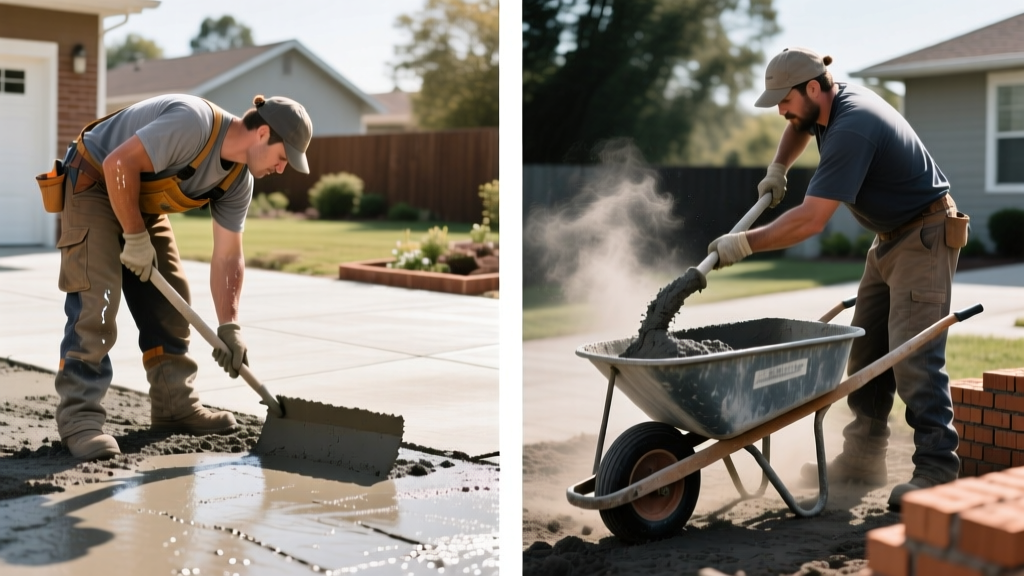
Concrete is specified when the project demands compressive strength, mass, and structural load distribution. The inclusion of coarse aggregate (crushed stone or gravel, typically 3/8" to 1" in diameter) is what gives concrete its structural skeleton, reducing the amount of expensive cement paste required and minimizing shrinkage cracking during the hydration process.
Flatwork, Driveways & Pavements
For residential driveways and commercial flatwork, a standard 4,000 psi mix design is the industry baseline. According to the Federal Highway Administration (FHWA), rigid pavement durability relies heavily on the water-cement (w/c) ratio. A 4,000 psi driveway mix typically features:
- Water-Cement Ratio: 0.45 (Maximum)
- Cement Content: ~564 lbs per cubic yard (Type I/II)
- Coarse Aggregate: 3/4" crushed limestone or granite
- Slump: 4 inches (Standard) to 6 inches (if using superplasticizers)
- Air Entrainment: 5% to 7% (Mandatory in freeze-thaw climates to prevent surface spalling)
Structural Foundations & Tilt-Up Panels
Continuous footings, grade beams, and tilt-up wall panels require higher early-strength mixes to allow for rapid form stripping. Builders often specify Type III (High Early Strength) Portland cement in these mixes, which achieves target compressive strengths in 3 to 7 days rather than the standard 28 days. For post-tensioned slabs or suspended decks, 5,000 psi to 6,000 psi mixes with low-slump (3-inch) characteristics are pumped into place to reduce bleed water and surface crusting.
2026 Procurement & Cost Breakdown
Material costs fluctuate based on regional aggregate availability and fuel surcharges. Below is the current market pricing for standard procurement methods, aiding in accurate project estimating.
| Material Type | Packaging / Unit | Avg. 2026 Cost | Best Application |
|---|---|---|---|
| Type I/II Portland Cement | 94 lb Bag | $15.50 - $18.00 | Custom mortar, stucco, soil stabilization |
| Type III High-Early Cement | 94 lb Bag | $19.00 - $22.50 | Cold weather concreting, rapid form removal |
| Ready-Mix Concrete (4,000 psi) | Per Cubic Yard | $145.00 - $175.00 | Driveways, foundations, large flatwork pours |
| Bagged Concrete Mix (e.g., Quikrete) | 80 lb Bag | $6.50 - $8.00 | Fence posts, small pad repairs, setting anchors |
| Bagged Mason Mix (Type S Mortar) | 80 lb Bag | $7.50 - $9.50 | Bricklaying, block walls, stone veneer setting |
Critical Job-Site Specification Errors
Confusing concrete and cement on the job site results in structural failures, aesthetic defects, and massive financial waste. Site superintendents must actively monitor for the following specification violations:
Novice crews sometimes dump bags of pure Portland cement into a ready-mix truck or bagged concrete mix, believing it will increase the compressive strength. This is a critical error. Adding uncalculated cement alters the water-cement ratio, drastically increases shrinkage, and guarantees severe thermal cracking as the excess cement hydrates. Strength is controlled by the w/c ratio, not just cement volume.
Attempting to lay brick or block using a standard concrete mix (which contains 3/4" gravel) prevents the mason from achieving tight, uniform 3/8" mortar joints. The coarse aggregate pushes the masonry units out of plumb, compromises the bond strength, and results in a structurally deficient wall. Always use fine-aggregate masonry mortar for bonding units.
Specifying a standard 4,000 psi concrete mix without air-entraining admixtures (AET) for an exterior driveway in northern climates will result in surface spalling and scaling within two winters. The microscopic air bubbles (5-7% by volume) are mandatory to provide expansion chambers for freezing water within the concrete capillary system.
Mastering the distinction between concrete and cement is not merely a semantic exercise; it is the foundation of accurate mix design, proper procurement, and long-term structural durability. By specifying the correct ASTM-standard material for the specific application, builders eliminate rework, control material costs, and ensure the longevity of the built environment.
Written by
Elena RodriguezElena Rodriguez is a civil engineer and technical writer specializing in concrete technology, masonry systems, and ASTM/ACI compliance. She earned her B.S. in Civil Engineering from Texas A&M University and spent a decade at a materials testing laboratory, performing over 2,000 concrete compressive strength tests and masonry prism evaluations. Elena is an ACI-certified Field Testing Technician (Grade I) and a member of ASTM Committee C12 on Natural Building Stone. She currently consults on forensic engineering cases involving concrete failures and moisture intrusion. Based in San Antonio, TX, Elena is a proud member of the Society of Women Engineers (SWE) and coaches her daughter's FIRST Robotics team.
More from Elena Rodriguez
View all
Walls & Panels
Cost Analysis: Light Gauge Steel Framing Advantages and Disadvantages
Evaluate light gauge steel framing advantages and disadvantages through a strict cost analysis lens, comparing material, labor, and lifecycle expenses.
Aug 4, 2026

Walls & Panels
Gypsum Board Types: Exact Specifications, Thickness & Dimensions
Compare standard, Type X, and moisture-resistant gypsum board types. Get exact specifications, thicknesses, dimensions, and ASTM standards for your project.
Aug 4, 2026

Fire Resistance
Best Fire-Resistant Outdoor Decking Materials: 2026 Buyer Guide
Discover the best fire-resistant outdoor decking materials for 2026. Compare Class A PVC, aluminum, and hardwood options for WUI compliance and safety.
Aug 4, 2026