Freddy's Sundae vs Concrete: A Mix Design & Material Guide
Explore the material science behind Freddy's sundae vs concrete mix design, comparing surface toppings to integral aggregate blending in construction.

The Linguistic Collision: Culinary Naming vs. Material Science
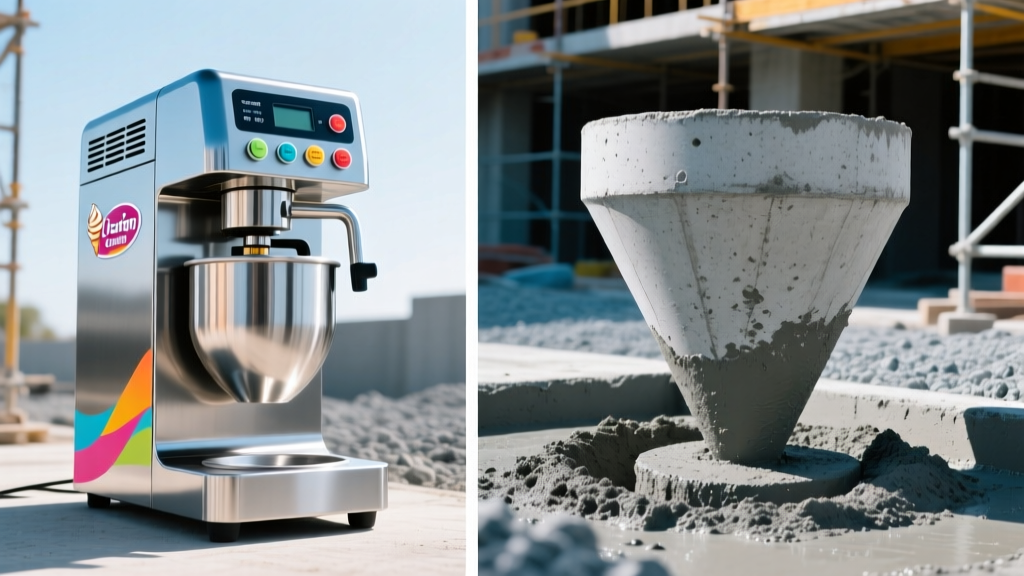
When industry professionals or internet searches encounter the phrase 'Freddy's sundae vs concrete,' they are witnessing a collision between culinary branding and structural material science. At Freddy’s Frozen Custard, a 'sundae' features toppings layered on the surface, while a 'concrete mixer' has ingredients blended entirely into the frozen matrix. In construction, this exact distinction defines the critical difference between surface treatments (the sundae approach) and integral mix design (the structural concrete approach). Understanding this dichotomy is essential for specifying decorative finishes, broadcast aggregates, and structural Portland cement matrices that meet ASTM standards.
The 'Sundae' Approach: Surface Treatments and Broadcast Aggregates
In concrete construction, the 'sundae' methodology refers to topical applications where decorative or functional elements are applied strictly to the surface of the slab after the base matrix is placed. This is common in architectural concrete, stamped patios, and industrial flooring.
Dry-Shake Hardeners and Broadcast Toppings
Dry-shake hardeners are broadcast onto the surface of fresh concrete and troweled in. Products like Butterfield Color PermaColor or L.M. Scofield Lithochrome provide color and surface abrasion resistance without altering the structural integrity of the underlying base mix. Because the 'mix-ins' are only on the top 1/8 to 1/4 inch of the slab, the base concrete must still possess adequate compressive strength and a low water-to-cement (w/c) ratio to prevent delamination.
The 'Concrete Mixer' Approach: Integral Matrix and ASTM C33
True structural concrete relies on an integral matrix where aggregates, binders, and admixtures are homogeneously blended. According to the Portland Cement Association, a properly proportioned structural mix ensures that every cubic inch of the slab possesses uniform compressive strength, durability, and rheology.
Aggregate Gradation and Volume
Aggregates constitute 60% to 75% of the total volume of a concrete mix. Unlike a dessert where mix-ins are arbitrary, construction aggregates must conform to ASTM C33 specifications for fine and coarse aggregates. The fineness modulus (FM) of the sand and the maximum nominal aggregate size (typically 3/4 inch for standard slabs) dictate the workability and paste demand of the mix.
| Component | Absolute Volume (%) | Typical Weight (per Cubic Yard) | Primary Function |
|---|---|---|---|
| Coarse Aggregate (3/4" Crushed Stone) | 31% - 34% | 1,500 - 1,700 lbs | Structural skeleton, reduces shrinkage |
| Fine Aggregate (Natural Sand) | 24% - 28% | 1,100 - 1,300 lbs | Fills voids, provides workability |
| Portland Cement (Type I/II) | 9% - 11% | 470 - 600 lbs | Hydration binder |
| Water | 14% - 16% | 220 - 280 lbs | Activates cement hydration |
| Air Voids (Entrained) | 4% - 7% | N/A | Freeze-thaw expansion chambers |
Rheology and the Slump Test: Viscosity in Practice
Whether discussing the viscosity of a custard dessert or the rheology of fresh cement paste, fluid dynamics dictate the final product. In construction, workability is measured via the ASTM C143 Slump Test. A standard structural slab requires a 4-inch to 5-inch slump. High-slump mixes (7+ inches) achieved through excess water severely compromise compressive strength, a principle defined by Abrams' Law.
To achieve high workability without adding water, modern mix designs utilize Polycarboxylate Ether (PCE) based High-Range Water Reducers (HRWR), commonly known as superplasticizers. Products like Sika ViscoCrete or Master Builders MasterLife allow ready-mix producers to deliver highly flowable self-consolidating concrete (SCC) that maintains a rigorous 0.38 w/c ratio.
Air Entrainment: The Invisible Structural Mix-In
One of the most critical 'mix-ins' in structural concrete is microscopic air. For any concrete exposed to freeze-thaw cycles and deicing chemicals, ASTM C260 mandates the use of air-entraining admixtures (AEAs). These chemicals generate a network of microscopic, disconnected air bubbles (10 to 1,000 micrometers in diameter) spaced no more than 0.008 inches apart. When pore water freezes and expands by 9%, these bubbles act as pressure-relief valves, preventing internal micro-cracking and surface scaling.
2026 Ready-Mix Pricing and PSI Specifications
Specifying the correct integral mix design requires balancing structural demands with project budgets. Based on 2026 regional ready-mix market data, pricing fluctuates based on cement content, admixture packages, and aggregate availability. The National Ready Mixed Concrete Association (NRMCA) emphasizes that specifying higher PSI mixes than necessary leads to excessive heat of hydration and thermal cracking in mass pours.
| Mix Designation | Target 28-Day PSI | Cement Content (lbs/yd³) | 2026 Avg. Cost per Cubic Yard | Primary Application |
|---|---|---|---|---|
| Standard Flatwork | 3,000 PSI | 470 - 500 lbs | $135 - $150 | Residential sidewalks, patios, non-structural fill |
| Commercial Slab-on-Grade | 4,000 PSI | 520 - 564 lbs | $155 - $175 | Warehouse floors, driveways, commercial flatwork |
| High-Early / Structural | 5,000+ PSI | 600 - 650 lbs | $180 - $210 | Suspended decks, precast elements, post-tensioned slabs |
| Fiber-Reinforced (FRC) | 4,000 PSI + Macro Fibers | 520 lbs + 3-5 lbs fibers | $175 - $195 | Industrial floors replacing welded wire mesh |
Summary Matrix: Surface vs. Integral Design
To finalize the 'Freddy's sundae vs concrete' framework for construction specifications, contractors and engineers must clearly delineate between surface treatments and integral matrix requirements.
- The 'Sundae' (Surface Treatment): Ideal for aesthetic modifications, UV-stable colorants, and localized abrasion resistance. Requires a sound, low-bleed base mix to prevent delamination. Cost is calculated per square foot ($3.00 - $8.00/sq ft installed).
- The 'Concrete Mixer' (Integral Design): Mandatory for structural load-bearing capacity, freeze-thaw durability, and bulk chemical resistance. Governed by ASTM C94 and ACI 318. Cost is calculated per cubic yard ($135 - $210/yd³ delivered).
By treating surface toppings and integral mix designs as distinct but complementary systems, construction professionals can avoid the catastrophic failures associated with improper material layering, ensuring long-term durability and structural compliance.
Written by
Marcus ChenMarcus Chen is a licensed structural engineer (PE) and building materials analyst with over 12 years of experience across residential, commercial, and industrial construction. He holds a Master of Science in Civil Engineering from UC Berkeley and spent six years at Thornton Tomasetti before transitioning to independent consulting and technical writing. Marcus specializes in material selection for seismic-prone regions, concrete reinforcement strategies, and lifecycle cost analysis. His work has been cited by the American Concrete Institute (ACI) and the Structural Engineers Association of California (SEAOC). When he is not on a job site or at his desk, you will find him hiking the Sierra Nevada or restoring a 1920s craftsman bungalow in Oakland, CA.
More from Marcus Chen
View all
Construction Cost
How Much Did the Eiffel Tower Cost to Build?
How much did the Eiffel Tower cost to build in 1889? We adjust for inflation and compare its budget to modern skyscraper construction.
Aug 4, 2026

Fire Resistance
What Is a Fire Resistant Material? Testing & Certification Guide
Discover what is a fire resistant material through ASTM and UL testing. Learn how fire ratings, certifications, and assemblies work in construction.
Aug 4, 2026

Construction Cost
How Much Did the Burj Khalifa Cost to Build?
How much did the Burj Khalifa cost to build? We break down the $1.5B project and extract 5 money-saving strategies for your next build.
Jul 30, 2026