Septic Blanket vs Concrete Blanket: 2026 Cost Breakdown
Compare septic blanket vs concrete blanket costs, installation labor, and permeability requirements for 2026 erosion control and drainage projects.

The Core Dilemma: Permeability vs. Armor
When stabilizing slopes, drainage swales, or sensitive infrastructure, engineers and contractors frequently debate the merits of a septic blanket vs concrete blanket. While both serve as erosion control mechanisms, their hydraulic properties and structural behaviors are fundamentally opposed. In 2026, material science has advanced significantly, but the core physics of soil percolation remain unchanged. Choosing the wrong system for a wastewater-adjacent or highly permeable site does not just result in erosion; it can trigger catastrophic hydraulic failure.
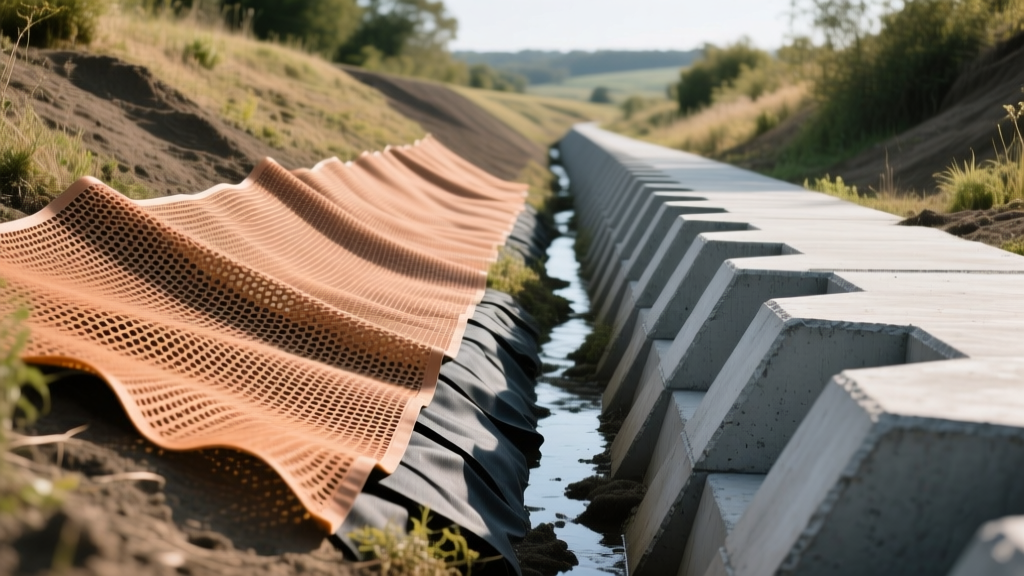
A concrete blanket—technically known as a Geosynthetic Cementitious Composite Mat (GCCM) or Articulated Concrete Block (ACB) system—provides rigid, impermeable armor. It is designed for high-velocity water channels and spillways. Conversely, a septic blanket (often a specialized permeable Erosion Control Blanket (ECB), compost blanket, or geocell system) is engineered to stabilize soil over leach fields, septic mounds, and bioretention areas while maintaining critical evapotranspiration and gas exchange rates.
Material Specifications & 2026 Pricing Matrix
Understanding the baseline material costs is the first step in an accurate cost breakdown analysis. The pricing below reflects Q1 2026 wholesale and distributor rates for commercial-grade materials.
| Feature | Concrete Blanket (GCCM / ACB) | Septic Blanket (Permeable ECB / Geocell) |
|---|---|---|
| Primary Material | Cementitious powder in 3D fiber matrix / Articulated concrete blocks on geogrid | Straw/coconut fiber matrix, compost, or HDPE geocell with topsoil |
| Material Cost (per sq. ft.) | $9.50 - $14.00 | $1.80 - $4.50 |
| Weight (per sq. yd.) | 15 - 22 lbs (Pre-hydration) | 0.5 - 1.2 lbs |
| Permeability | Low / Impermeable (10^-9 cm/s) | High (Allows full percolation & gas exchange) |
| Typical Thickness | 5mm - 13mm (GCCM) / 4" - 8" (ACB) | 0.25" - 0.75" (ECB) / 4" - 8" (Geocell depth) |
| Lifespan | 50+ years (Structural) | 1-3 years (ECB) / 50+ years (Geocell) |
Comprehensive Cost Breakdown: Installation & Equipment
Material costs only tell half the story. The installation methodology for a septic blanket vs concrete blanket dictates the heavy equipment requirements, crew size, and overall labor hours. Below is a comparative cost model for a standard 2,000 square foot sloped drainage swale adjacent to a sensitive wastewater zone.
Scenario A: Concrete Blanket (GCCM) Installation
- Site Prep (Grading & Compaction): $1,200 (Requires 95% Proctor density to prevent subgrade voids that crack the concrete).
- Material (GCCM5 @ $11.50/sq ft): $23,000.
- Equipment (Mini-Excavator & Crane Lift): $1,800 (GCCM rolls weigh over 1,500 lbs and require mechanical unrolling).
- Labor (3-person crew, 2 days): $2,400.
- Hydration & Curing Water: $150.
- Total Estimated Cost: $28,550 ($14.27 / sq. ft. installed)
Scenario B: Permeable Septic Blanket (ECB + Geocell) Installation
- Site Prep (Light Grading & Topsoil Amendment): $600 (Strict adherence to EPA septic system guidelines to avoid compacting the underlying biomat).
- Material (S150 Straw/Coconut ECB @ $2.80/sq ft + Anchors): $6,400.
- Equipment: $0 (Manual deployment; rolls weigh under 60 lbs).
- Labor (2-person crew, 1.5 days): $900.
- Hydroseeding / Tackifier: $800.
- Total Estimated Cost: $8,700 ($4.35 / sq. ft. installed)
"The primary cost driver for concrete blankets is not the cement; it is the mobilization of heavy machinery and the rigorous subgrade compaction required. Over a septic mound, that compaction requirement alone disqualifies GCCM, as it destroys the soil's percolation capacity."
— Geosynthetic Institute (GSI) Technical Notes on Wastewater Infrastructure
Lifecycle & Maintenance Costs (The Hidden Variables)
When evaluating long-term ROI, the maintenance profiles of these two systems diverge sharply. According to FHWA geosynthetic design resources, environmental stress cracking and UV degradation are the primary failure points for exposed geosynthetics, while concrete blankets face spalling and subgrade washout.
Concrete Blanket Maintenance
Annual Cost: $0.05 - $0.10 / sq. ft.
Tasks: Inspecting for edge-scour (water bypassing the mat), repairing hairline cracks with polyurethane sealants, and clearing debris that traps moisture against the PVC underlayer.
Septic Blanket Maintenance
Annual Cost: $0.15 - $0.30 / sq. ft.
Tasks: Mowing vegetation (using lightweight, wide-tire mowers to prevent soil compaction), re-seeding bare patches, and monitoring for localized subsidence caused by shifting effluent lines below.
Decision Framework: When to Specify Which
To eliminate guesswork, use this binary decision tree when drafting site plans or bidding on erosion control projects near wastewater infrastructure.
- Is the substrate an active leach field, septic mound, or bioretention cell?
- Yes: Specify a Septic Blanket (Permeable ECB or vegetated Geocell). Never use concrete.
- No: Proceed to step 2.
- Will the surface experience high-velocity water flow (> 6 ft/s) or serve as a lined spillway?
- Yes: Specify a Concrete Blanket (GCCM or ACB). Permeable mats will wash out under these shear stresses.
- No: Proceed to step 3.
- Is heavy equipment access restricted (e.g., tight residential backyards, fenced enclosures)?
- Yes: Specify lightweight Septic Blankets or manual-deploy TRMs. GCCM rolls require crane or excavator access.
- No: Evaluate based on total lifecycle budget and aesthetic requirements.
Edge Case: The Transition Zone
A common engineering challenge occurs where a concrete-lined drainage ditch empties into a septic-mound splash pad. In this transition zone, contractors must overlap the impermeable GCCM with the permeable ECB. The concrete blanket must terminate up-slope of the leach field boundary by at least 10 feet, utilizing a French drain or rock apron to dissipate kinetic energy before the water reaches the permeable septic blanket zone. Failure to design this transition correctly results in edge-scour that undermines the concrete matting.
Regulatory & Permitting Hidden Costs
Do not overlook the soft costs associated with local health department permitting. Most municipal codes strictly regulate the impermeable coverage ratio over designated wastewater reserve areas. If a contractor mistakenly submits a site plan utilizing a concrete blanket over a designated septic reserve, the permitting office will flag the violation. This results in plan rejection, requiring a civil engineer to redraw the drainage scheme (costing $1,500 - $3,000 in revision fees) and delaying the project timeline by 4 to 8 weeks.
Conversely, utilizing Geosynthetic Institute (GSI) approved permeable mats over septic mounds often qualifies for expedited environmental permitting, as these materials align with state-level green infrastructure mandates for stormwater management and groundwater recharge. Always verify the specific percolation and coverage requirements with the local Department of Environmental Quality (DEQ) before finalizing your material takeoffs.
Written by
David NakamuraDavid Nakamura is a licensed architect (AIA) and construction technology writer focused on sustainable building methods, mass timber engineering, and high-performance building envelopes. He holds a Master of Architecture from the University of Washington and is a certified Passive House Consultant (CPHC). David spent eight years at the Seattle firm Mithun, where he led the design of three LEED Platinum projects, before founding his own practice specializing in net-zero residential design. He serves on the editorial advisory board of GreenBuilder Magazine and has authored peer-reviewed papers on cross-laminated timber (CLT) connections for the Journal of Structural Engineering. In his spare time, David teaches woodworking at Pratt Fine Arts Center and kayaks the Puget Sound.
More from David Nakamura
View all
Construction Cost
Labor Cost to Build a Deck Per Sq Ft: 2026 Installation Guide
Discover the exact labor cost to build a deck per sq ft in 2026. This installation guide breaks down contractor rates, complexity factors, and hidden fees.
Aug 4, 2026

Construction Cost
How Much Does It Cost to Build a 3 Bedroom House? Financing Guide
Learn exactly how much it costs to build a 3 bedroom house and explore 2026 financing options, construction loan types, and budget frameworks for your build.
Aug 4, 2026

Construction Cost
Cost to Build a Tennis Court: 2026 Guide
How much does it cost to build a tennis court in 2026? Breakdowns for asphalt, concrete, and synthetic surfaces plus fencing and lighting.
Jul 30, 2026