Roman Concrete vs Modern Concrete: Structural Applications
An engineering showcase comparing Roman concrete vs modern concrete in marine and structural applications, with actionable 2026 mix design specs.

The Engineering Reality: 2,000 Years vs. 100 Years
When specifying materials for high-durability infrastructure, engineers face a paradox: modern Ordinary Portland Cement (OPC) achieves compressive strengths exceeding 100 MPa, yet its functional lifespan in aggressive environments rarely surpasses 100 years. Conversely, Roman concrete (opus caementicium), with a modest compressive strength of 20–30 MPa, has survived two millennia of tidal battering and seismic shifts. Understanding the divergence between Roman concrete vs modern concrete requires moving beyond basic strength metrics and examining mineralogical evolution, application-specific failure modes, and how 2026 building codes are adapting ancient chemistry for modern infrastructure.
Core Mineralogical Divergence
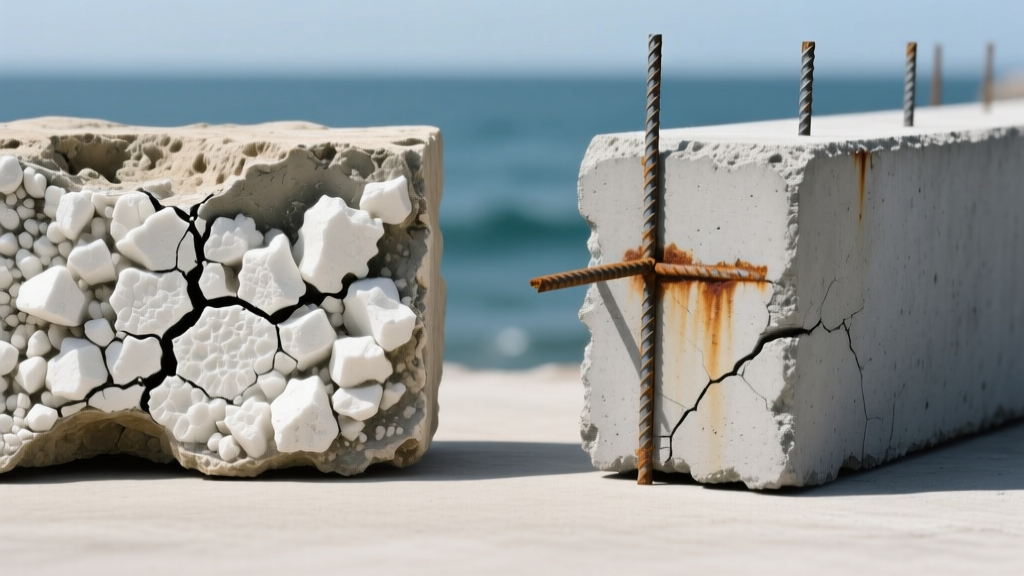
Modern OPC: Relies on the hydration of alite and belite to form Calcium Silicate Hydrate (C-S-H) gel. While initially dense, C-S-H is vulnerable to chloride ingress and sulfate attack, leading to the expansion of ettringite and subsequent micro-cracking.
Roman Pozzolanic: Utilizes volcanic ash (pozzolana) and quicklime. Seawater or groundwater percolation triggers the growth of rare minerals like Al-tobermorite and strätlingite. These minerals form interlocking, ductile microstructures that actively resist crack propagation rather than succumbing to it.
Marine Application Showcase: Breakwaters and Seawalls
The most stark contrast between Roman concrete vs modern concrete emerges in marine environments. Modern marine structures rely on ASTM C150 Type V (sulfate-resisting) Portland cement, low water-to-cement (w/c) ratios, and physical barriers like epoxy-coated rebar. Roman marine structures, such as the breakwaters at Portus Cosanus, were poured directly into the Mediterranean Sea without steel reinforcement.
| Performance Metric | Modern Marine Concrete (ASTM C150 Type V) | Roman Marine Concrete (Opus Caementicium) |
|---|---|---|
| Primary Binder | C3S and C2S (Portland clinker) | Volcanic ash (pozzolana) + quicklime |
| Seawater Reaction | Degrades C-S-H; forms expansive ettringite | Forms Al-tobermorite; increases ductility |
| Tensile Strategy | Steel rebar (prone to chloride-induced corrosion) | Mass gravity and aggregate interlock (no steel) |
| Design Lifespan | 50–120 years (with maintenance) | 2,000+ years (documented in situ) |
According to research published by MIT and the University of Utah, the secret to Roman marine durability lies in the "hot mixing" technique. By mixing quicklime directly with volcanic ash and water, the exothermic reaction creates lime clasts. When micro-cracks form from wave action, water enters the cracks, reacts with the lime clasts, and precipitates new calcium carbonate, effectively "healing" the concrete. Modern OPC lacks these unhydrated lime reserves, meaning once a crack forms in a modern seawall, chloride ions immediately attack the steel reinforcement.
Monumental & Architectural Showcase: Unreinforced Mass vs. Reinforced Skeletons
The Pantheon’s unreinforced dome remains the largest of its kind in the world, spanning 43.3 meters. Modern architectural concrete relies on high-strength steel tendons and rebar to achieve long spans. The application showcase here highlights a fundamental trade-off: structural efficiency versus long-term chemical stability.
The Rebar Corrosion Bottleneck
Modern high-rise cores and long-span bridges utilize concrete with compressive strengths of 60 to 120 MPa. However, the embedded carbon steel rebar has a different thermal expansion coefficient than the surrounding concrete and is highly susceptible to oxidation. When steel rusts, it expands up to six times its original volume, causing the concrete cover to spall. Roman builders avoided this entirely by designing strictly in compression. They utilized lightweight pumice aggregates in the upper sections of domes and dense basalt in the foundations, creating a graded density structure that modern engineers are only now replicating using 3D concrete printing technologies.
2026 Application Specs: Mimicking Roman Chemistry in Modern Mix Designs
While we cannot abandon steel reinforcement for modern high-rises, the structural engineering sector is actively integrating Roman pozzolanic principles to extend lifespans and reduce carbon footprints. The production of modern OPC accounts for roughly 8% of global CO2 emissions, driving a massive shift toward blended cements. Below are actionable specifications for achieving Roman-like durability in modern applications.
Actionable Mix Design Strategies for High-Durability Projects
- Specify LC3 (Limestone Calcined Clay Cement): Replace up to 50% of OPC with a blend of calcined clay and ground limestone. This mimics the aluminosilicate chemistry of Roman volcanic ash, promoting the formation of stable carboaluminate phases that resist chloride penetration.
- Utilize ASTM C595 Type IP Blends: For marine breakwaters, specify Portland-pozzolan cement with a minimum 30% fly ash or natural pozzolan replacement. This lowers the heat of hydration and reduces the calcium hydroxide available for sulfate attack.
- Implement Geopolymer Binders: For pre-cast marine elements, use alkali-activated fly ash/slag geopolymers. These binders contain zero Portland cement and form a highly cross-linked aluminosilicate network that is virtually immune to sulfuric and hydrochloric acid degradation.
- Introduce Engineered Lime Clasts: Emerging admixtures now include encapsulated quicklime particles designed to rupture only when micro-cracking occurs, providing the same autogenous healing properties documented in ancient Roman harbor structures.
Decision Framework: Which Technology to Specify?
Selecting between traditional modern OPC, high-performance blended cements, and emerging geopolymer alternatives depends on the specific structural and environmental demands of the project. The American Concrete Institute (ACI) provides rigorous guidelines for these exposure classes.
| Application Scenario | Recommended Binder Technology | Key Engineering Rationale |
|---|---|---|
| High-Rise Core (High Tensile Load) | High-Strength OPC (ASTM C150 Type I/II) + Silica Fume | Requires immediate high early strength and compatibility with dense rebar cages; pozzolanic blends cure too slowly for rapid floor cycling. |
| Tidal Zone Seawall / Breakwater | LC3 Blend or High-Volume Fly Ash (ASTM C595) | Eliminates free calcium hydroxide, preventing ettringite expansion and mimicking the self-healing Al-tobermorite formation of Roman marine concrete. |
| Mass Gravity Retaining Wall | Geopolymer or Roller-Compacted Pozzolanic Concrete | Unreinforced mass structures benefit from low heat-of-hydration blends, preventing thermal cracking during the curing of massive pours. |
| Sewer / Wastewater Infrastructure | Calcium Aluminate Cement (CAC) or Geopolymer | Resists biogenic sulfuric acid attack, which rapidly dissolves the calcium carbonate matrix found in standard modern OPC. |
The transition from viewing concrete as a disposable, 50-year consumable to a multi-generational infrastructure asset requires a fundamental shift in mix design. By studying the failure modes of modern reinforced structures and reverse-engineering the mineralogical resilience of Roman pozzolanic blends, structural engineers can specify materials that satisfy both the immediate load-bearing requirements of modern architecture and the extreme durability demands of marine and subterranean environments. As NIST's Materials and Structural Systems Division continues to validate low-carbon, high-durability blended cements, the line between ancient empirical wisdom and modern computational material science continues to blur, yielding infrastructure built to outlast the century.
Written by
James ThorntonJames Thornton is a construction industry veteran with 25 years of hands-on experience in wood framing, lumber grading, and residential building codes. He started as a framing carpenter in rural Oregon, earned his ICC Residential Building Inspector certification, and eventually became a senior plan reviewer for the City of Portland Bureau of Development Services. James holds a B.S. in Wood Science & Technology from Oregon State University and is a certified lumber grader through the West Coast Lumber Inspection Bureau (WCLIB). He has inspected over 3,000 residential construction sites and authored the city's internal guide on advanced framing techniques (2x6 at 24" O.C.). James lives in Bend, OR, where he builds custom timber-frame cabins and competes in lumberjack sports.
More from James Thornton
View all
Insulation
Best Home Insulation Materials: Complete 2026 Guide
Compare top home insulation materials for 2026. Find R-values, installed costs per square foot, and best uses for fiberglass, spray foam, and mineral wool.
Aug 4, 2026

Sustainable Building
Certify Your Green Building Material for LEED and WELL
Step-by-step guide to certifying a green building material for LEED v5 and WELL v2. Master EPDs, HPDs, and VOC limits for 2026 project specifications.
Aug 4, 2026

Stone & Masonry
Veneer Stacked Stone Panels: Interior Design & Style Showcase
Discover how veneer stacked stone panels transform interiors. Explore modern design profiles, material pairings, and technical installation specs.
Aug 4, 2026