Self Leveling Floor Compound Cost Calculator & Estimation Guide
Calculate exact self leveling floor compound costs and material quantities. Includes current pricing, brand coverage rates, and hidden prep expenses.
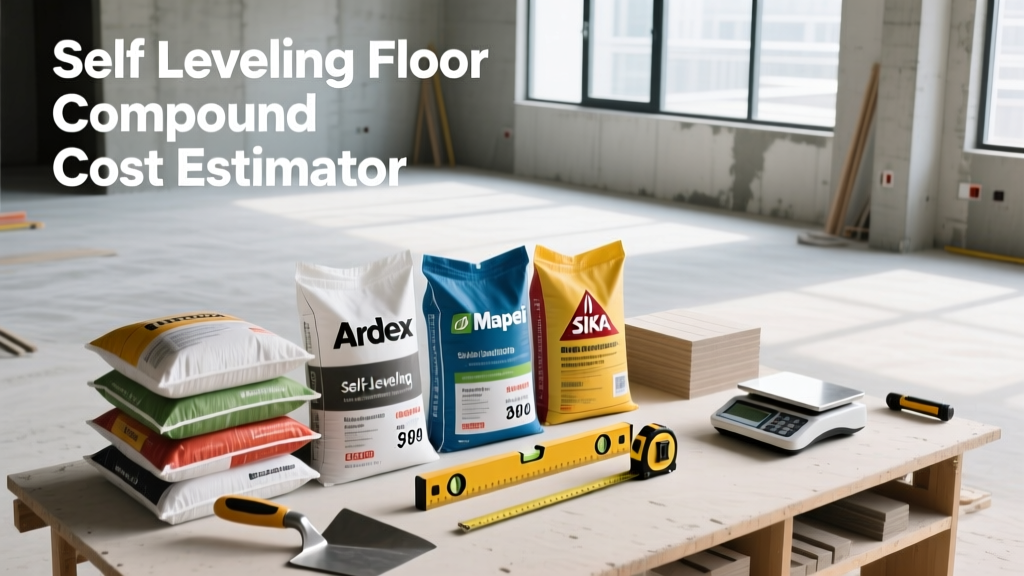
The True Cost of Self-Leveling Underlayment (SLU)
Estimating a self leveling floor compound project requires more than multiplying square footage by a generic price per bag. Self-leveling underlayment (SLU) is a high-stakes, time-sensitive material where under-ordering results in catastrophic cold joints, and over-ordering wastes hundreds of dollars in non-returnable inventory. Whether you are flattening a residential bathroom for large-format tile or prepping a 5,000-square-foot commercial slab for LVT, precise volume calculations and an understanding of hidden prep costs are mandatory.
Quick Cost Snapshot (Current Market Rates)
- Material Only (Compound + Primer): $1.25 – $2.80 per sq. ft.
- Professional Installation (Labor + Materials): $3.50 – $6.50 per sq. ft.
- Moisture Mitigation (If required): Adds $1.50 – $2.50 per sq. ft.
- Mechanical Prep (Shotblasting/Scarifying): Adds $0.50 – $1.25 per sq. ft.
Step-by-Step Quantity Calculator Framework
To calculate the exact number of bags required, you must determine the total volume of the space and account for the specific yield of your chosen product. Never estimate based on floor area alone; depth is the primary cost driver.
1. Calculate Base Volume and Bag Count
The industry standard formula for SLU estimation relies on the manufacturer's stated coverage rate at a specific thickness. Most premium cement-based compounds are engineered to cover approximately 50 square feet per 50 lb bag at a 1/8-inch thickness, or 25 square feet at a 1/4-inch thickness.
The Formula:
Total Square Footage ÷ Coverage Rate at Target Depth = Total Bags Required
Example: You are pouring 800 sq. ft. at an average depth of 1/4 inch. Using a standard yield of 25 sq. ft. per bag at 1/4 inch: 800 ÷ 25 = 32 bags.
2. Apply the 'Over-Pour' and Waste Factor
Concrete slabs are rarely perfectly flat. A floor that measures 1/4 inch out of level at the center may require 1/2 inch at the edges to achieve a true plane. Furthermore, material is lost to barrel residue, pump hoses, and edge dam seepage.
- Add 10% waste factor for standard residential pours under 1,000 sq. ft.
- Add 5-7% waste factor for large commercial pours utilizing a pumping truck (hoses hold 1-2 bags of material that cannot be recovered).
- Add 15% waste factor if the substrate is heavily pitted, spalled, or features exposed aggregate that will absorb excess compound.
Brand-Specific Coverage Rates & Material Costs
Not all self leveling floor compound formulations are equal. Cement-based SLUs are required for moisture-prone areas and heavy floor coverings, while gypsum-based alternatives are cheaper but strictly limited to dry, interior environments. Below is a comparison of industry-standard cementitious products.
| Brand / Product | Bag Weight | Avg. Cost | Coverage @ 1/4" | Best Application |
|---|---|---|---|---|
| Ardex K 15 | 50 lbs | $52 - $58 | ~25 sq. ft. | Premium commercial, high-flow, thick pours |
| Mapei Novoplan 21 | 50 lbs | $38 - $44 | ~25 sq. ft. | Mid-tier residential/light commercial |
| Henry 565 FloorPro | 40 lbs | $30 - $35 | ~20 sq. ft. | Budget DIY, big-box retail availability |
| Custom LevelQuik RS | 50 lbs | $40 - $46 | ~23 sq. ft. | Rapid set, residential tile prep |
Note: Pricing reflects current distributor and pro-desk averages. Bulk pallet pricing (typically 40-50 bags) can reduce per-unit costs by 10-15%.
The Hidden Costs: Primer, Prep, and Moisture Mitigation
The most common budgeting error is purchasing the self leveling floor compound while ignoring the mandatory chemical and mechanical prerequisites. Pouring SLU directly onto unprimed concrete guarantees failure; the dry slab will suck the water out of the mix, causing flash-setting, micro-cracking, and delamination.
Primer Costs and Dilution Ratios
Manufacturers like the Ardex Group and Mapei Corporation require their specific branded primers to maintain the product warranty. Primer costs average $45 to $65 per gallon. However, coverage varies wildly based on the porosity of the substrate and the required dilution ratio (often 1:1 or 1:3 with water for the first coat, and neat for the second coat). Budget roughly $0.15 to $0.25 per square foot for a two-coat primer application.
Critical Warning: Never use a generic concrete bonding adhesive as a substitute for an SLU-specific primer. Standard adhesives create a film that re-emulsifies when the massive volume of water in the self-leveling compound is introduced, resulting in a total bond failure.
Moisture Vapor Emission Rates (MVER)
If a calcium chloride test reveals an MVER exceeding 3 to 5 lbs per 1,000 sq. ft. (depending on the flooring manufacturer's warranty), you cannot pour standard SLU. You must first apply a moisture mitigation system, such as a two-part epoxy vapor barrier (e.g., Mapei Primer EP or Ardex MC RAPID). This adds significant cost and time, requiring broadcast quartz sand to provide a mechanical grip for the SLU. Factor in an additional $1.50 to $2.50 per square foot for mitigation materials and labor.
Labor Estimates: DIY Mixing vs. Professional Pumping
The logistics of mixing and placing the compound dictate your labor budget. Self leveling floor compound has a strict 'pot life' (usually 10 to 15 minutes) and must be placed continuously to avoid cold joints.
Barrel Mixing (Under 1,500 sq. ft.)
Cost: $1.50 - $3.00 / sq. ft. (Labor)
Crew: 3-4 workers minimum.
Logistics: Requires heavy-duty low-RPM drills (minimum 650 RPM, high torque) and specialized mixing paddles. One person gauges water, one drills, one carries, and one spreads with a gauging rake. Highly physically demanding; limited by the number of drills and barrels available.
Pump Truck (Over 1,500 sq. ft.)
Cost: $1,500 - $2,800 flat day rate + $0.50 / sq. ft.
Crew: 2-3 workers on site + pump operator.
Logistics: A specialized truck mixes the SLU in a continuous hopper and pumps it through 2-inch hoses directly into the room. Ensures perfect water-to-cement ratios, eliminates barrel residue waste, and allows 10,000+ sq. ft. to be poured in a single, seamless day.
Common Estimation Mistakes That Ruin Budgets
1. Ignoring Minimum Thickness Requirements
Many estimators plan for a 'feather-edge' pour to save material. However, most cement-based self leveling floor compound products have a strict minimum thickness of 1/8 inch, and some require 1/4 inch over non-absorbent surfaces. If your floor only has a 1/16 inch dip, you cannot simply pour a thin skim coat of SLU; it will shatter under foot traffic. You must either grind the high spots down (increasing mechanical prep costs) or use a specialized patching compound for the shallow areas before the main pour.
2. Underestimating Tooling and Edge Dams
SLU flows like water and will find every crack, floor drain, and HVAC vent. Budgeting must include closed-cell foam weatherstripping or specialized plastic edge dams to seal the perimeter and protect adjacent rooms. Additionally, you must budget for a spiked roller. According to installation standards highlighted by Floor Daily industry publications, rolling the compound with a spiked roller within 15 minutes of placement is non-negotiable to release trapped air bubbles and ensure a flat, dense surface. A professional spiked roller and frame cost roughly $120 to $180.
3. Failing to Account for Curing Time Before Flooring
Time is money on a job site. While some rapid-setting compounds claim 'walkable in 2 hours,' installing moisture-sensitive floor coverings (like LVT or epoxy coatings) requires the SLU to dry completely. Standard 50 lb bags contain roughly 1.5 gallons of water. If you pour 1/2 inch thick, that is a massive amount of water trapped against the slab. Budget for 3 to 5 days of drying time per 1/2 inch of thickness before moisture testing and flooring installation can begin, factoring in temporary climate control (HVAC and dehumidifiers) to accelerate the process.
Final Estimation Checklist
Before finalizing your self leveling floor compound budget, verify these line items:
- Substrate Profiling: Has the concrete been tested for CSP (Concrete Surface Profile)? Shotblasting may be required.
- Moisture Testing: Are ASTM F1869 (Calcium Chloride) or ASTM F2170 (In-situ RH) tests completed?
- Primer Volume: Calculated based on a two-coat application over porous concrete.
- Compound Volume: Base square footage × target depth + 10% waste factor.
- Consumables: Edge dams, spiked rollers, mixing paddles, and PPE (respirators for silica dust during prep).
- Logistics: Freight delivery fees for palletized SLU (often $150-$300 for liftgate service).