Ice Melt vs Rock Salt on Concrete: Technical Specs & Prevention
Compare ice melt vs rock salt on concrete using technical specs, chemical thresholds, and ACI standards to prevent scaling and spalling damage.
The Chemistry of Deicers: Rock Salt vs. Formulated Ice Melts
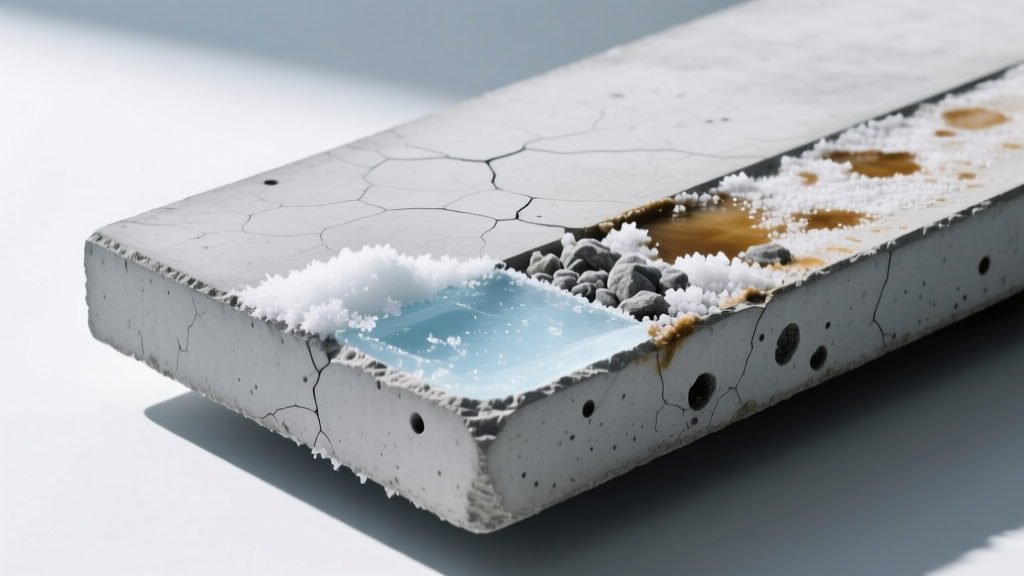
When evaluating ice melt vs rock salt on concrete, the distinction lies in the chemical composition of the deicing agent and its thermodynamic interaction with Portland cement paste. Deicers function through freezing point depression, but their secondary effects—specifically osmotic pressure generation and chemical reactivity with calcium hydroxide (Ca(OH)2)—dictate the rate of concrete degradation.
Rock salt (Sodium Chloride, NaCl) is the most widely used deicer due to its low cost, but it presents severe physical scaling risks. Formulated ice melts utilize alternative chloride salts or organic compounds, each with distinct eutectic temperatures and reactivity profiles.
Mechanisms of Concrete Degradation
The deterioration of concrete exposed to deicers is rarely a single-mode failure. It is a synergistic combination of physical frost action and chemical attack.
Osmotic Pressure and Frost Action
When a deicer melts surface ice, it creates a concentrated brine. This brine establishes a concentration gradient between the surface and the interior pore water of the concrete. Osmotic pressure forces water to migrate toward the surface. When temperatures drop again, this supersaturated surface layer freezes, expanding by 9%. If the concrete's air-void system cannot accommodate this hydraulic pressure, the surface paste ruptures, resulting in scaling.
Chemical Attack and Paste Decalcification
While NaCl primarily causes physical scaling, Magnesium Chloride (MgCl2) and Calcium Chloride (CaCl2) introduce chemical degradation. MgCl2 is particularly aggressive. It reacts with the calcium hydroxide in the cement paste to form magnesium hydroxide (brucite) and soluble calcium chloride. The calcium chloride leaches out, increasing the paste's porosity, while the brucite layer eventually cracks, exposing the calcium-silicate-hydrate (C-S-H) gel to decalcification.
Technical Specification Matrix: Deicer Performance & Concrete Impact
The following matrix outlines the thermodynamic limits and degradation risks associated with common deicing agents when applied to standard Portland cement concrete.
| Deicer Type | Chemical Formula | Eutectic Temp | Practical Lowest Temp | Physical Scaling Risk | Chemical Attack Risk |
|---|---|---|---|---|---|
| Rock Salt | NaCl | -6°F (-21°C) | 15°F (-9°C) | High | Low |
| Calcium Chloride | CaCl2 | -20°F (-29°C) | -15°F (-26°C) | Moderate | Moderate |
| Magnesium Chloride | MgCl2 | -28°F (-33°C) | -10°F (-23°C) | Low | Severe |
| Calcium Magnesium Acetate | CMA | 20°F (-6°C) | 25°F (-4°C) | Very Low | None |
| Potassium Chloride | KCl | 15°F (-9°C) | 20°F (-6°C) | High | Low |
Concrete Mix Design Requirements for Deicer Exposure
Surviving the application of ice melt vs rock salt on concrete requires strict adherence to ACI 318 building code requirements for freezing and thawing exposures. For surfaces exposed to moisture and deicing chemicals (Exposure Class F3), the mix design must meet stringent parameters.
- Maximum Water-Cementitious Materials Ratio (w/cm): 0.45. Lowering the w/cm ratio reduces the capillary porosity, limiting the ingress of deicer brines.
- Minimum Compressive Strength (f'c): 4,500 psi (31 MPa) at 28 days. High-strength paste resists the tensile stresses generated by osmotic pressure.
- Air-Entrainment: 5% to 8% target air content (depending on nominal maximum aggregate size). Crucially, the air-void system must meet ASTM C457 specifications, requiring a spacing factor of ≤ 0.008 inches (200 μm). This ensures no point in the cement paste is farther than 200 μm from an air void to relieve hydraulic pressure.
- Supplementary Cementitious Materials (SCMs): Limit fly ash to 25% and slag cement to 50% when deicer exposure is anticipated. High SCM replacements can increase surface permeability and vulnerability to scaling if finishing practices trap bleed water.
Application Rates and Thresholds
Over-application is the leading cause of deicer-induced scaling. More deicer does not melt ice faster; it merely increases the brine concentration, thereby amplifying the osmotic pressure differential within the concrete pores.
"The recommended application rate for residential concrete is typically 1 cup (approx. 0.5 lbs) of deicer per 100 square feet. Exceeding this rate exponentially increases the risk of surface scaling without providing a proportional increase in ice-melting speed." — Clear Roads Research Project P-207
For commercial or municipal applications, pre-wetting rock salt with a liquid brine (such as CaCl2 or beet juice blends) at a rate of 8 to 12 gallons per ton of salt reduces the required application rate by up to 30%, minimizing the total chloride load on the concrete surface.
Troubleshooting Existing Deicer Damage
When evaluating a slab that has suffered from improper ice melt vs rock salt on concrete applications, follow this diagnostic and repair protocol:
- Petrographic Examination: If scaling exceeds 3mm in depth, extract a core sample for ASTM C856 petrographic analysis. This will determine if the failure is purely physical (frost action) or if chemical degradation (thaumasite or M-S-H gel formation) has compromised the structural integrity.
- Surface Preparation: Remove all loose, spalled material using a low-impact scarifier. Avoid aggressive shot-blasting, which can open micro-fractures in the underlying sound concrete.
- Patch Repair: Apply a polymer-modified, air-entrained micro-concrete patching compound. Standard non-shrink grouts lack the air-void system necessary to withstand future freeze-thaw cycles and will inevitably fail.
- Penetrating Sealer Application: Once repaired and fully cured (minimum 14 days), apply a silane or siloxane-based penetrating sealer. These hydrophobic sealers do not form a surface film (which can trap moisture) but rather line the capillary pores, reducing brine absorption by up to 90%.
Frequently Asked Technical Questions
Does calcium chloride ice melt destroy concrete?
Calcium chloride (CaCl2) is generally less damaging to concrete physically than rock salt because it generates exothermic heat, which reduces the number of freeze-thaw cycles the surface endures. However, in concrete mixes with high tricalcium aluminate (C3A) content, CaCl2 can react to form calcium chloroaluminate, leading to expansive cracking. It is safe for use on properly air-entrained, fully cured concrete with standard C3A levels.
Why is magnesium chloride considered bad for concrete?
Magnesium chloride (MgCl2) attacks the fundamental binding phases of Portland cement. It reacts with calcium hydroxide to form magnesium hydroxide, which lacks binding properties, and leaches calcium out of the C-S-H gel. Over multiple winter seasons, this chemical reaction turns the hard surface paste into a soft, mushy layer that easily spalls under traffic loads.
What is the safest ice melt for new concrete driveways?
For the first winter (less than 12 months old), no chemical deicers should be used. Use clean, washed sand or non-clumping kitty litter for traction. If chemical intervention is absolutely necessary after the first year, Calcium Magnesium Acetate (CMA) is the safest option, as it is biodegradable, non-corrosive, and does not trigger the severe osmotic pressures associated with chloride salts, though it is significantly more expensive and acts slower.
Written by
Priya KapoorPriya Kapoor is a real estate market analyst and construction economics researcher with expertise in housing affordability, development feasibility, and infrastructure investment. She holds a Master of Regional Planning from Cornell University and previously worked as a senior analyst at CBRE's Investment Properties group, where she modeled returns for $4B in mixed-use development pipelines. Priya now runs an independent research practice advising developers, municipalities, and REITs on construction cost forecasting and market timing. She publishes the quarterly "BuildMat Market Pulse" report tracking material price indices across 12 commodity categories. Based in Austin, TX, Priya serves on the board of Habitat for Humanity Austin and is a marathon runner.
More from Priya Kapoor
View all
Construction Cost
Cost to Build a 1600 Sq Ft Home in 2026: Full Breakdown
Accurate 2026 cost to build a 1600 sq ft home—material, labor, and regional pricing breakdowns included. Plan your budget with real-time estimates.
Aug 11, 2026

Wood & Lumber
Name the Types of Wood for Pressure Treatment and Preservation
Learn how to name the types of wood best suited for pressure treatment. Compare species treatability, chemical retention levels, and 2026 preservation costs.
Aug 4, 2026

Stone & Masonry
Stone Veneer Suppliers Lindenhurst: 2026 Cost Analysis
Analyze 2026 stone veneer costs in Lindenhurst, NY. Compare local supplier pricing, delivery fees, and Suffolk County installation labor rates.
Aug 4, 2026