Concrete Sand vs Mason Sand: Mix Selection & Failure Risks
Understand concrete sand vs mason sand differences. Learn ASTM specs, mixing ratios, and how choosing the wrong aggregate causes structural failure.

The Core Distinction: Gradation and Particle Shape
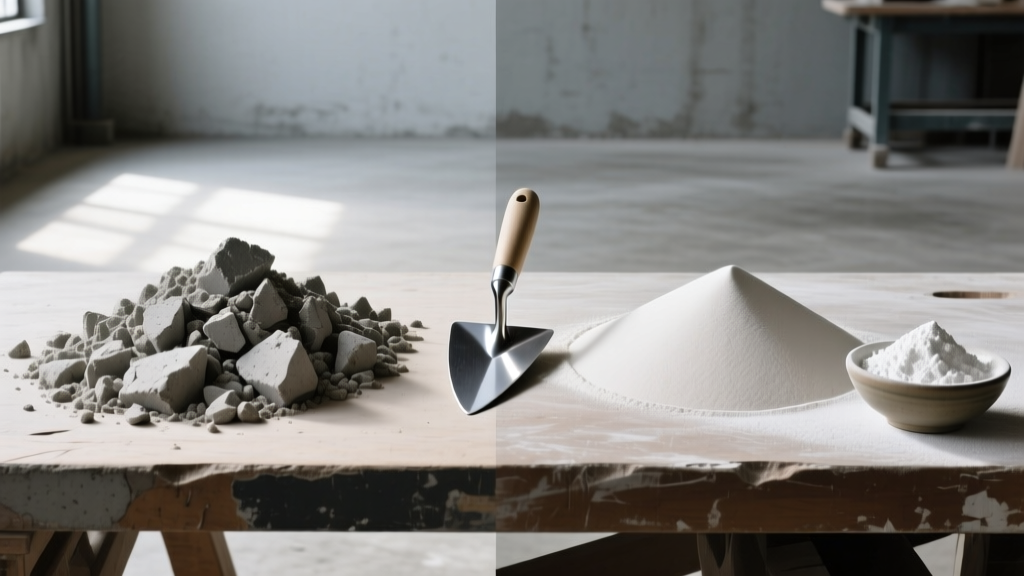
The fundamental difference between concrete sand and mason sand lies in their particle size distribution (gradation) and physical shape. While both are typically derived from crushed natural rock or river deposits, their processing diverges significantly to meet distinct structural requirements. Concrete sand is washed and screened to retain larger, angular particles that mechanically interlock, providing high compressive strength. Mason sand is screened through finer meshes and often washed to remove silt, resulting in smaller, smoother particles that improve workability and water retention in thin mortar joints.
ASTM Standards: C33 vs. C144 Explained
Professional contractors do not guess which sand to use; they rely on strict Federal Highway Administration and ASTM International guidelines. Using sand that falls outside these gradation bands compromises the structural integrity of the mix.
| Specification | Concrete Sand (ASTM C33) | Mason Sand (ASTM C144) |
|---|---|---|
| Primary Use | Structural concrete, slabs, footings | Masonry mortar, plaster, stucco |
| Max Particle Size | 4.75 mm (No. 4 sieve) | 2.36 mm (No. 8 sieve) |
| Fineness Modulus | 2.3 – 3.1 (Coarse) | 1.3 – 2.3 (Fine) |
| Particle Shape | Angular, cubical (crushed) | Sub-angular to rounded |
| Clay/Silt Limit | < 3.0% by weight | < 10.0% (varies by mortar type) |
According to the Portland Cement Association, proper gradation in concrete sand minimizes the void spaces between particles. This reduces the amount of cement paste required to fill those voids, lowering the overall cost and minimizing shrinkage. Conversely, The Masonry Society emphasizes that the finer gradation of C144 mason sand is critical for mortar, as it allows the mix to hold water longer, preventing the porous bricks from sucking moisture out of the mortar before it cures.
What Happens When You Swap Them? (Failure Modes)
Substituting one sand for the other is a common DIY mistake and an occasional contractor shortcut that leads to predictable, expensive failures.
Because mason sand has a much higher surface area due to its fine particles, it demands 10% to 15% more water to achieve the same slump (workability) as concrete sand. If a DIYer adds extra water to make the mix pourable without adjusting the cement ratio, the water-cement ratio spikes. This results in a driveway or patio that suffers from severe plastic shrinkage cracking, surface dusting, and a compressive strength reduction of up to 25%. The slab will likely spall and degrade within 3 to 5 years in freeze-thaw climates.
Concrete sand particles are too large and angular for thin masonry joints (typically 3/8-inch). When used in mortar, the mix becomes 'harsh' and unworkable. It will not extrude cleanly from the trowel, and it lacks the water-retention properties needed to bond with clay brick or CMU blocks. The mortar will dry out prematurely, resulting in a crumbly joint with near-zero flexural bond strength. The masonry wall will be highly susceptible to water infiltration and structural shifting.
Evaluating Other Sand Alternatives
When neither concrete nor mason sand is available, or when specialized applications arise, contractors evaluate other alternatives. However, most retail 'bagged' sands are unsuitable for structural work.
- Play Sand: Strictly prohibited for structural concrete or load-bearing mortar. Play sand is washed to remove dust but often contains high levels of fine silt and clay to make it moldable. This clay coats the cement particles, preventing hydration and destroying compressive strength.
- Silica Sand (Quartz Sand): Extremely hard, uniformly graded, and highly expensive. It is rarely used in standard Portland cement mixes but is the mandatory aggregate for epoxy mortars, polymer concretes, and specialized self-leveling underlayments where chemical inertness and precise gradation are required.
- Manufactured Sand (M-Sand): Produced by crushing hard granite rock. M-Sand is an excellent, sustainable alternative to river-dredged concrete sand. Because it is mechanically crushed, it is highly angular, which increases the flexural strength of concrete. However, it must be properly washed; excess rock dust (micro-fines) will drastically increase water demand.
Cost and Sourcing in 2026
Bulk pricing for sand fluctuates based on regional quarry availability and transportation costs, but the processing requirements dictate the baseline price difference.
2026 Bulk Aggregate Estimates (Per Ton)
- Concrete Sand (ASTM C33): $22 – $38 per ton. Requires standard crushing, screening, and basic washing.
- Mason Sand (ASTM C144): $28 – $45 per ton. Commands a premium due to the additional energy required for fine screening and the higher volume of material lost during the washing process to remove micro-fines.
- Bagged Retail Sand (50 lbs): $4.50 – $6.00 per bag. (Equivalent to $180 – $240 per ton; only viable for patch jobs under 2 cubic feet).
Note: Delivery fees for bulk dump trucks typically add $150 to $300 per load depending on mileage from the quarry or batch plant.
Decision Matrix: Which Sand for Which Project?
Use this framework to specify the correct aggregate for your next project. Do not rely on supplier labels like 'all-purpose sand,' as these rarely meet strict ASTM gradation bands.
| Project Scenario | Required Sand Type | Critical Specification |
|---|---|---|
| Driveways, Sidewalks, Foundation Footings | Concrete Sand | ASTM C33, FM 2.5 - 2.9 |
| Laying Clay Brick, CMU Blocks, Stone Veneer | Mason Sand | ASTM C144, FM 1.5 - 2.0 |
| Stucco Base Coats and Scratch Coats | Concrete Sand (or Plaster Sand) | ASTM C33 or C897 |
| Stucco Finish Coats | Mason Sand (or White Silica) | ASTM C144, strictly graded |
| Paver Base and Setting Beds | Concrete Sand (ASTM C33) | Must be coarse to allow drainage |
| Epoxy Grout and Chemical Resistant Mortar | Graded Silica Sand | ASTM C778 (Standard Sand) |
Selecting the correct sand is not a matter of preference; it is a matter of chemical and mechanical compatibility. By matching the aggregate gradation to the specific ASTM standard required by your mix design, you ensure optimal workability, maximum compressive strength, and long-term durability of your masonry or concrete structure.
Written by
Elena RodriguezElena Rodriguez is a civil engineer and technical writer specializing in concrete technology, masonry systems, and ASTM/ACI compliance. She earned her B.S. in Civil Engineering from Texas A&M University and spent a decade at a materials testing laboratory, performing over 2,000 concrete compressive strength tests and masonry prism evaluations. Elena is an ACI-certified Field Testing Technician (Grade I) and a member of ASTM Committee C12 on Natural Building Stone. She currently consults on forensic engineering cases involving concrete failures and moisture intrusion. Based in San Antonio, TX, Elena is a proud member of the Society of Women Engineers (SWE) and coaches her daughter's FIRST Robotics team.
More from Elena Rodriguez
View all
Walls & Panels
Cost Analysis: Light Gauge Steel Framing Advantages and Disadvantages
Evaluate light gauge steel framing advantages and disadvantages through a strict cost analysis lens, comparing material, labor, and lifecycle expenses.
Aug 4, 2026

Walls & Panels
Gypsum Board Types: Exact Specifications, Thickness & Dimensions
Compare standard, Type X, and moisture-resistant gypsum board types. Get exact specifications, thicknesses, dimensions, and ASTM standards for your project.
Aug 4, 2026

Fire Resistance
Best Fire-Resistant Outdoor Decking Materials: 2026 Buyer Guide
Discover the best fire-resistant outdoor decking materials for 2026. Compare Class A PVC, aluminum, and hardwood options for WUI compliance and safety.
Aug 4, 2026