Concrete vs Fibreglass Swimming Pool: 2026 Build Cost Showcase
Compare concrete vs fibreglass swimming pool builds in 2026. Expert analysis on shotcrete application, gelcoat finishes, site constraints, and real costs.

The Application Reality: Shotcrete vs Pre-Moulded Shells
When evaluating a concrete vs fibreglass swimming pool project, the physical application process dictates the timeline, site disruption, and structural outcome. Concrete pools are built in situ using pneumatically projected mortar or concrete, commonly known as shotcrete or gunite. The application requires a rigid framework of #3 or #4 steel rebar tied on 10-inch to 12-inch centers. The shotcrete mix design typically targets a compressive strength of 3,500 to 4,000 PSI at 28 days, utilizing a 3/8-inch aggregate. Nozzle operators must maintain a consistent 90-degree angle and a 3-to-4-foot distance from the rebar grid to minimize rebound (waste material that bounces off the steel), which must be manually cleared before it cures to prevent structural weak points.
Conversely, fibreglass pools are manufactured in controlled factory environments using isophthalic gelcoat layered over vinyl ester resin and chopped fibreglass roving. The application on-site is essentially a heavy-lift operation. A 100-ton mobile crane hoists the single-piece shell—weighing between 3,000 and 6,000 pounds—and lowers it into the excavated pit. The critical application step for fibreglass is the backfill: installers must use clean, 3/8-inch crushed stone (never native soil or sand) and simultaneously fill the pool with water to balance the hydrostatic pressure and prevent the shell walls from bowing inward.
Material Science & Structural Integrity
The structural behavior of these two materials under ground movement and water pressure is fundamentally different. According to guidelines published by the American Concrete Institute (ACI), properly cured shotcrete exhibits exceptional compressive strength, making it highly resistant to the inward pressure of surrounding soil. However, concrete is brittle and possesses low tensile strength. If the underlying soil undergoes differential settlement or expansive clay swelling, concrete shells are prone to micro-cracking. To mitigate this, modern applications mandate a 7-to-14-day wet curing process to prevent plastic shrinkage cracks before the interior finish is applied.
Fibreglass, by contrast, operates on tensile flexibility. The resin-and-glass matrix allows the shell to flex slightly under hydrostatic pressure and minor soil shifts without fracturing. This makes fibreglass highly advantageous in regions with high water tables or expansive clay soils, provided the installation includes a properly engineered gravel sump and a hydrostatic relief valve in the main drain to prevent the pool from 'popping' out of the ground if emptied.
2026 Cost Breakdown: Excavation to Final Fill
Material and labour costs have shifted significantly leading into 2026. While concrete prices have stabilized following supply chain disruptions, the specialized labour required for shotcrete application and custom masonry coping continues to drive concrete pool prices upward. Fibreglass shells have seen price increases tied to petroleum-based resin costs, but the drastically reduced on-site labour hours keep the total project cost lower.
| Project Phase | Shotcrete Concrete Pool | Fibreglass Shell Pool |
|---|---|---|
| Engineering & Permits | $2,500 - $4,000 | $1,500 - $2,500 |
| Excavation & Haul-off | $8,000 - $15,000 | $6,000 - $10,000 |
| Shell Material & Installation | $25,000 - $35,000 | $35,000 - $55,000 (incl. crane) |
| Plumbing & Electrical Rough-in | $7,000 - $12,000 | $6,000 - $9,000 |
| Interior Finish (Pebble/Gelcoat) | $12,000 - $20,000 | Included in Shell Cost |
| Coping & Concrete Bond Beam | $8,000 - $15,000 | $4,000 - $8,000 |
| Estimated Total Base Cost | $85,000 - $135,000+ | $70,000 - $105,000 |
Note: Costs reflect 2026 national averages for a standard 14' x 28' pool. Complex topography, retaining walls, and premium automation systems will increase both totals proportionally.
Surface Finishes: Pebble Aggregates vs Factory Gelcoat
The interior surface of the pool dictates both the aesthetic and the long-term chemical maintenance. A concrete shell is essentially a porous, alkaline sponge until it is sealed with an interior finish. Modern applications heavily favour exposed pebble aggregate finishes (such as PebbleTec or Wet Edge) over traditional white marcite. Pebble finishes consist of Portland cement mixed with smooth, naturally tumbled river stones. While highly durable (lasting 15 to 20+ years), the application is incredibly time-sensitive. Installers must trowel the mix onto the shotcrete shell and wash away the top layer of cement with a mild acid solution within hours to expose the stone. If the shell dries out during this process, delamination and 'check-cracking' will occur.
Fibreglass pools arrive with a factory-cured isophthalic gelcoat surface. This non-porous finish completely eliminates the need for on-site plastering. According to the Pool & Hot Tub Alliance (PHTA), the smooth, inert nature of fibreglass prevents algae from embedding into the surface, drastically reducing the need for aggressive brushing and algaecide applications. However, if a fibreglass gelcoat is damaged or degrades due to prolonged UV exposure or severe chemical imbalances (typically after 15-25 years), repairing it requires specialized composite technicians and colour-matching that can be visually inconsistent.
Long-Term Maintenance & Chemical Demand
Understanding the Langelier Saturation Index (LSI) is critical when choosing between these materials. Concrete is highly alkaline and will continuously leach calcium hydroxide into the water, especially during the first 12 months. This naturally drives the pool's pH upward, requiring weekly additions of muriatic acid or dry acid to maintain a balanced LSI and prevent scale formation on the pump impellers and salt chlorine generator cells.
Fibreglass is chemically inert. It does not buffer the water or alter the pH. While this means chemical costs are generally 30% to 40% lower annually compared to concrete, it also means the water has zero buffering capacity from the shell itself. If the water becomes aggressively acidic (low pH/low LSI), it will not etch a fibreglass shell the way it will etch concrete plaster, but it will rapidly corrode metal components like stainless steel ladders, pool light niches, and copper heat exchangers.
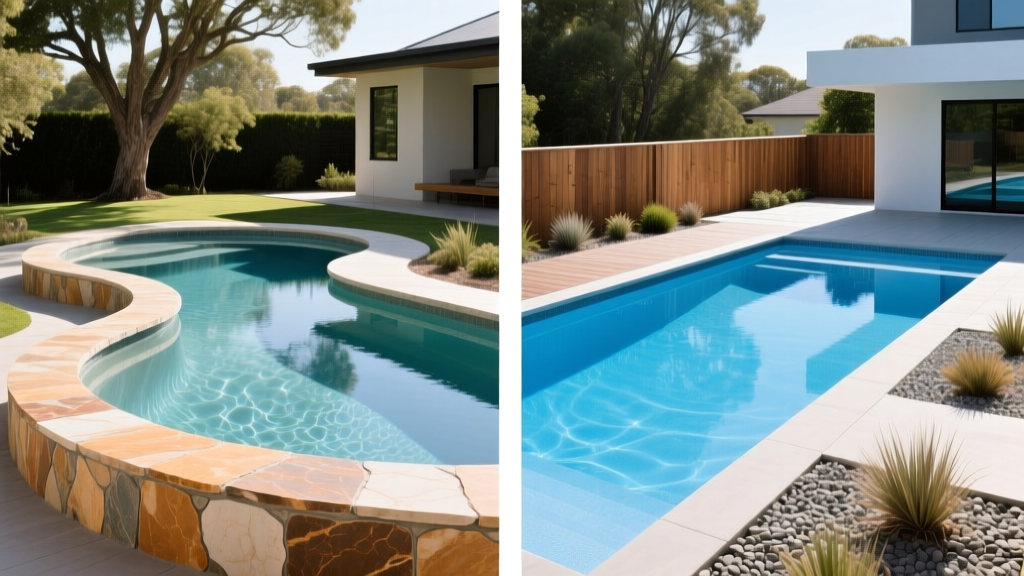
Site Constraints: The Decision Matrix
The physical realities of your property often make the concrete vs fibreglass swimming pool decision for you. Use the following application constraints to determine which material is viable for your site:
- Overhead Obstructions: If your backyard has low-hanging power lines or mature tree canopies that cannot be removed, a mobile crane cannot safely lift a fibreglass shell. Shotcrete is the only viable option, as it is pumped through ground-level hoses.
- Access Width: Fibreglass shells require a minimum of 12 to 14 feet of clear, unobstructed access from the street to the backyard for the crane and flatbed truck. If you have a narrow side yard (under 10 feet) or tight property setbacks, concrete is required. Shotcrete equipment can be staged in the front yard and piped over the house, or mixed on-site and transported via wheelbarrow.
- Dimensional Limits: Because fibreglass pools are transported on public highways, they are strictly limited to a maximum width of 16 feet (and usually 14 feet to avoid escort vehicle requirements). If your design calls for a 20-foot wide lagoon-style freeform pool, concrete is mandatory.
- Timeline Requirements: A fibreglass pool can be filled with water and ready for chemical balancing within 5 to 7 days of excavation. A concrete pool requires a minimum of 4 to 6 weeks for rebar tying, shooting, curing, plumbing, and interior finishing before water is introduced.
For comprehensive energy and water conservation strategies applicable to both pool types, consult the U.S. Department of Energy's pool efficiency guidelines, which detail how variable-speed pumps and thermal covers interact with different shell thermal masses.
Written by
David NakamuraDavid Nakamura is a licensed architect (AIA) and construction technology writer focused on sustainable building methods, mass timber engineering, and high-performance building envelopes. He holds a Master of Architecture from the University of Washington and is a certified Passive House Consultant (CPHC). David spent eight years at the Seattle firm Mithun, where he led the design of three LEED Platinum projects, before founding his own practice specializing in net-zero residential design. He serves on the editorial advisory board of GreenBuilder Magazine and has authored peer-reviewed papers on cross-laminated timber (CLT) connections for the Journal of Structural Engineering. In his spare time, David teaches woodworking at Pratt Fine Arts Center and kayaks the Puget Sound.
More from David Nakamura
View all
Construction Cost
Labor Cost to Build a Deck Per Sq Ft: 2026 Installation Guide
Discover the exact labor cost to build a deck per sq ft in 2026. This installation guide breaks down contractor rates, complexity factors, and hidden fees.
Aug 4, 2026

Construction Cost
How Much Does It Cost to Build a 3 Bedroom House? Financing Guide
Learn exactly how much it costs to build a 3 bedroom house and explore 2026 financing options, construction loan types, and budget frameworks for your build.
Aug 4, 2026

Construction Cost
Cost to Build a Tennis Court: 2026 Guide
How much does it cost to build a tennis court in 2026? Breakdowns for asphalt, concrete, and synthetic surfaces plus fencing and lighting.
Jul 30, 2026