Cost of Concrete vs Asphalt Driveway: 2026 Install Guide
Compare the true cost of concrete vs asphalt driveway installation in 2026. Expert breakdown of base prep, material specs, and lifecycle maintenance.

The Real Cost of Concrete vs Asphalt Driveway Installation
Evaluating the cost of concrete vs asphalt driveway installations requires looking far beyond the price per square foot of the surface material. While asphalt is generally cheaper upfront, the installation variables—specifically subgrade preparation, structural thickness, and local climate adaptations—dictate the true financial outlay. In 2026, supply chain stabilization has normalized material costs, but labor and heavy equipment rates for excavation and grading remain significant budget drivers.
According to Forbes Home Improvement, national averages provide a baseline, but regional soil conditions and frost-line requirements can swing these numbers by up to 30%. Below is a detailed installation cost matrix for a standard 600-square-foot (two-car) driveway.
| Installation Phase | Concrete Driveway (per sq. ft.) | Asphalt Driveway (per sq. ft.) |
|---|---|---|
| Excavation & Grading | $1.50 – $3.00 | $1.50 – $3.00 |
| Aggregate Subbase | $1.00 – $2.50 (4-6 inch layer) | $2.00 – $4.00 (6-8 inch layer) |
| Material & Pour/Pave | $6.00 – $12.00 | $3.50 – $8.00 |
| Finishing & Compaction | $2.50 – $5.00 | $1.50 – $3.00 |
| Total Initial Install | $11.00 – $22.50 | $8.50 – $18.00 |
Subgrade and Base Preparation: Where Budgets Break
The most common installation failure for both materials stems from inadequate base preparation. However, the structural mechanics of concrete and asphalt demand entirely different approaches to the subbase, directly impacting your excavation and gravel costs.
Rigid vs. Flexible Pavement Mechanics
Concrete is a rigid pavement. It possesses high tensile and compressive strength, allowing it to bridge minor subgrade inconsistencies. A 4-to-6-inch layer of compacted crushed stone (ASTM D2940) is typically sufficient to provide drainage and prevent frost heave.
Asphalt is a flexible pavement. It has virtually no tensile strength and relies entirely on the underlying base to distribute vehicular loads into the soil. If the subgrade shifts, the asphalt surface will mirror that movement, resulting in alligator cracking. Consequently, asphalt installations require a thicker 6-to-8-inch aggregate base, and in areas with expansive clay soils, a geotextile fabric separator ($0.50–$1.00 per sq. ft.) is often mandatory to prevent base contamination.
If your soil test reveals high plasticity clay (PI > 25), neither material can be installed directly on native soil. You must budget for an additional 12-18 inches of excavation to remove the clay, replacing it with engineered fill. Skipping this step will guarantee structural failure within 3 to 5 years, regardless of the surface material chosen.
Installation Execution: Pouring vs. Paving
The physical installation process introduces distinct labor costs, equipment requirements, and scheduling constraints.
Concrete Installation Variables
A professional concrete driveway install requires precise forming, reinforcement, and finishing. For a standard residential driveway, specify a 4,000 PSI mix design with 6% to 8% air-entrainment if you live in a freeze-thaw climate. The air-entrainment creates microscopic bubbles that give freezing water room to expand, preventing surface spalling.
- Reinforcement: Use 6x6 W1.4xW1.4 welded wire mesh (WWM) placed in the upper third of the slab, or #4 rebar on an 18-inch grid. Rebar adds roughly $0.75 to $1.25 per sq. ft. but drastically reduces structural cracking.
- Control Joints: Saw-cut or tooled joints must be placed every 10 feet and at a depth of 25% of the slab thickness (e.g., 1 inch deep for a 4-inch slab) to control where shrinkage cracks occur.
- Curing Timeline: Concrete requires 7 days to cure sufficiently for passenger vehicles and 28 days to reach full design strength. During this window, the surface must be kept moist or treated with a membrane-forming curing compound.
Asphalt Installation Variables
Asphalt installation is highly weather-dependent and requires heavy compaction equipment. The standard specification for residential driveways is a 2.5 to 3-inch compacted layer of Hot Mix Asphalt (HMA) over the aggregate base. According to the National Asphalt Pavement Association (NAPA), proper compaction is the single most critical factor in asphalt longevity.
- Temperature Constraints: HMA must be delivered at 275°F to 300°F. If ambient temperatures are below 50°F and falling, or if the base is frozen, the mix will cool too rapidly to achieve the required 92% theoretical maximum specific gravity (Gmm) density. Poor compaction leads to premature raveling and water infiltration.
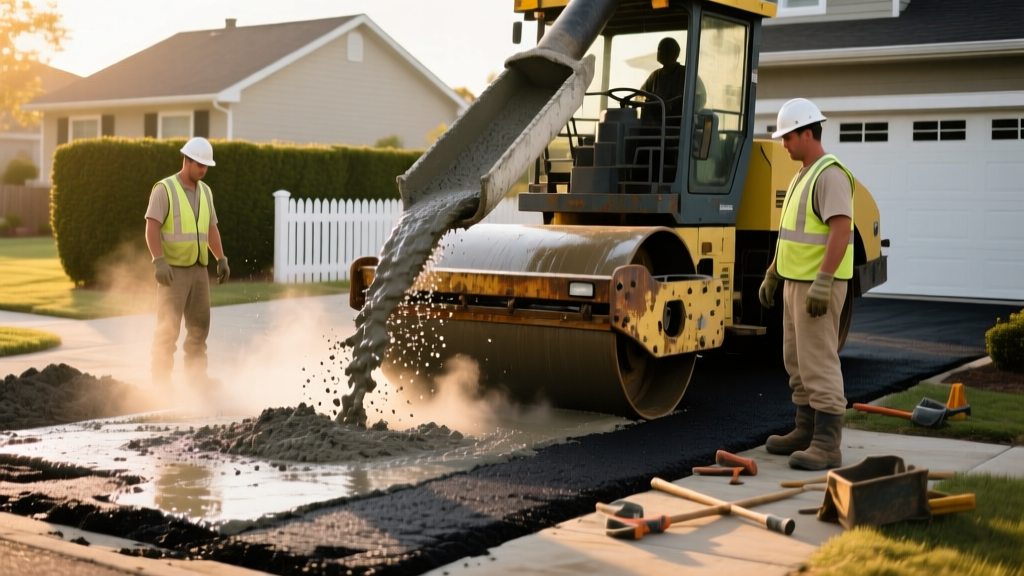
- Equipment: A proper install requires a vibratory steel-drum roller for the initial breakdown pass and a pneumatic-tire roller for the finish pass to seal the surface. Hand-tamping edges is unacceptable for long-term durability.
- Curing Timeline: Asphalt is traffic-ready in 48 to 72 hours, making it ideal for homeowners who cannot tolerate a multi-week construction zone.
Lifecycle and Maintenance Cost Projections
The initial cost of concrete vs asphalt driveway installation is only half the equation. Lifecycle maintenance heavily favors concrete in warm climates, while asphalt requires a strict, recurring maintenance schedule to prevent oxidative degradation.
| Maintenance Task | Concrete Frequency | Concrete Cost (600 sq ft) | Asphalt Frequency | Asphalt Cost (600 sq ft) |
|---|---|---|---|---|
| Surface Sealing | Every 5–7 years (Silane/Siloxane penetrating sealer) | $150 – $250 | Every 3–5 years (Coal tar or asphalt emulsion) | $180 – $300 |
| Crack Filling | Rare (if joints are maintained) | $50 – $100 | Annually (Hot rubberized crack filler) | $75 – $150 |
| Resurfacing/Overlay | Every 30+ years (Mudjacking or full replacement) | $2,500 – $5,000+ | Every 15–20 years (1.5 inch mill and overlay) | $1,800 – $3,000 |
Over a 30-year horizon, the cumulative maintenance and eventual resurfacing costs of an asphalt driveway often eclipse the higher initial installation cost of a properly poured concrete slab.
The 2026 Decision Matrix: Climate and Load Factors
Use the following framework to determine which material aligns with your specific environmental and usage parameters. The American Concrete Institute (ACI) provides extensive guidelines on regional mix designs that further inform these recommendations.
| Project Variable | Optimal Choice | Technical Rationale |
|---|---|---|
| Severe Freeze-Thaw Cycles | Concrete | Air-entrained concrete resists frost heave damage better than asphalt, which becomes brittle in extreme cold and prone to cracking. |
| Extreme Heat / High UV | Concrete | Asphalt softens at temperatures above 120°F, leading to rutting from heavy tires and tracking into the home. Concrete reflects UV and remains structurally rigid. |
| Heavy RV / Boat Storage | Concrete (6-inch thick) | Point loads from RV jacks and heavy dual-tire axles will cause permanent depressions in asphalt over time. A 6-inch, 4,000 PSI concrete slab handles these loads effortlessly. |
| Heavily Treed Lot | Asphalt | Tree roots will inevitably crack rigid concrete slabs. Asphalt can flex slightly with root movement and is much cheaper to patch and repair. |
| Strict HOA Aesthetics | Concrete | Concrete offers stamped, stained, and exposed aggregate finishes that comply with high-end architectural guidelines, whereas asphalt is limited to black or dull gray coatings. |
Final Installation Advice
When soliciting bids, do not simply ask for a 'driveway quote.' Demand a written specification sheet from both concrete and asphalt contractors that details the exact excavation depth, aggregate base thickness, material PSI or Performance Grade (PG) binder, and reinforcement methods. The contractor who provides a granular, engineered specification—rather than a vague per-square-foot estimate—is the one who understands the hidden costs of subgrade mechanics and will deliver a surface that survives the next three decades.
Written by
Marcus ChenMarcus Chen is a licensed structural engineer (PE) and building materials analyst with over 12 years of experience across residential, commercial, and industrial construction. He holds a Master of Science in Civil Engineering from UC Berkeley and spent six years at Thornton Tomasetti before transitioning to independent consulting and technical writing. Marcus specializes in material selection for seismic-prone regions, concrete reinforcement strategies, and lifecycle cost analysis. His work has been cited by the American Concrete Institute (ACI) and the Structural Engineers Association of California (SEAOC). When he is not on a job site or at his desk, you will find him hiking the Sierra Nevada or restoring a 1920s craftsman bungalow in Oakland, CA.
More from Marcus Chen
View all
Construction Cost
How Much Did the Eiffel Tower Cost to Build?
How much did the Eiffel Tower cost to build in 1889? We adjust for inflation and compare its budget to modern skyscraper construction.
Aug 4, 2026

Fire Resistance
What Is a Fire Resistant Material? Testing & Certification Guide
Discover what is a fire resistant material through ASTM and UL testing. Learn how fire ratings, certifications, and assemblies work in construction.
Aug 4, 2026

Construction Cost
How Much Did the Burj Khalifa Cost to Build?
How much did the Burj Khalifa cost to build? We break down the $1.5B project and extract 5 money-saving strategies for your next build.
Jul 30, 2026