How Long Does a Stamped Concrete Patio Last? Durability Analysis
Discover the true lifespan of a stamped concrete patio. We analyze durability, common failure modes, sealer schedules, and repair costs for lasting results.
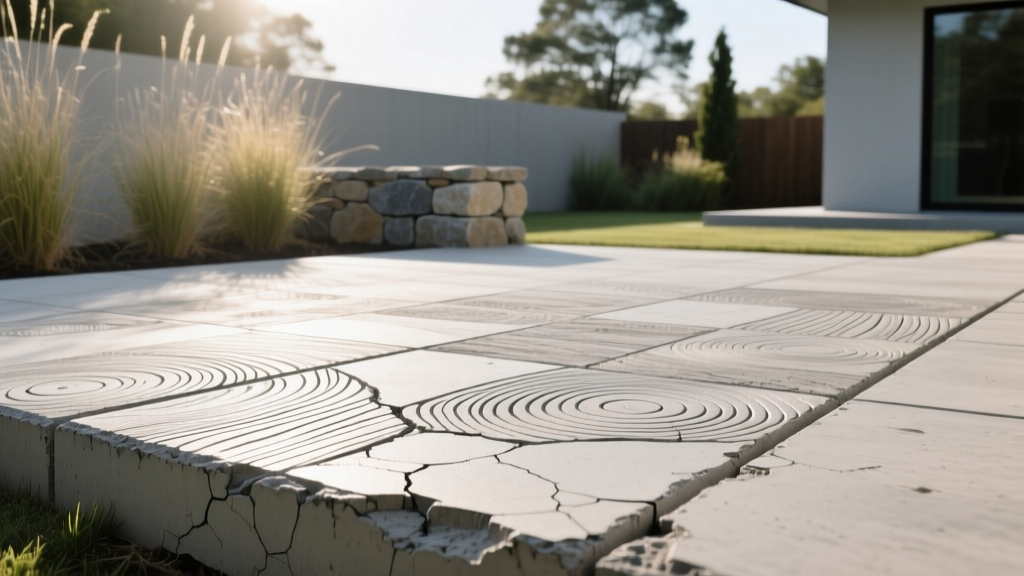
The Baseline: Structural vs. Aesthetic Lifespan
When evaluating a stamped concrete patio, contractors and homeowners must separate structural integrity from aesthetic longevity. Structurally, a properly poured and reinforced concrete slab will easily last 30 to 50 years. However, the aesthetic lifespan—the period during which the color remains vibrant and the sealer protects the surface without peeling or yellowing—is significantly shorter, typically ranging from 10 to 15 years before major cosmetic restoration is required.
The primary vulnerability of stamped concrete is not the slab itself, but the surface treatment. The stamping process relies on color hardeners, release agents, and chemical sealers. When any of these three components fail, the patio begins to look aged, chalky, or patchy, prompting expensive resurfacing long before the structural concrete has reached the end of its lifecycle.
- Compressive Strength: Minimum 4,000 PSI (pounds per square inch)
- Slab Thickness: 4 inches minimum (6 inches for heavy load areas)
- Subgrade Base: 4 to 6 inches of compacted aggregate base course (ABC)
- Control Joints: Cut to 25% of slab depth within 12 hours of pouring
Subgrade and Mix Design: The Foundation of Longevity
The durability of a stamped concrete patio is dictated before the first stamping mat is ever pressed into the surface. According to guidelines published by the National Ready Mixed Concrete Association (NRMCA), the subgrade and mix design are the primary determinants of freeze-thaw resistance and long-term cracking.
Critical Mix Design Parameters
For exterior flatwork exposed to weather, a standard 3,000 PSI residential mix is insufficient. You must specify a 4,000 PSI mix with a maximum water-to-cement (w/c) ratio of 0.45. Lowering the w/c ratio reduces the capillary pore structure in the concrete, limiting water ingress that leads to freeze-thaw spalling.
Furthermore, air entrainment is non-negotiable in climates that experience freezing temperatures. The mix must contain 5% to 7% entrained air. These microscopic, disconnected air bubbles act as pressure relief valves when water inside the concrete freezes and expands by 9%. Without adequate air entrainment, the internal hydraulic pressure will exceed the tensile strength of the concrete, causing the surface to pop and spall.
The Sealer Matrix: UV and Abrasion Resistance
The most common point of failure for a stamped concrete patio is sealer degradation. Ultraviolet (UV) radiation breaks down the chemical bonds in inferior sealers, causing them to chalk, peel, or yellow. Selecting the correct sealer chemistry is the single most impactful decision for extending the aesthetic lifespan of the patio.
| Sealer Type | Expected Lifespan | UV Stability | Cost per Sq. Ft. | Best Use Case |
|---|---|---|---|---|
| Solvent-Based Acrylic (e.g., SuperSeal 25) |
1 to 2 Years | Moderate (Yellows over time) | $0.50 - $0.80 | Budget projects, high-gloss 'wet look' desired |
| Water-Based Acrylic (e.g., Cryli-Tek 5500) |
2 to 3 Years | High (Non-yellowing) | $0.75 - $1.10 | Matte or satin finishes, eco-sensitive areas |
| Aliphatic Polyurethane (e.g., Euco Eucolac) |
3 to 5 Years | Excellent | $1.20 - $1.80 | High-traffic patios, commercial applications |
| Polyaspartic / Polyurea (e.g., Spartan Coat) |
10+ Years | Superior | $2.50 - $4.00 | Premium installations, extreme UV/salt exposure |
While polyaspartic sealers cost up to five times more than basic acrylics, their 10-year lifecycle eliminates the need for four to five resealing cycles, ultimately lowering the 15-year total cost of ownership while maintaining superior abrasion resistance.
Common Failure Modes and Root Causes
When a stamped concrete patio degrades prematurely, it is almost always traceable to specific installation errors or environmental mismanagement. Understanding these failure modes is critical for troubleshooting and prevention.
1. Freeze-Thaw Spalling and De-icer Damage
Spalling occurs when the surface layer of the concrete flakes or peels away. While lack of air entrainment is a primary cause, the application of chemical de-icers is the most common accelerator. Calcium chloride and magnesium chloride lower the freezing point of water, causing the concrete to undergo rapid, localized freeze-thaw cycles. The Portland Cement Association explicitly advises against using chemical de-icers on stamped or finished concrete during its first winter, and recommends using clean sand for traction thereafter.
2. Crust Delamination
Delamination happens when a thin crust (1/8 to 1/4 inch thick) separates from the underlying concrete. This occurs when the finishing crew stamps the surface while bleed water is still trapped beneath the surface crust, or when they over-trowel the surface, sealing in air and water. As the trapped moisture expands or freezes, the crust pops off, taking the color hardener and release agent with it. There is no chemical fix for delamination; the loose crust must be chipped away and patched with a polymer-modified overlay.
3. Efflorescence and Color Mottling
Efflorescence presents as a white, powdery residue on the surface. It is caused by water-soluble calcium hydroxide migrating to the surface and reacting with carbon dioxide in the air. On stamped concrete, this white powder obscures the secondary color release agent, making the patio look faded or mottled. If the efflorescence is severe, it must be treated with a mild muriatic acid wash (diluted 10:1 with water) before resealing, otherwise the new sealer will trap the white powder permanently.
Climate Impact on Degradation Rates
The geographic location of the patio dictates the primary environmental threat, which in turn influences the required mix design and maintenance schedule.
High UV / Arid Climates (Southwest US)
Primary Threat: UV degradation and thermal expansion.
Failure Mode: Sealer chalking, color fading, and shrinkage cracking.
Mitigation: Use UV-stable aliphatic polyurethane sealers. Cut control joints at tighter intervals (every 6 to 8 feet) to manage thermal expansion.
Freeze-Thaw Climates (Midwest / Northeast US)
Primary Threat: Moisture ingress and freezing expansion.
Failure Mode: Surface spalling, joint deterioration, and heaving.
Mitigation: Mandate 6% air entrainment. Seal joints with high-quality polyurethane caulk (e.g., Sikaflex) to prevent water from pooling under the slab edges.
Coastal / Marine Environments
Primary Threat: Chloride ion penetration and salt crystallization.
Failure Mode: Rebar corrosion (if reinforced) and subgrade washout.
Mitigation: Use epoxy-coated rebar or fiberglass (GFRP) rebar. Apply a penetrating silane/siloxane water repellent beneath the topical sealer.
25-Year Lifecycle Cost Analysis
To accurately assess the value of a stamped concrete patio, it must be compared against alternative materials like natural stone or concrete pavers over a 25-year horizon. While the initial installation cost of stamped concrete ($12 to $18 per square foot) is generally lower than natural flagstone ($25 to $40 per square foot), the maintenance burden shifts the long-term financial picture.
| Material | Initial Install (per sq. ft.) | 25-Year Maintenance | Total 25-Year Cost (per sq. ft.) |
|---|---|---|---|
| Stamped Concrete | $15.00 | $12.00 (Resealing 6x @ $2.00/sqft) | $27.00 |
| Concrete Pavers | $18.00 | $4.50 (Joint sand replenishment & weed control) | $22.50 |
| Natural Flagstone | $32.00 | $6.00 (Mortar joint repair & stone sealing) | $38.00 |
As noted by industry analysts at Concrete Construction Magazine, the long-term cost efficiency of stamped concrete relies entirely on the homeowner's adherence to a strict resealing schedule. If a homeowner neglects resealing for 5 to 7 years, the color will fade permanently, necessitating a full acid-stain or overlay restoration that can cost $8 to $12 per square foot, instantly destroying the material's cost advantage.
Expert Verdict: Maximizing the Investment
A stamped concrete patio is a highly durable, cost-effective hardscape solution, provided the installation specifications are strictly enforced and the maintenance schedule is respected. To guarantee a 30-year structural lifespan and a 15-year aesthetic lifespan, demand a 4,000 PSI air-entrained mix, ensure the subgrade is compacted to 95% Proctor density, and invest in an aliphatic polyurethane or polyaspartic sealer from day one. By treating the surface chemistry with the same rigor as the structural engineering, the patio will outlast and outperform almost any competing modular paving system.