Concrete vs Clay Brick Masonry: Cost, Durability, and Use Cases
Compare concrete vs clay brick masonry for your 2026 build. Analyze costs, compressive strength, thermal mass, and climate suitability in this expert guide.
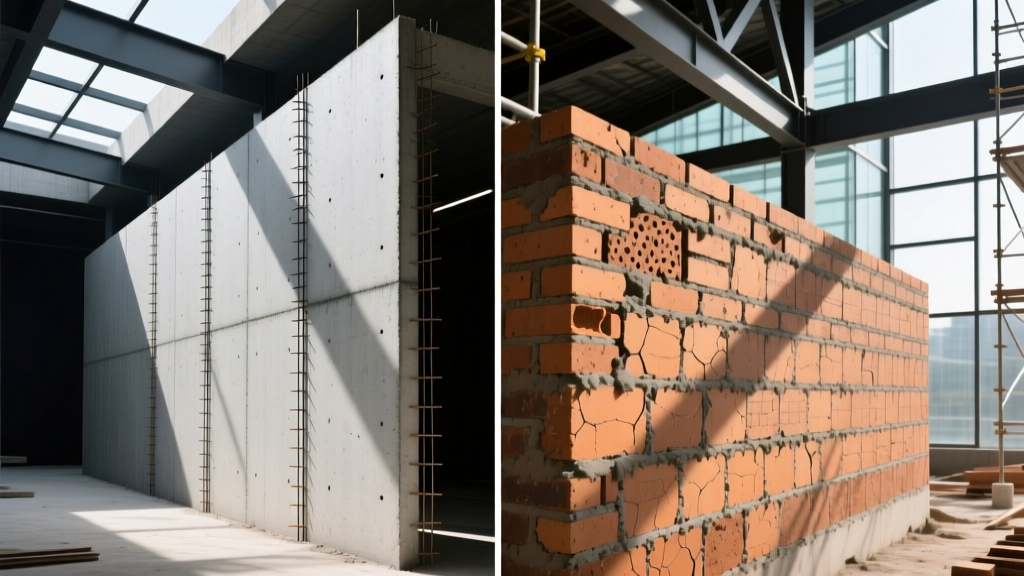
The Core Composition: Manufacturing and Material Science
When evaluating concrete vs clay brick for structural or veneer applications, the decision begins at the molecular level. Concrete masonry units (CMUs) are formed by combining Portland cement, water, and aggregates (sand, gravel, or crushed stone). The mixture is vibrated into molds and cured, often in a low-pressure steam kiln, to achieve structural integrity without chemical alteration of the aggregates. Modern 2026 CMU production increasingly incorporates supplementary cementitious materials (SCMs) like fly ash or slag to reduce the carbon footprint of the Portland cement binder.
Clay brick, conversely, relies on a thermal transformation process. Shale and clay are extruded or molded, dried, and then fired in kilns at temperatures exceeding 2,000°F (1,093°C). This vitrification process fuses the silica and alumina particles, creating a dense, glass-like matrix that gives fired clay its exceptional compressive strength and inherent color. Unlike CMUs, which rely on mechanical interlocking of aggregates, clay brick derives its strength from chemical sintering.
Head-to-Head Technical Comparison Matrix
The following matrix contrasts the baseline engineering properties of standard load-bearing CMUs and standard facing bricks. Data reflects current ASTM testing standards and 2026 industry averages.
| Property | Concrete Masonry Units (CMU) | Fired Clay Brick |
|---|---|---|
| Governing ASTM Standard | ASTM C90 (Loadbearing) | ASTM C216 (Facing) / C62 (Building) |
| Net Compressive Strength | 1,500 – 4,000+ psi | 3,000 – 12,000+ psi |
| Unit Weight (Standard) | 28 – 35 lbs per 8x8x16 block | 4.5 – 5.5 lbs per modular brick |
| Water Absorption (Max) | 10 – 18 lbs/cu ft (varies by density) | 8% – 17% by weight (weathering grade dependent) |
| Fire Resistance (4-inch wall) | 2-Hour Rating | 2-Hour Rating |
| Installed Cost (2026 Avg) | $18.00 – $26.00 per sq. ft. | $28.00 – $45.00 per sq. ft. |
Structural Integrity and Load-Bearing Dynamics
A common misconception is that higher material compressive strength equates to a stronger wall. While a high-density clay brick can easily exceed 8,000 psi in laboratory compression tests, the overall load-bearing capacity of a masonry wall is governed by the weakest link: the mortar joint and the tensile reinforcement.
The Mortar Hardness Rule
In both concrete and clay masonry, the mortar must always be softer (lower compressive strength) than the masonry unit. If the mortar is too hard, thermal expansion and structural settling will cause the bricks or blocks to crack rather than the mortar joints. For high-strength clay brick, Type N mortar (750 psi) or Type S mortar (1,800 psi) is specified. For standard CMUs, Type S or Type M (2,500 psi) is typically utilized due to the larger bed joints and higher shear forces.
Expert Insight: Never use a high-Portland cement mortar mix (Type M) with soft, low-psi historic or reclaimed clay bricks. The rigid mortar will trap moisture and spall the brick faces during freeze-thaw cycles. Always match the mortar's permeability and strength to the specific masonry unit.
Thermal Mass vs. Insulation: Clarifying the R-Value Myth
Architects frequently confuse thermal mass with thermal resistance (R-value). Neither concrete nor clay brick provides significant standalone insulation. A solid 8-inch CMU wall yields an R-value of approximately 2.0, while a 4-inch clay brick wythe yields an R-value of just 0.8. To meet modern 2026 energy codes (often requiring R-20+ for exterior walls), both materials require continuous insulation (ci), typically rigid XPS or mineral wool boards, placed either in the cavity or on the exterior.
Thermal Mass Advantage
Where both materials excel is thermal mass—the ability to absorb, store, and slowly release heat. Concrete has a slightly higher volumetric heat capacity than clay brick due to its density and aggregate composition. In passive solar designs or climates with high diurnal temperature swings (hot days, cold nights), an exposed interior CMU or brick wall will absorb daytime heat and release it at night, flattening HVAC load peaks and reducing energy consumption by up to 15%.
Moisture Resistance and Climate Suitability
Water intrusion is the primary enemy of masonry. The approach to moisture management differs fundamentally between the two materials.
- Clay Brick (Severe Weathering Rating): For exterior applications in climates with freezing temperatures, you must specify clay brick with an SW (Severe Weathering) rating per ASTM C62/C216. SW bricks are vitrified to a degree that limits water absorption, preventing the expansion and spalling that occurs when trapped water freezes. In mild, frost-free climates, MW (Moderate Weathering) or NW (Negligible Weathering) bricks can be used to save costs.
- Concrete CMU (Porosity and Parging): CMUs are inherently porous. While integral water repellents can be added to the concrete mix during manufacturing, exposed CMU walls in wet climates almost always require a secondary moisture barrier. This typically involves parging (a thin coat of Portland cement mortar) followed by an elastomeric masonry paint, or applying a cementitious stucco finish. Unsealed CMUs in freeze-thaw zones will rapidly degrade.
Cost Analysis: The Labor Multiplier
When calculating the budget for concrete vs clay brick, material costs are only a fraction of the equation. Labor is the dominant cost driver in masonry.
A standard 8x8x16 inch CMU covers 0.89 square feet of wall area. A standard modular clay brick (with a 3/8-inch mortar joint) covers only 0.14 square feet. A mason can lay approximately 90 to 120 CMUs in an 8-hour shift, covering roughly 100 square feet. That same mason will lay 400 to 500 bricks in the same timeframe, covering only about 60 square feet. Because bricklaying requires vastly more mortar mixing, joint tooling, and unit handling, the installed labor cost for clay brick veneer is typically 40% to 60% higher than for CMU construction.
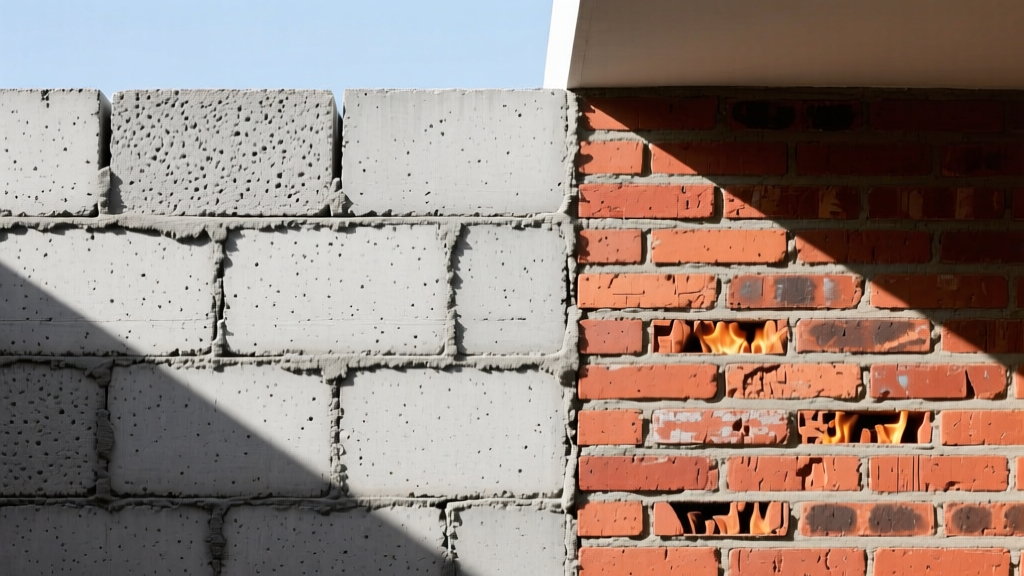
Environmental Impact and Embodied Carbon
Sustainability metrics in 2026 heavily scrutinize embodied carbon (measured in kgCO2e per functional unit). The environmental profiles of these materials present distinct trade-offs:
- Concrete CMU: The primary environmental burden is the Portland cement, which accounts for roughly 8% of global CO2 emissions due to the calcination of limestone. However, the concrete masonry industry has heavily adopted carbon-cured concrete technologies and high-volume SCM replacements, lowering the embodied carbon of modern CMUs by up to 30% compared to 2015 baselines. Furthermore, CMUs are 100% recyclable as aggregate base.
- Clay Brick: Clay extraction has a low environmental impact, but the kiln-firing process requires massive amounts of thermal energy, traditionally sourced from natural gas. While some modern kilns are transitioning to biogas or hydrogen blends, the embodied carbon of fired brick remains relatively high. However, clay brick boasts a lifespan exceeding 100 years with zero maintenance, which amortizes its carbon footprint over a much longer lifecycle than most building materials.
For project-specific data, architects should request Environmental Product Declarations (EPDs) from manufacturers. The Brick Industry Association (BIA) Technical Notes and the National Concrete Masonry Association (NCMA) TEK Library provide extensive, up-to-date lifecycle assessments and EPD directories for specifying professionals.
Expert Verdict: When to Specify Which
The choice between concrete and clay brick should be dictated by structural requirements, budget, and aesthetic intent rather than assuming one is universally superior.
Specify Concrete Masonry Units (CMU) When:
- Structural Load-Bearing is Required: CMUs are easily reinforced with vertical rebar and grout cells, making them the default choice for structural shear walls, foundation walls, and commercial load-bearing envelopes.
- Budget and Speed are Priorities: The larger unit size drastically reduces labor hours and scaffolding time.
- Industrial or Utilitarian Aesthetics: Exposed, painted, or burnished CMUs provide a cost-effective modern industrial look without the premium of face brick.
Specify Fired Clay Brick When:
- Uncoated Exterior Veneer is Desired: Clay brick offers unmatched color permanence, UV resistance, and zero-maintenance weathering. It will not fade, peel, or require repainting.
- Extreme Compressive Loads Exist: For specialized applications like heavy retaining walls or historic restoration requiring ultra-high psi materials, engineered clay brick outperforms CMU.
- Detailing and Modularity: The smaller scale of brick allows for intricate corbeling, arches, and complex geometric patterns that are impossible to achieve with standard CMU dimensions.
Written by
Marcus ChenMarcus Chen is a licensed structural engineer (PE) and building materials analyst with over 12 years of experience across residential, commercial, and industrial construction. He holds a Master of Science in Civil Engineering from UC Berkeley and spent six years at Thornton Tomasetti before transitioning to independent consulting and technical writing. Marcus specializes in material selection for seismic-prone regions, concrete reinforcement strategies, and lifecycle cost analysis. His work has been cited by the American Concrete Institute (ACI) and the Structural Engineers Association of California (SEAOC). When he is not on a job site or at his desk, you will find him hiking the Sierra Nevada or restoring a 1920s craftsman bungalow in Oakland, CA.
More from Marcus Chen
View all
Construction Cost
How Much Did the Eiffel Tower Cost to Build?
How much did the Eiffel Tower cost to build in 1889? We adjust for inflation and compare its budget to modern skyscraper construction.
Aug 4, 2026

Fire Resistance
What Is a Fire Resistant Material? Testing & Certification Guide
Discover what is a fire resistant material through ASTM and UL testing. Learn how fire ratings, certifications, and assemblies work in construction.
Aug 4, 2026

Construction Cost
How Much Did the Burj Khalifa Cost to Build?
How much did the Burj Khalifa cost to build? We break down the $1.5B project and extract 5 money-saving strategies for your next build.
Jul 30, 2026