Polyurethane Concrete Lifting vs Mudjacking: Costs & Applications
Compare polyurethane concrete lifting vs mudjacking for 2026 applications. Explore costs, cure times, and ideal use cases for residential and commercial slabs.

The Subgrade Dilemma: Why Slabs Sink and How We Fix Them
Concrete slabs do not fail on their own; they fail because the soil beneath them fails. Whether due to poor initial compaction, clay soil shrinkage during droughts, or subsurface water erosion, voids form under the slab. Once the unsupported concrete bears a load exceeding its tensile strength, it cracks and sinks. For property managers, municipal engineers, and homeowners in 2026, the decision on how to remediate this settlement comes down to two primary slab-jacking methods: high-density polyurethane foam injection and traditional cementitious mudjacking. Choosing the wrong method for a specific application leads to secondary settlement, blown budgets, and aesthetic disasters.
Material Science Showdown: Structural Foam vs. Cementitious Slurry
Before evaluating specific applications, it is critical to understand the physical properties of the lifting media. The fundamental difference lies in density, expansion rate, and curing mechanics.
| Property | Polyurethane Foam (Polyjacking) | Mudjacking (Slabjacking) |
|---|---|---|
| Material Composition | Two-part closed-cell structural polymer | Topsoil, sand, Portland cement, water slurry |
| Cured Density (Weight) | 2.5 to 4.0 lbs per cubic foot | 100 to 120 lbs per cubic foot |
| Injection Hole Size | 5/8 inch (dime-sized) | 1.5 to 2.0 inches |
| Expansion Ratio | 20x to 30x original liquid volume | None (displaces volume 1:1) |
| Cure / Traffic Time | 15 minutes (immediate traffic) | 24 to 48 hours |
| Water Resistance | Hydrophobic (impervious to water) | Hydrophilic (can erode or wash out) |
Application Showcase: Where Polyurethane Lifting Dominates
Residential Driveways, Walkways, and Stamped Pool Decks
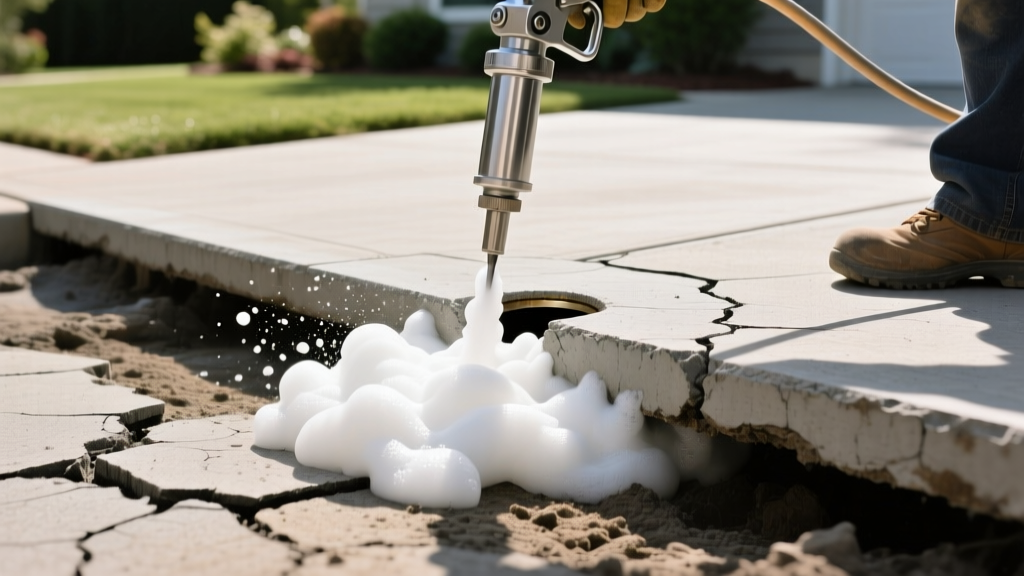
In residential and light commercial environments, aesthetics and minimal disruption are paramount. Polyurethane concrete lifting is the undisputed standard for these applications. The 5/8-inch injection holes are virtually invisible once patched with a matching non-shrink grout, preserving the visual continuity of stamped concrete, exposed aggregate, or decorative scored finishes.
Furthermore, pool decks are highly susceptible to water intrusion. Because high-density polyurethane (such as NCFI Polyurethanes' TerraThane or Alchemy-Spetec's AP Lift series) is a closed-cell, hydrophobic material, it will not absorb water, degrade, or wash away when exposed to constant pool splash-out and subgrade moisture. The 15-minute cure time means homeowners can drive on their lifted driveways or walk on their pool decks the same afternoon the crew finishes.
Precision Warehouse Floors and Cold Storage Facilities
Industrial facilities operate under strict floor flatness and levelness (FF/FL) tolerances. A sunken slab in a high-bay warehouse disrupts forklift traffic, causes mast wobble, and accelerates equipment wear. Polyurethane injection allows for millimeter-precise leveling. Technicians use digital laser levels and dial gauges to monitor the slab's rise in real-time, stopping the injection the exact moment the slab meets the specified F-min tolerance.
In cold storage facilities, mudjacking is virtually impossible; introducing a water-based cement slurry into a sub-zero environment results in freezing before the slurry can cure, leading to catastrophic expansion and slab heaving. Polyurethane foam, however, reacts and cures exothermically (generating its own heat), making it the only viable lifting solution for active freezer warehouses.
Application Showcase: The Enduring Niche for Mudjacking
Highway Approach Slabs and Massive Subgrade Voids
While polyurethane has captured the precision and residential markets, mudjacking retains a vital economic advantage in heavy civil infrastructure. According to pavement preservation guidelines referenced by the Federal Highway Administration (FHWA), highway approach slabs and bridge abutments frequently suffer from deep, massive voids caused by decades of water scouring and soil consolidation.
Consider a 100-square-foot highway slab that has dropped 8 inches due to a washed-out culvert bed. This creates a void requiring roughly 66 cubic feet of fill material. Pumping high-density polyurethane into a void of this magnitude would cost thousands of dollars in raw chemical material alone. Conversely, a mudjacking crew can pump a locally sourced slurry of sand, clay, and cement into that same void for a fraction of the material cost. When the void depth exceeds 4 to 6 inches, and the surface aesthetics of 2-inch patched holes are irrelevant, mudjacking is the mathematically correct choice.
Heavy-Duty Laydown Yards and Port Terminals
In environments where slabs are subjected to extreme static loads—such as steel coil storage yards or intermodal shipping container stacks—the sheer mass of the mudjacking slurry can be an asset rather than a liability. The 120 lbs/cu ft density of the cured slurry provides a rigid, high-mass base that resists the immense point-loads of heavy industrial storage, provided the underlying subgrade has been stabilized against future water intrusion.
2026 Cost Analysis and ROI Matrix
Pricing for concrete lifting fluctuates based on regional material costs, accessibility, and the severity of the settlement. Below is the current market baseline for 2026:
- Polyurethane Lifting: $5.00 to $9.00 per square foot. Minimum mobilization fees typically range from $1,500 to $2,500. Best ROI for slabs where replacement would cost $15+ per square foot and disrupt operations.
- Mudjacking: $3.00 to $6.00 per square foot. Minimum mobilization fees range from $800 to $1,200. Highly cost-effective for large municipal contracts exceeding 2,000 square feet.
- Full Slab Replacement: $12.00 to $22.00+ per square foot (including demolition, hauling, subgrade prep, and new pour). Requires 7 to 28 days of curing before heavy traffic.
Failure Modes: What Goes Wrong in the Field?
Understanding how these repairs fail is just as important as knowing how they work. The American Concrete Institute (ACI) emphasizes that surface repairs are only as durable as the subgrade preparation and environmental controls applied.
⚠️ Mudjacking Failure: Secondary Settlement and Washout
The most common failure in mudjacking is secondary settlement. By injecting 120 lbs/cu ft of heavy slurry under a slab that already failed due to weak soil, contractors add thousands of pounds of dead weight to the compromised subgrade. If the underlying soil cannot bear the new load, the slab sinks again. Furthermore, if the root cause of the void (e.g., a leaking downspout or broken sewer lateral) is not fixed, the water will simply wash away the soil-cement slurry, recreating the void.
💡 Polyurethane Failure: UV Degradation and Over-Lifting
Polyurethane foam is incredibly durable underground, but it is highly susceptible to ultraviolet (UV) degradation if exposed to direct sunlight. If foam extrudes through an unsealed expansion joint or a crack and is left exposed, it will turn brittle and crumble within months. Additionally, because the foam expands with significant force, inexperienced technicians can easily 'over-lift' a slab, causing it to crack or tilt in the opposite direction. Precise, staged injection is mandatory.
Project Decision Framework
Use this diagnostic flow to determine the correct lifting method for your specific project parameters:
- Step 1: Measure the Void Depth. If the void is deeper than 6 inches and spans a large area, default to mudjacking for economic viability. If the void is shallow (1-5 inches) or localized, proceed to Step 2.
- Step 2: Evaluate Surface Aesthetics. Is the concrete stamped, stained, or highly visible (e.g., a residential driveway or retail entrance)? If yes, use polyurethane to avoid unsightly 2-inch mudjacking patches.
- Step 3: Assess Traffic and Cure Time Requirements. Does the slab need to support traffic within hours (e.g., a busy warehouse aisle, an active fire station apron, or a hospital emergency ramp)? If yes, polyurethane's 15-minute cure is mandatory.
- Step 4: Analyze Subgrade Moisture. Is the soil constantly saturated or prone to seasonal water flow? Use hydrophobic polyurethane to prevent the lifting media from washing away.
By matching the material properties of the lifting media to the specific mechanical and environmental demands of the site, facility managers and contractors can ensure a permanent, cost-effective repair that restores both the structural integrity and the operational safety of the concrete infrastructure.
Written by
Priya KapoorPriya Kapoor is a real estate market analyst and construction economics researcher with expertise in housing affordability, development feasibility, and infrastructure investment. She holds a Master of Regional Planning from Cornell University and previously worked as a senior analyst at CBRE's Investment Properties group, where she modeled returns for $4B in mixed-use development pipelines. Priya now runs an independent research practice advising developers, municipalities, and REITs on construction cost forecasting and market timing. She publishes the quarterly "BuildMat Market Pulse" report tracking material price indices across 12 commodity categories. Based in Austin, TX, Priya serves on the board of Habitat for Humanity Austin and is a marathon runner.
More from Priya Kapoor
View all
Construction Cost
Cost to Build a 1600 Sq Ft Home in 2026: Full Breakdown
Accurate 2026 cost to build a 1600 sq ft home—material, labor, and regional pricing breakdowns included. Plan your budget with real-time estimates.
Aug 11, 2026

Wood & Lumber
Name the Types of Wood for Pressure Treatment and Preservation
Learn how to name the types of wood best suited for pressure treatment. Compare species treatability, chemical retention levels, and 2026 preservation costs.
Aug 4, 2026

Stone & Masonry
Stone Veneer Suppliers Lindenhurst: 2026 Cost Analysis
Analyze 2026 stone veneer costs in Lindenhurst, NY. Compare local supplier pricing, delivery fees, and Suffolk County installation labor rates.
Aug 4, 2026