Stamped Concrete vs Non-Slip Surfaces: Slip Resistance & Durability
Compare stamped concrete vs non-slip surfaces for slip resistance and durability. Discover DCOF ratings, sealer impacts, and best alternatives for wet areas.

The Core Conflict: Aesthetics vs. Traction
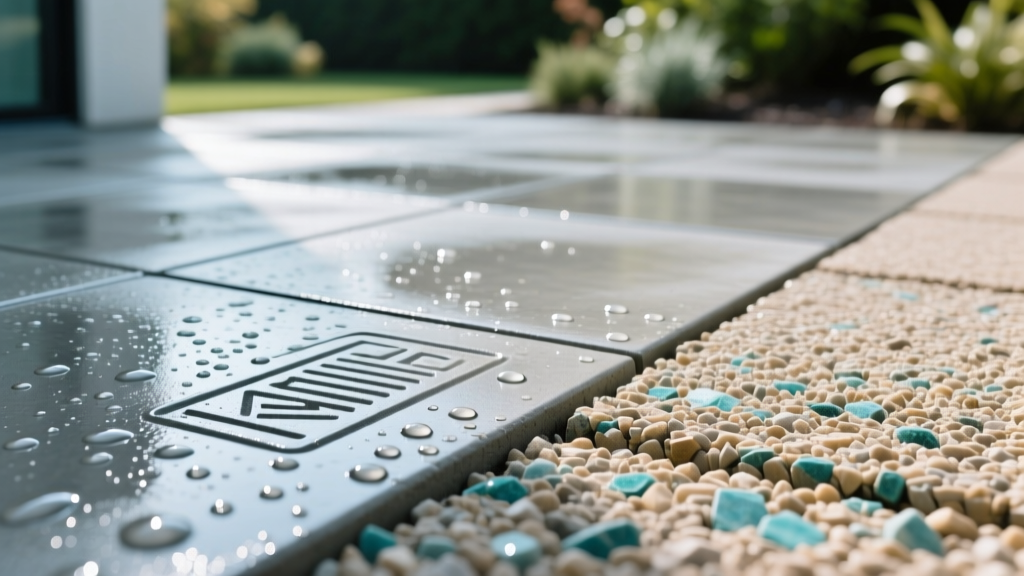
When designing exterior hardscapes, pool decks, and commercial walkways, property owners frequently face a critical trade-off: the high-end visual appeal of stamped concrete versus the functional safety of non-slip surfaces. Stamped concrete offers unparalleled design versatility, mimicking natural stone, slate, or brick at a fraction of the cost. However, the very chemicals required to protect and enhance stamped patterns often create severe slip hazards when wet. Understanding the friction metrics, sealer chemistry, and long-term durability of stamped concrete compared to dedicated non-slip alternatives is essential for avoiding liability and ensuring pedestrian safety.
Decoding Slip Resistance: DCOF Ratings Explained
Slip resistance in hardscapes is measured by the Dynamic Coefficient of Friction (DCOF). Unlike the older Static Coefficient of Friction (SCOF), DCOF measures the friction required to keep an object in motion from slipping, which more accurately simulates human walking mechanics. According to OSHA walking-working surface standards and ANSI A326.3 guidelines, a DCOF of 0.42 or higher is generally recommended for level interior spaces, but exterior wet environments demand significantly higher thresholds to prevent hydroplaning.
| Surface Type | Wet DCOF Range | Safety Classification |
|---|---|---|
| Polished / Sealed Smooth Concrete | 0.20 - 0.35 | Hazardous (High Slip Risk) |
| Stamped Concrete (Standard Acrylic Sealer) | 0.35 - 0.45 | Marginal (Caution Required) |
| Stamped Concrete (Sealer + Polymer Grit Additive) | 0.55 - 0.65 | Safe (Exterior Wet Rated) |
| Broom Finish Concrete | 0.60 - 0.75 | Very Safe |
| Exposed Aggregate Concrete | 0.65 - 0.80+ | Maximum Traction |
Stamped Concrete: The Sealer Trap and Additive Fixes
The Acrylic Sealer Problem
Stamped concrete relies on film-forming sealers—typically solvent-based or water-based acrylics like SuperSeal 25 or SureCrete Super Seal—to enhance color and protect the surface from UV degradation and efflorescence. When these acrylic resins cure, they form a microscopically smooth plastic film over the concrete. When water pools on this film, it acts as a hydroplaning layer, dropping the DCOF to dangerous levels. The stamped texture itself provides some mechanical grip, but the valleys of the stamp pattern often trap water, negating the friction of the peaks.
Formulating a Safe Stamped Surface
To make stamped concrete viable for pool decks or rainy climates, contractors must introduce anti-slip additives. Products like H&C SharkGrip or SureCrete SureGrip consist of micronized polymer beads or aluminum oxide grit. The critical factor is the application method:
- Mix-In Method: Adding 1 lb of grit per 5 gallons of sealer and rolling it on. This is easier but can dull the glossy finish and cause the grit to settle unevenly in the stamp crevices.
- Broadcast Method (Recommended): Rolling a pure coat of sealer and immediately broadcasting the grit by hand or with a hopper gun, followed by a second clear topcoat to lock it in. This preserves the visual depth of the stamp while providing a uniform DCOF of 0.60+.
Non-Slip Alternatives: Durability and Cost Breakdown
When slip resistance cannot be compromised, several alternative concrete finishes offer superior inherent traction without relying on fragile topical sealers.
1. Exposed Aggregate
Exposed aggregate involves pouring a standard concrete mix and washing away the top layer of cement paste before it fully cures, revealing the underlying stones (aggregate). Because the surface consists of rough, natural stone peaks, it achieves a wet DCOF of 0.65 to 0.80. Durability: Exceptional. It does not require a film-forming sealer. A penetrating silane/siloxane sealer (e.g., Ghostshield Siloxa-Tek 8500) can be applied to prevent water intrusion and freeze-thaw spalling without altering the surface friction. Cost: $9 to $14 per square foot.
2. Broom Finish
The most economical non-slip surface, achieved by dragging a stiff-bristled broom across fresh concrete. It creates linear striations that channel water away from the footprint. Durability: High, but the ridges can soften over 10-15 years of heavy traffic or snow plowing. Cost: $6 to $10 per square foot. While lacking the aesthetic prestige of stamped concrete, it remains the gold standard for municipal ramps and commercial loading docks where ADA accessibility guidelines mandate strict slip resistance.
3. Permeable Pavers with Sand Joints
While not a monolithic concrete pour, concrete permeable pavers offer a dual advantage. The textured surface of the pavers provides a DCOF above 0.60, while the open-graded aggregate joints allow water to drain instantly, eliminating surface pooling. Durability: Excellent freeze-thaw performance, though joints require re-sanding every 3-5 years. Cost: $16 to $24 per square foot.
Long-Term Durability & Maintenance Matrix
Choosing between stamped and non-slip surfaces requires looking past the installation day. Below is a 10-year projection of maintenance requirements and failure modes.
| Feature | Stamped Concrete (with Grit Additive) | Exposed Aggregate | Broom Finish |
|---|---|---|---|
| 10-Year Maintenance Cost | High ($4.50 - $7.50 / sq ft) | Low ($1.00 - $2.00 / sq ft) | Minimal ($0.50 / sq ft) |
| UV Resistance | Poor (Acrylic yellows/degrades) | Excellent (Integral stone color) | Excellent (Integral color) |
| Primary Failure Mode | Sealer delamination, white hazing, loss of slip grit | Aggregate pop-out in severe freeze-thaw cycles | Ridge erosion, surface scaling from de-icing salts |
| Winter De-icing | Highly sensitive to magnesium chloride; sealer will blister | Moderate resistance; penetrating sealers help | Good resistance, but salt accelerates ridge wear |
Decision Framework: Which Surface Fits Your Project?
Use this scenario-based framework to finalize your material specification:
- Choose Stamped Concrete (with Broadcast Grit) if: The project is a residential patio, courtyard, or low-traffic commercial entryway where high-end aesthetics are the primary driver, the budget accommodates bi-annual resealing, and winter de-icing chemicals will not be heavily used.
- Choose Exposed Aggregate if: You are building a pool deck, a steep driveway, or a waterfront walkway. The permanent, chemical-free traction and superior resistance to barefoot abrasion make it the undisputed champion for wet, high-traffic recreational zones.
- Choose Broom Finish if: The project involves public right-of-ways, ADA-compliant commercial ramps, or utility areas where budget constraints and strict adherence to NSC slip-and-fall prevention standards outweigh decorative concerns.
Ultimately, stamped concrete can be engineered to meet safety standards through rigorous additive protocols, but it will always require a higher maintenance burden to sustain that safety. True non-slip surfaces like exposed aggregate derive their friction from their physical geometry, offering a permanent, low-maintenance solution for environments where water and pedestrian traffic intersect.
Written by
Marcus ChenMarcus Chen is a licensed structural engineer (PE) and building materials analyst with over 12 years of experience across residential, commercial, and industrial construction. He holds a Master of Science in Civil Engineering from UC Berkeley and spent six years at Thornton Tomasetti before transitioning to independent consulting and technical writing. Marcus specializes in material selection for seismic-prone regions, concrete reinforcement strategies, and lifecycle cost analysis. His work has been cited by the American Concrete Institute (ACI) and the Structural Engineers Association of California (SEAOC). When he is not on a job site or at his desk, you will find him hiking the Sierra Nevada or restoring a 1920s craftsman bungalow in Oakland, CA.
More from Marcus Chen
View all
Construction Cost
How Much Did the Eiffel Tower Cost to Build?
How much did the Eiffel Tower cost to build in 1889? We adjust for inflation and compare its budget to modern skyscraper construction.
Aug 4, 2026

Fire Resistance
What Is a Fire Resistant Material? Testing & Certification Guide
Discover what is a fire resistant material through ASTM and UL testing. Learn how fire ratings, certifications, and assemblies work in construction.
Aug 4, 2026

Construction Cost
How Much Did the Burj Khalifa Cost to Build?
How much did the Burj Khalifa cost to build? We break down the $1.5B project and extract 5 money-saving strategies for your next build.
Jul 30, 2026