Troubleshooting Failures Linked to Types of Admixtures in Concrete
Diagnose and fix concrete failures caused by misused chemical admixtures. Expert troubleshooting steps and repair protocols for structural slabs.

The Hidden Culprit: When Admixtures Cause Concrete Failures
Concrete failures are rarely just about the water-cement ratio or poor curing. The misuse, overdosing, or incompatibility of the various types of admixtures in concrete is a leading, yet frequently misdiagnosed, cause of premature slab deterioration, scaling, and structural cracking. While chemical admixtures are essential for modern mix designs—improving workability, accelerating set times, or enhancing durability—an error in dosage by as little as 2% can compromise the entire structural matrix.
Troubleshooting these failures requires looking beyond surface symptoms to understand the chemical interactions occurring at the micro-level. This guide provides a diagnostic framework for identifying admixture-induced failures and outlines specific repair protocols using advanced admixture technologies to restore structural integrity.
Diagnostic Matrix: Matching Symptoms to Admixture Errors
Field diagnostics must differentiate between environmental wear and chemical imbalance. Use the following matrix to cross-reference visual symptoms with potential admixture failures before ordering destructive core testing.
| Failure Symptom | Likely Admixture Culprit | Mechanism of Failure | Immediate Field Test / Verification |
|---|---|---|---|
| Surface scaling, pop-outs, or dusting | Air-Entraining Agent (AEA) Overdose | Air voids exceed 8%, trapping bleed water near the surface and reducing surface paste density. | Petrographic analysis of a shallow core (ASTM C457) to measure air-void spacing factor. |
| Map cracking, rebar rust staining | Calcium Chloride Accelerator | Chloride ions break down the passive oxide layer on reinforcing steel, initiating rapid oxidation. | Half-cell potential testing (ASTM C876) and rapid chloride permeability test (ASTM C1202). |
| Flash set, severe slump loss in transit | Incompatible Superplasticizers | Polycarboxylate ethers (PCE) and older naphthalene-based SPs cross-link, causing rapid flocculation. | Slump cone test at 15-minute intervals; check batch plant dispenser logs for dual-dosing. |
| Excessive shrinkage cracking post-trowel | Overdosed Retarding Admixtures | Delayed hydration extends the plastic state, increasing vulnerability to plastic shrinkage evaporation. | Review weather logs against set times; perform penetration resistance test (ASTM C403). |
Case 1: Air-Entraining Agent (AEA) Overdosing
Air-entraining agents are critical for freeze-thaw durability, but the margin for error is razor-thin. The industry rule of thumb is that for every 1% increase in air content above the target (typically 5% to 7% for exterior slabs), compressive strength drops by approximately 5%. When AEA is overdosed, the resulting macro-voids weaken the surface paste, leading to severe scaling under de-icing salts.
Repair Protocol: You cannot chemically reverse an overdosed AEA in hardened concrete. The repair requires mechanical removal of the weakened surface. Scarify the top 1/4 inch using a planetary grinder equipped with 30-grit metal-bonded diamonds. Apply a bonding agent, then resurface with a micro-silica modified overlay (such as SikaTop-122 or Euclid EucoThin). The micro-silica particles (averaging 0.1 micrometers) fill the capillary pores, restoring surface density and achieving compressive strengths exceeding 6,000 psi within 28 days.
Case 2: Calcium Chloride Accelerator Corrosion
Calcium chloride is a highly effective, low-cost accelerating admixture used in cold-weather concreting. However, ACI Committee 212 strictly warns against its use in reinforced concrete exposed to moisture. ACI 318 limits water-soluble chloride ions to 0.15% for reinforced concrete exposed to chlorides and 0.30% for general reinforced concrete. Exceeding these limits guarantees eventual rebar corrosion, which expands up to six times its original volume, causing catastrophic delamination.
Repair Protocol: Locate the anodic areas using half-cell potential mapping. Remove the chloride-contaminated concrete via hydrodemolition (water pressure at 10,000 to 15,000 psi) to a depth of at least 1 inch behind the rebar mat. Clean the steel and apply a migrating corrosion inhibitor (MCI) liquid, such as Cortec MCI-2020, which penetrates the surrounding concrete to form a protective molecular layer on the steel. Patch the void with a shrinkage-compensated, polymer-modified repair mortar.
Selecting the Right Types of Admixtures in Concrete for Repairs
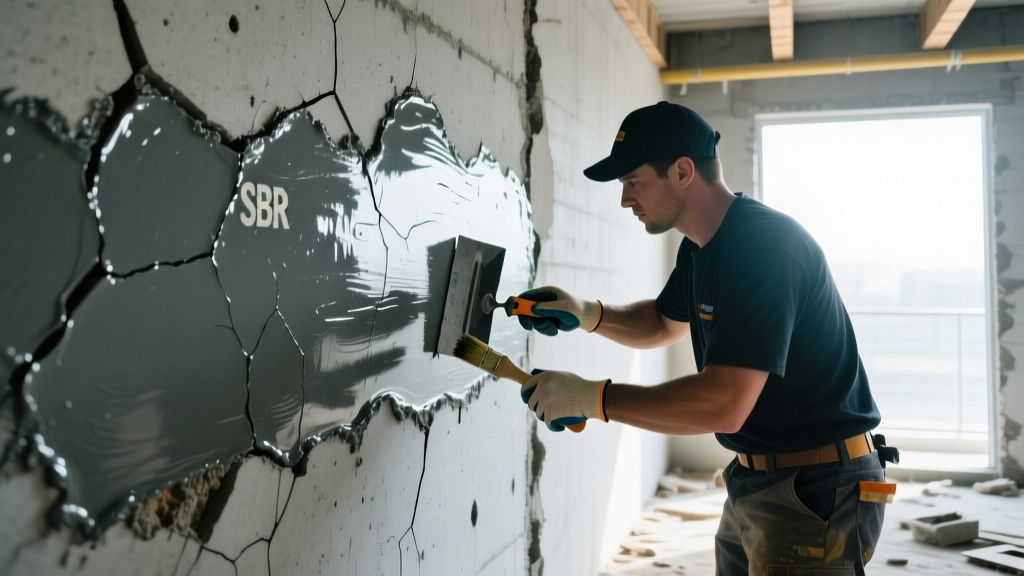
When executing structural repairs, standard concrete mixes will fail due to differential shrinkage between the new patch and the old substrate. Integrating specific repair-focused admixtures into your patching mortar is non-negotiable for long-term adhesion.
Shrinkage-Compensating Admixtures (SCA) for Structural Patching
Standard Portland cement shrinks as it cures, pulling away from the edges of a repair cavity and creating a micro-fissure where water ingress begins. Shrinkage-compensating admixtures (often based on calcium sulfoaluminate or magnesium oxide) induce a slight, controlled expansion during the first 24 to 48 hours of hydration. When restrained by the existing concrete substrate and rebar, this expansion creates a pre-compressive stress that locks the patch tightly against the old concrete, eliminating the shrinkage gap. Dosage typically ranges from 8% to 12% by weight of cement, depending on the specific SCA brand (e.g., Sika Expantec or GCP PREPRUFE).
Crystalline Waterproofing Admixtures for Leak Sealing
For below-grade repairs or water-retaining structures, crystalline admixtures (like Xypex or Kryton) offer a self-sealing mechanism. These admixtures contain proprietary blends of silica, treated sand, and reactive chemicals. When mixed into a repair mortar, they remain dormant until exposed to moisture. Upon contact with water, they react with the free lime (calcium hydroxide) in the cement paste to form millions of needle-like calcium silicate hydrate crystals. These crystals block capillary tracts and micro-cracks up to 0.4mm wide, effectively making the repair patch permanently waterproof even under hydrostatic pressure.
Step-by-Step Protocol: Flushing and Re-dosing Liquid Admixtures
If a batch plant or site-mix error is caught before the concrete is placed (e.g., a missed dose of superplasticizer resulting in a 2-inch slump instead of the required 6-inch slump), follow this strict re-dosing protocol to avoid creating localized weak zones:
- Calculate the Deficit: Determine the exact volume of admixture needed based on the manufacturer's dosage rate (typically expressed in fluid ounces per 100 lbs of cement). Never exceed the manufacturer's maximum recommended dosage limit, as this can cause severe retardation.
- Dilute the Admixture: Mix the required chemical dose with 1 to 2 gallons of clean water in a separate container. Adding raw, concentrated superplasticizer directly to the truck drum can cause localized flash-setting or air-void collapse.
- High-Speed Drum Rotation: Add the diluted mixture to the transit mixer and rotate the drum at mixing speed (12 to 15 RPM) for a minimum of 5 minutes, or at least 30 revolutions, to ensure homogenous distribution throughout the batch.
- Verify Slump and Air: Perform a fresh slump test and an air content test (ASTM C231) before authorizing the pour. If the air content has dropped below the specified tolerance due to the late addition of superplasticizer, a secondary micro-dose of AEA may be required.
Expert Sourcing and Testing Standards
Understanding the chemical mechanics of concrete requires adherence to rigorous industry standards. The Portland Cement Association (PCA) provides comprehensive guidelines on the classification and proper application of chemical admixtures, emphasizing that all liquid admixtures must be stored at temperatures above 40°F to prevent precipitation and separation of active solids.
Furthermore, when troubleshooting persistent field failures, always refer to the National Ready Mixed Concrete Association (NRMCA) Concrete In Practice (CIP) bulletins. CIP documents provide peer-reviewed, field-tested protocols for evaluating admixture interactions, ensuring that your repair strategies are backed by empirical data rather than anecdotal site practices. By mastering the specific types of admixtures in concrete, contractors can transition from reactive patching to proactive, chemically sound structural restoration.
Written by
Sarah WhitfieldSarah Whitfield is a chartered quantity surveyor (MRICS) and construction cost analyst with 15 years of experience in material pricing, procurement strategy, and project budgeting. She earned her degree in Construction Management from the University of Reading (UK) and has worked on projects ranging from $2M custom homes to $180M mixed-use developments across North America and Europe. Sarah currently leads cost estimating for BuildMat Insight, maintaining a proprietary database of 4,000+ material price points updated quarterly. She is a frequent contributor to RSMeans cost data panels and has presented at the International Cost Engineering Council (ICEC) congress. Based in Denver, CO, Sarah is an avid trail runner and volunteer mentor for Women in Construction.
More from Sarah Whitfield
View all
Wood & Lumber
What Are the Different Types of Wood? A Builder's Guide
Compare structural softwoods, finish hardwoods, and engineered lumber. Analyze Janka ratings, MOE values, and 2026 pricing for construction.
Aug 4, 2026

Walls & Panels
Steel Framing vs Wood Framing: Corrosion and Moisture Defense
Compare steel framing vs wood framing for moisture resistance. Learn about galvanized coatings, condensation risks, and corrosion protection strategies.
Jul 21, 2026

Stone & Masonry
How to Cut Stone Veneer: Wet Saw vs Grinder Comparison
Compare the best tools for cutting stone veneer. We review wet saws, angle grinders, and chop saws to help you achieve clean, chip-free cuts.
Jul 21, 2026