Stamped Concrete vs Regular Concrete Cost: 2026 Installation Guide
Compare stamped concrete vs regular concrete cost for 2026. This installation guide breaks down labor, materials, and long-term maintenance expenses.

The Core Differential: Where the Budget Actually Goes
When evaluating stamped concrete vs regular concrete cost, the divergence is rarely about the base material itself. A cubic yard of 4,000 PSI ready-mix concrete costs the same whether it is destined for a basic broom-finished sidewalk or a high-end ashlar slate patio. The 2026 pricing gap—where stamped installations routinely cost 2.5 to 3 times more than standard pours—is driven entirely by specialized chemical treatments, extended labor hours, and advanced finishing techniques.
2026 National Average Installation Costs
- Regular Concrete (Broom Finish): $9.00 – $14.00 per square foot
- Stamped Concrete (Single Pattern/Color): $16.00 – $24.00 per square foot
- Stamped Concrete (Custom/Multi-Color): $22.00 – $32.00+ per square foot
Understanding these costs from an installation perspective requires breaking down the sequential phases of the pour, the chemical additives required, and the long-term maintenance liabilities inherent to each system.
Regular Concrete Installation: The Baseline Process
Standard concrete flatwork prioritizes structural integrity and basic slip resistance. According to the American Concrete Institute (ACI) guidelines for flatwork finishing, a standard installation relies on a straightforward sequence that minimizes on-site labor hours.
Material and Subgrade Specifications
Both regular and stamped concrete require identical subgrade preparation to prevent differential settlement. This includes excavating to a depth of 8 to 10 inches and compacting a 4-inch base of 3/4-inch crushed aggregate. In 2026, site prep and forming account for roughly $2.50 to $4.00 per square foot of the total budget. Reinforcement typically utilizes 6x6 W1.4/W2.0 welded wire mesh or synthetic macro-fibers (like Fibermesh) dosed at 3 to 5 lbs per cubic yard to control plastic shrinkage cracking.
Labor and Finishing Steps
The labor cost for regular concrete is relatively low because the finishing window is forgiving. After the concrete is struck off (screeded) and bullfloated, the crew waits for the bleed water to evaporate. A single pass with a float followed by a coarse broom finish completes the job. The entire finishing process for a standard 500-square-foot driveway can be completed by a three-person crew in under two hours.
Stamped Concrete Installation: The Premium Tier
Stamping transforms a utilitarian slab into an architectural surface. This process interrupts the standard finishing timeline, requiring a larger crew, precise weather monitoring, and expensive proprietary chemicals.
The Three-Step Coloring System
Unlike regular concrete, which is either left gray or integrally colored, premium stamped concrete utilizes a multi-layered coloring system to achieve realistic depth. This adds significant material costs:
- Base Color: Achieved via integral liquid or powder pigments added to the ready-mix truck at the batch plant (adds $1.50 – $2.50 per sq ft).
- Color Hardener: A dry-shake broadcast applied to the surface that increases surface compressive strength to over 8,000 PSI while providing the primary color. Brands like Butterfield Color or Brickform cost approximately $45 to $60 per 60-lb pail, covering roughly 100 square feet per color layer.
- Antiquing Release Agent: A secondary, contrasting color applied in powder or liquid form before stamping to prevent the polyurethane mats from sticking to the concrete while creating realistic 'grout' lines and shadowing.
The Stamping Process and Labor Multipliers
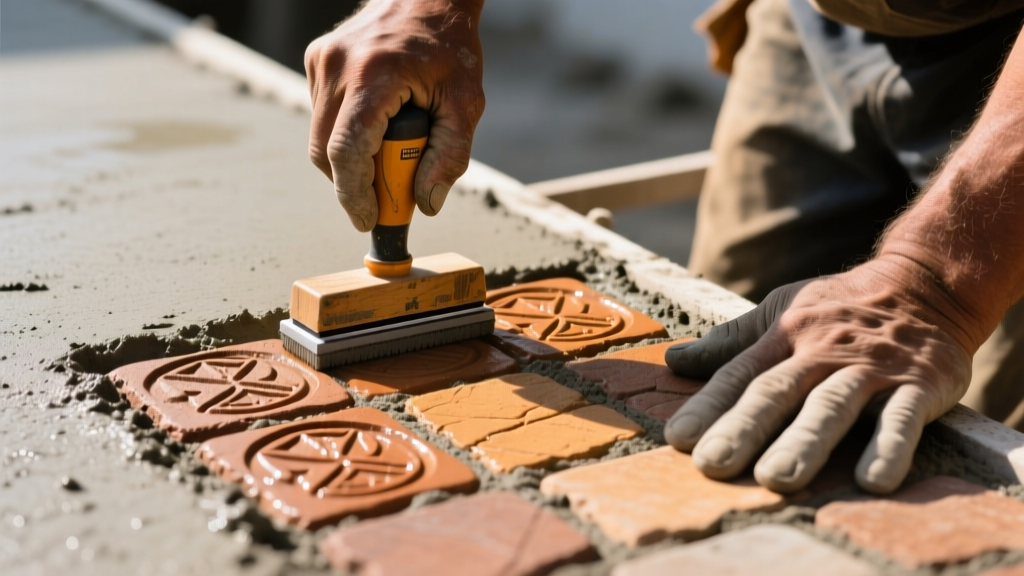
The stamping phase requires exact timing. If the crew stamps too early, the mats sink into the aggregate; too late, and the surface crusts, resulting in shallow, poorly defined patterns. A standard stamping crew requires 5 to 7 people: one to broadcast the release agent, three to align and step on the interlocking polyurethane mats, and one to manage edge detailing with flexible 'floppy' mats. This intense labor concentration easily doubles the finishing labor cost compared to a broom finish.
Side-by-Side Installation Cost Matrix
The following table breaks down the exact line-item costs for a hypothetical 600-square-foot patio installation in 2026, highlighting where the premiums are absorbed.
| Cost Category | Regular Concrete (Broom) | Stamped Concrete (Ashlar Slate) |
|---|---|---|
| Site Prep & Forming | $1,800 ($3.00/sq ft) | $1,800 ($3.00/sq ft) |
| Ready-Mix Concrete (4,000 PSI) | $1,200 ($2.00/sq ft) | $1,200 ($2.00/sq ft) |
| Integral Color Additive | $0 | $900 ($1.50/sq ft) |
| Color Hardener & Release Agent | $0 | $1,050 ($1.75/sq ft) |
| Finishing & Stamping Labor | $1,500 ($2.50/sq ft) | $4,500 ($7.50/sq ft) |
| Washing & Sealing (Post-Cure) | $0 | $1,200 ($2.00/sq ft) |
| Total Estimated Cost | $4,500 ($7.50/sq ft)* | $10,650 ($17.75/sq ft) |
*Note: Base costs can reach up to $14.00/sq ft depending on regional labor rates, complex forming, and reinforcement upgrades like rebar grids.
Long-Term Maintenance and Lifecycle Costs
The stamped concrete vs regular concrete cost debate extends far beyond the initial invoice. Regular concrete is virtually maintenance-free. Beyond occasional pressure washing, a broom-finished slab requires no chemical upkeep. If it cracks, the repair is straightforward and easily camouflaged.
Stamped concrete, however, introduces mandatory lifecycle expenses. The Portland Cement Association notes that decorative surfaces are highly dependent on their protective sealers to prevent UV degradation and moisture intrusion.
The Resealing Mandate
Stamped concrete must be cleaned and resealed every 2 to 3 years using a solvent-based acrylic or water-based polyurethane sealer. In 2026, professional resealing costs between $1.50 and $3.00 per square foot. Over a 15-year period, a 600-square-foot stamped patio will incur an additional $2,700 to $5,400 in mandatory maintenance, a cost entirely absent in regular concrete installations.
Common Installation Mistakes That Inflate Costs
When contractors cut corners to bridge the price gap between stamped and regular concrete, catastrophic failures occur. Understanding these edge cases is critical for evaluating bids and ensuring long-term durability.
1. Delamination from Improper Troweling
If a crew broadcasts color hardener and immediately begins heavy steel troweling before the material has fully absorbed the bleed water, they trap moisture beneath a dense surface crust. As the concrete cures, this trapped moisture turns to vapor, causing the colored surface layer to blister and delaminate. Repairing delamination requires complete surface grinding and the application of a micro-topping overlay, costing upwards of $8.00 per square foot.
2. Blistering from Premature Sealing
Stamping requires a secondary release agent that must be thoroughly power-washed off the surface 24 to 48 hours after the pour. If the crew seals the concrete before it has fully outgassed (typically requiring a 28-day full cure for solvent-based sealers), the trapped gasses create permanent white blisters beneath the acrylic film. Stripping and resealing a blistered patio adds roughly $4.50 per square foot in chemical stripping and labor costs.
3. Ignoring Control Joint Depth
Both regular and stamped concrete will crack. The goal is to control where it cracks. ACI standards dictate that saw-cut control joints must be to a depth of exactly one-quarter the slab thickness (e.g., 1 inch deep on a 4-inch slab) and must be executed within 12 to 24 hours of the pour. In stamped concrete, contractors often attempt to hide joints within the pattern's 'grout' lines, cutting them too shallow to avoid ruining the stamp alignment. This inevitably results in random, jagged cracking that ruins the visual illusion of the stone pattern.
Decision Framework: Which System Fits Your Project?
Use this practical framework to determine which installation justifies the investment for your specific application.
- Choose Regular Concrete If: The area is primarily utilitarian (driveways, alleyways, basement floors), the budget is strictly capped below $12/sq ft, or you want zero mandatory maintenance over a 30-year lifespan.
- Choose Stamped Concrete If: The project is a high-visibility entertainment space (patios, pool decks, walkways), you require the aesthetic of natural stone or brick without the $35+/sq ft cost of masonry installation, and you are prepared to budget for triennial resealing.
- Consider Exposed Aggregate (The Middle Ground): If you want more visual interest than a broom finish but cannot justify the $18+ cost of stamping, exposed aggregate offers a durable, slip-resistant decorative surface for roughly $12.00 to $16.00 per square foot, requiring significantly less maintenance than stamped systems.
Ultimately, evaluating the stamped concrete vs regular concrete cost requires looking past the initial pour. Stamped concrete is an architectural finish applied to a structural base, demanding specialized labor and ongoing chemical upkeep. Regular concrete is a pure structural wear surface. Align your choice with your long-term maintenance tolerance and the aesthetic demands of the space.
Written by
James ThorntonJames Thornton is a construction industry veteran with 25 years of hands-on experience in wood framing, lumber grading, and residential building codes. He started as a framing carpenter in rural Oregon, earned his ICC Residential Building Inspector certification, and eventually became a senior plan reviewer for the City of Portland Bureau of Development Services. James holds a B.S. in Wood Science & Technology from Oregon State University and is a certified lumber grader through the West Coast Lumber Inspection Bureau (WCLIB). He has inspected over 3,000 residential construction sites and authored the city's internal guide on advanced framing techniques (2x6 at 24" O.C.). James lives in Bend, OR, where he builds custom timber-frame cabins and competes in lumberjack sports.
More from James Thornton
View all
Insulation
Best Home Insulation Materials: Complete 2026 Guide
Compare top home insulation materials for 2026. Find R-values, installed costs per square foot, and best uses for fiberglass, spray foam, and mineral wool.
Aug 4, 2026

Sustainable Building
Certify Your Green Building Material for LEED and WELL
Step-by-step guide to certifying a green building material for LEED v5 and WELL v2. Master EPDs, HPDs, and VOC limits for 2026 project specifications.
Aug 4, 2026

Stone & Masonry
Veneer Stacked Stone Panels: Interior Design & Style Showcase
Discover how veneer stacked stone panels transform interiors. Explore modern design profiles, material pairings, and technical installation specs.
Aug 4, 2026