Concrete Mites vs Chiggers: Identification & Yard Treatment Costs
Compare concrete mites vs chiggers with our 2026 cost breakdown. Learn identification, DIY chemical prices, and concrete sealing costs to stop infestations.

The Core Misconception: Concrete Mites vs Chiggers
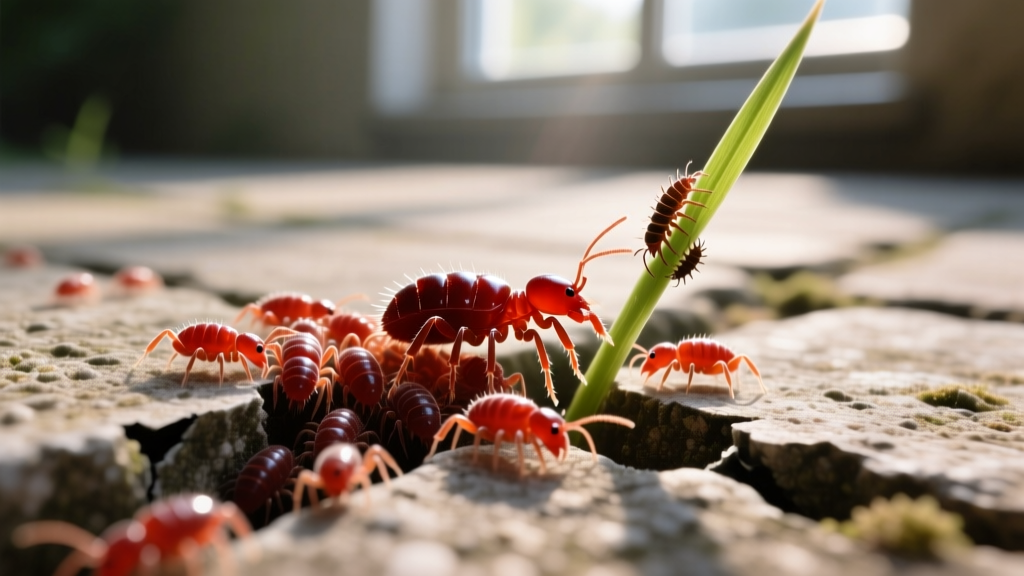
Homeowners frequently encounter swarms of tiny red insects on their concrete patios, sidewalks, and retaining walls during late spring and summer. When intense, itchy bites follow outdoor exposure, the immediate assumption is that the bugs on the concrete are the culprits. This is a fundamental biological misunderstanding that leads to wasted money on ineffective treatments. To budget accurately for eradication, you must first distinguish between Balaustium mites (concrete mites) and Trombiculidae larvae (chiggers).
Concrete mites do not bite humans. They are predatory or plant-feeding arachnids that congregate on sun-baked concrete to hunt smaller insects or seek warmth. Chiggers, conversely, are parasitic larvae that require high humidity, shade, and dense vegetation to survive. They cannot survive on hot, exposed concrete slabs. However, they will harbor in the damp soil adjacent to the slab, within overgrown expansion joints, or in moss growing in shaded concrete cracks. The bites you experience are from chiggers in the perimeter grass, while the red swarm on the slab is likely harmless concrete mites.
Visual & Behavioral Identification Matrix
| Feature | Concrete Mites (Balaustium spp.) | Chiggers (Trombiculidae) |
|---|---|---|
| Size | 1/16 inch (visible to naked eye) | 1/60 inch (nearly microscopic) |
| Color | Bright brick-red or velvety red | Translucent red or orange |
| Primary Habitat | Hot concrete, brick, sunny rocks | Tall grass, damp soil, shaded weeds |
| Human Bite Risk | Zero (do not feed on blood/skin) | High (inject digestive enzymes) |
| Concrete Affinity | Gather in massive surface swarms | Hide in cracks/joints, avoid open slab |
For authoritative biological data on parasitic mites, refer to the Centers for Disease Control and Prevention (CDC) guidelines on chigger habitats and bite prevention.
Concrete-Specific Remediation: The Hidden Eradication Cost
Most pest control guides ignore the structural substrate. Concrete is highly porous and prone to micro-fissuring. While chiggers won't live in the center of a dry slab, both pests utilize unsealed concrete cracks, spalled surfaces, and degraded expansion joints as moisture traps and breeding grounds. Eradicating the pests requires sealing the concrete ecosystem.
Crack Filling and Joint Sealing Costs
Standard acrylic caulk fails under UV exposure and foot traffic, reopening habitats within months. For permanent pest exclusion, use self-leveling polyurethane sealants.
- Sikaflex Self-Leveling Sealant: $11.50 per 10.1 oz tube. Covers approximately 12 linear feet of a 1/2-inch wide crack. Ideal for horizontal driveway and patio expansion joints.
- Backer Rod (Closed-Cell Foam): $8.00 per 20-foot roll. Required for cracks deeper than 1/2 inch to prevent the sealant from sinking and wasting material.
- Labor: DIY application takes 15 minutes per 10-foot joint. Professional concrete caulking services charge $3.50 to $6.00 per linear foot.
Penetrating Concrete Sealers
To stop mites from harboring in the microscopic pores of the concrete surface, apply a silicate-based penetrating sealer. These sealers react chemically with free lime in the cement to form a calcium silicate hydrate (CSH) barrier, densifying the surface without leaving a slippery topical film.
- RadonSeal Deep-Penetrating Concrete Sealer: $59.00 per gallon. Covers 200-250 square feet per coat. Requires two coats applied wet-on-wet.
- Armor SX5000 Silane-Siloxane Sealer: $185.00 per 5-gallon pail. Covers up to 1,250 square feet. Excellent for repelling the moisture that attracts perimeter pests.
Many homeowners attempt to blast concrete mites away with a 3000-PSI pressure washer. This is counterproductive. High-pressure water forces mites deeper into the concrete pores and strips away existing protective sealants. Furthermore, the residual moisture left in the concrete attracts more pests. Always use a chemical application followed by a gentle rinse, not mechanical force.
Chemical Treatment Cost Breakdown: DIY vs. Professional
Once the concrete substrate is sealed, the surrounding perimeter must be treated to eliminate chiggers in the soil and concrete mites on the surface. The Environmental Protection Agency (EPA) mandates strict adherence to label instructions when applying outdoor pesticides near residential foundations.
DIY Chemical Material Costs (2026 Pricing)
| Active Ingredient | Product Example | Cost | Yield / Coverage | Target Pest |
|---|---|---|---|---|
| Bifenthrin 7.9% | Talstar P Professional | $52.00 / 3/4 gal | 1 oz per gallon; yields 96 gallons | Chiggers, Mites, Ants |
| Permethrin 36.8% | Martin's Permethrin SFR | $28.00 / quart | 1 oz per gallon; yields 32 gallons | Chiggers, Ticks, Fleas |
| Essential Oils | Essentria IC3 (Organic) | $45.00 / quart | 2 oz per gallon; yields 16 gallons | Surface Mites (Repellent) |
| Diatomaceous Earth | Harris Food Grade DE | $15.00 / 4 lbs | Light dusting; covers ~500 sq ft | Dry surface mites only |
Note: Bifenthrin and Permethrin are highly toxic to aquatic life and bees during application. Apply in the early evening when bees are inactive, and never allow runoff to enter storm drains.
Professional Extermination Pricing Tiers
If the infestation spans beyond the concrete perimeter into heavy brush or wooded areas, professional application is necessary. Exterminators use commercial-grade backpack mist blowers that penetrate the thatch layer of soil where chiggers reside.
| Yard Size | Treatment Type | Average Cost (2026) | Frequency Required |
|---|---|---|---|
| Under 5,000 sq ft | Perimeter & Concrete Barrier | $175 - $250 | One-time or Quarterly |
| 1/4 Acre (10,890 sq ft) | Full Yard Broadcast Spray | $280 - $375 | Monthly during peak season |
| 1/2 Acre+ | Full Yard + Brush Clearing | $450 - $650+ | Bi-monthly + vegetation mgmt |
Step-by-Step Eradication & Budgeting Protocol
To achieve total control, execute the following sequence. Skipping the concrete preparation step will result in rapid re-infestation after the first heavy rain.
- Vegetation Management (Day 1): Trim all grass, weeds, and shrubs back at least 12 inches from the edge of the concrete slab. Chiggers require the humid microclimate provided by tall grass; removing it exposes the soil to UV light, naturally reducing their population. Cost: $0 (DIY) or $85-$150 for a landscaping crew.
- Substrate Preparation (Day 2): Sweep the concrete thoroughly. Rake out loose debris from expansion joints. Insert closed-cell backer rod into deep cracks and cap with Sikaflex polyurethane sealant. Allow 48 hours to cure. Cost: ~$25 for materials per standard patio.
- Surface Sealing (Day 4): Apply a silicate penetrating sealer to the concrete slab using a low-pressure garden sprayer. This eliminates the porous micro-habitats. Cost: ~$60-$120 depending on square footage.
- Chemical Broadcast (Day 5): Mix Bifenthrin at a rate of 1 oz per gallon of water. Spray the concrete surface, the foundation of the home, and a 10-foot wide band of soil/grass extending outward from the slab. Cost: ~$15 for a 3/4 gallon bottle of concentrate and a $35 pump sprayer.
Frequently Asked Questions
Can concrete mites infest the interior of my home?
Yes, Balaustium mites can migrate indoors through weep holes, window sills, and unsealed foundation cracks, especially during extreme heat or heavy rain. However, they cannot reproduce indoors due to the lack of their natural food sources and lower humidity. Sealing exterior concrete cracks and installing copper mesh in weep holes prevents entry.
Why do chigger bites itch more than mosquito bites?
Chiggers do not suck blood. They inject a salivary enzyme that dissolves skin cells, which the larva then consumes. The intense itching is an allergic reaction to the digestive enzymes and the hardened stylostome (a tube-like structure the chigger forms in your skin). Treatment requires anti-itch creams containing hydrocortisone or pramoxine, not pest control on the concrete itself.
Is Diatomaceous Earth effective on concrete patios?
Diatomaceous Earth (DE) is only effective when completely dry. On an outdoor concrete patio exposed to morning dew, rain, or sprinkler overspray, DE quickly turns into a useless paste. It is highly effective in dry, covered areas like crawl spaces or beneath covered porches, but synthetic pyrethroids like Bifenthrin are required for exposed concrete perimeters.
Written by
David NakamuraDavid Nakamura is a licensed architect (AIA) and construction technology writer focused on sustainable building methods, mass timber engineering, and high-performance building envelopes. He holds a Master of Architecture from the University of Washington and is a certified Passive House Consultant (CPHC). David spent eight years at the Seattle firm Mithun, where he led the design of three LEED Platinum projects, before founding his own practice specializing in net-zero residential design. He serves on the editorial advisory board of GreenBuilder Magazine and has authored peer-reviewed papers on cross-laminated timber (CLT) connections for the Journal of Structural Engineering. In his spare time, David teaches woodworking at Pratt Fine Arts Center and kayaks the Puget Sound.
More from David Nakamura
View all
Construction Cost
Labor Cost to Build a Deck Per Sq Ft: 2026 Installation Guide
Discover the exact labor cost to build a deck per sq ft in 2026. This installation guide breaks down contractor rates, complexity factors, and hidden fees.
Aug 4, 2026

Construction Cost
How Much Does It Cost to Build a 3 Bedroom House? Financing Guide
Learn exactly how much it costs to build a 3 bedroom house and explore 2026 financing options, construction loan types, and budget frameworks for your build.
Aug 4, 2026

Construction Cost
Cost to Build a Tennis Court: 2026 Guide
How much does it cost to build a tennis court in 2026? Breakdowns for asphalt, concrete, and synthetic surfaces plus fencing and lighting.
Jul 30, 2026