Types of Concrete Grinding Wheels vs Alternative Prep Methods
Compare types of concrete grinding wheels with alternative prep methods. Expert guide on PCD, diamond cups, costs, and CSP profiles.

The Surface Preparation Dilemma: Grinding vs. Alternatives
Achieving the correct Concrete Surface Profile (CSP) is the single most critical variable in coating adhesion, overlay bonding, and structural repair longevity. While contractors have multiple mechanical and chemical methods at their disposal, selecting the right tool requires matching the substrate hardness, coating thickness, and project scale. Understanding the specific types of concrete grinding wheels—and how they compare to alternative preparation methods like shot blasting or acid etching—prevents catastrophic adhesion failures and minimizes consumable burn rates.
Core Types of Concrete Grinding Wheels Explained
Grinding wheels remove material through micro-fracturing the concrete matrix or shearing elastomeric coatings. The efficacy of the wheel depends entirely on the bond matrix holding the cutting agents.
1. Standard Diamond Cup Wheels
Diamond cup wheels are the workhorses of concrete prep. They consist of synthetic diamond grit suspended in a metal powder matrix (typically cobalt, iron, or copper) that is sintered onto a steel core. The fundamental rule of diamond tooling is inverse: use a soft bond for hard concrete, and a hard bond for soft concrete.
- Segmented (Arrow or T-Bar): Features gaps between segments to expel dust and dissipate heat. Best for aggressive stock removal, leveling uneven joints, and achieving a CSP 2 to CSP 3 profile. Standard grits range from 16/20 (coarse) to 30/40 (medium).
- Turbo (Continuous Rim with Serrations): Offers a smoother finish with less aggressive scratching. Ideal for removing thin mil coatings or prepping for polished concrete transitions. Typically achieves a CSP 1 to CSP 2.
- Double-Row: Balances material removal speed with surface flatness, minimizing the deep gouges common with single-row segmented wheels.
2. Polycrystalline Diamond (PCD) Wheels
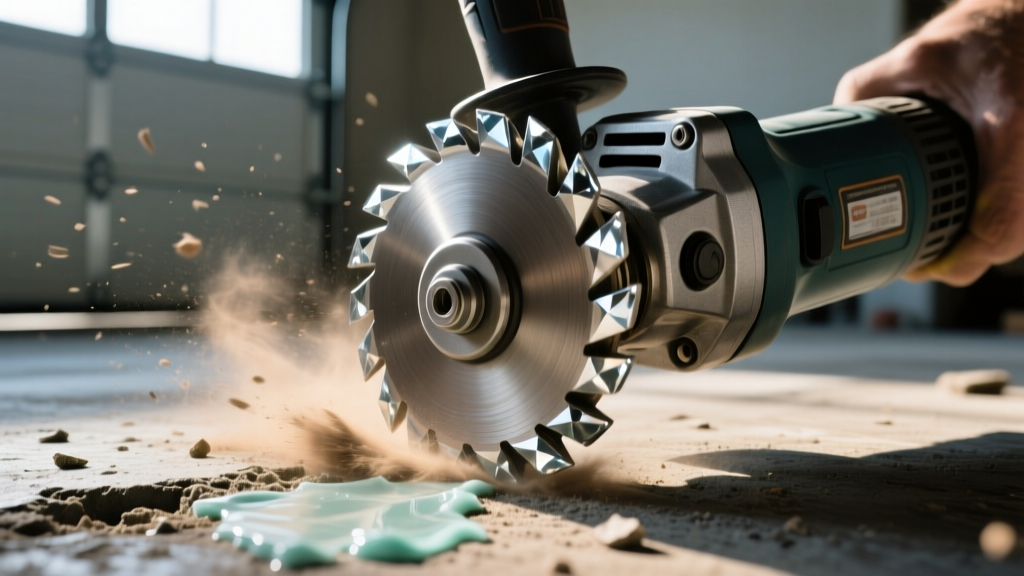
When removing thick, gummy coatings like VCT mastic, polyurethane, or high-build epoxy, standard diamond wheels will instantly "load" (clog) with melted resin. PCD wheels solve this. PCD segments are manufactured by sintering macro-crystalline synthetic diamonds with a carbide substrate under extreme heat and pressure. The resulting cutting edge is a massive, jagged diamond structure that shears elastomeric coatings rather than grinding them into a paste. A 5-inch PCD wheel with 3/4-inch segments can strip 1,000 square feet of stubborn epoxy in the time it takes a standard diamond wheel to ruin three segments.
3. Carbide Scarifier Cutters (Flails)
While technically used on scarifying machines rather than rotary grinders, tungsten carbide star-cutters and flails are a vital comparison point. They operate via blunt-force impact rather than abrasion, chipping away the top 1/8 to 1/4 inch of the concrete surface. They are unmatched for removing thermoplastic road markings or heavily spalled, degraded surface layers.
Wheel Selection Matrix: Application and Cost
| Wheel / Cutter Type | Best Application | Bond / Material | Est. Cost (5-inch / 125mm) | Target CSP Profile |
|---|---|---|---|---|
| Segmented Diamond Cup | Bare concrete leveling, thin-set removal | Soft/Medium Metal Matrix | $35 - $75 | CSP 2 - 4 |
| Turbo Diamond Cup | Smooth finishing, thin mil paint removal | Hard Metal Matrix | $45 - $90 | CSP 1 - 2 |
| PCD (Polycrystalline) | Thick epoxy, VCT glue, tar, mastic | Sintered Macro-Diamond | $140 - $280 | Stripping to bare (CSP 1-3) |
| Carbide Flails (Scarifier) | Heavy spalling, traffic lines, grooving | Tungsten Carbide | $120 - $200 (per drum set) | CSP 4 - 5+ |
Direct Comparison: Grinding vs. Alternative Prep Methods
Grinding is not always the optimal choice. Evaluating alternative methods ensures you do not waste labor hours on an inefficient process.
Decision Framework: Choose Your Prep Method
- IF the slab is >5,000 sq. ft. and requires a CSP 3-4 for a heavy-duty urethane mortar → Choose Shot Blasting. Shot blasting uses centrifugal force to propel steel shot, leaving a uniform, dimpled profile without the swirl marks inherent to rotary grinding.
- IF the slab has heavy surface undulations, curling joints, or requires a CSP 5 for thick overlay → Choose Planing/Scarifying. Grinders follow the existing contour; planers cut through high spots to establish true flatness (F-numbers).
- IF the project is a residential garage <2,000 sq. ft. with tight edges and complex obstacles → Choose Diamond Grinding. Hand-held 5-inch or 7-inch grinders with shrouds and HEPA vacuums can reach within 1/16-inch of walls, whereas shot blasters leave a 4-inch unprocessed perimeter.
- IF the specification calls for acid etching (muriatic acid) → Reject and Substitute. As of 2026, acid etching is widely banned in commercial coating specifications. It yields an inconsistent CSP, fails to remove surface laitance reliably, and creates severe environmental runoff liabilities.
Real-World Failure Modes and Edge Cases
Even with the correct wheel type, operators frequently encounter substrate-specific failures. Recognizing these edge cases separates novice prep crews from experts.
Wheel Glazing on Hard-Troweled Slabs
The Symptom: The diamond cup wheel spins freely, generating heat and sparks but removing zero concrete. The segments look smooth and shiny.
The Cause: Using a hard-bond wheel on a dense, hard-troweled slab (e.g., >4,500 PSI warehouse floors). The metal matrix is not wearing away fast enough to expose fresh, sharp diamond grit.
The Fix: Immediately stop. Dress the wheel using a silicon carbide rubbing stone or a cinder block to artificially wear the metal matrix and expose new diamonds. For future passes, switch to a "soft bond" diamond cup specifically engineered for high-PSI concrete.
PCD Loading on Cutback Adhesive
The Symptom: PCD segments become coated in a black, tar-like substance, ceasing all cutting action.
The Cause: Friction heat is melting old asphalt-based cutback adhesives into the macro-pores of the PCD segments.
The Fix: Do not use a wire brush, which will snap the brittle PCD edges. Instead, use a specialized PCD cleaning solvent or lightly dress the segment with a soft abrasive brick. In extreme cases, applying a fine mist of water (if the vacuum system allows) keeps the adhesive cool and brittle.
Silica Dust Mitigation and OSHA Compliance
Dry grinding concrete generates massive amounts of respirable crystalline silica (RCS). Under OSHA's Respirable Crystalline Silica Standard for Construction, contractors must strictly adhere to Table 1 controls. For hand-held grinders, this mandates either a water-fed delivery system or a commercially available dust collection shroud paired with a HEPA-filtered vacuum.
According to NIOSH guidelines on silica exposure, standard shop vacuums are entirely inadequate; their filters clog with sub-micron silica dust within minutes, causing the vacuum to exhale toxic dust back into the breathing zone. A compliant HEPA vacuum must capture 99.97% of particles at 0.3 microns and feature an automatic pulse-clean mechanism to maintain suction during continuous grinding operations.
2026 Pricing and Procurement Guide
Procurement strategy heavily impacts the bottom line. While big-box store generic diamond cups cost $25-$40, their soft steel cores warp under lateral load, and their inconsistent diamond distribution leads to premature segment loss. For professional surface prep, invest in OEM or premium aftermarket tooling.
- Premium Diamond Cups (e.g., Husqvarna Redi Lock, Bosch Brute, Diamant Boart): Expect to pay $65 to $110 per 5-inch wheel. The ROI is realized in segment longevity and core stability, which prevents the wheel from "wobbling" and creating deep, unrepairable gouges in the slab.
- PCD Tooling: High-quality 5-inch PCD wheels with 3 to 5 segments range from $160 to $280. Beware of sub-$80 PCD wheels online; these often feature "PCD-tipped" segments where only a microscopic layer of diamond is brazed onto standard carbide, which will fail within the first 50 square feet of thick epoxy removal.
- Equipment Rental Alternative: If the project exceeds 3,000 square feet, hand-grinding becomes economically unviable. Renting a 20-inch planetary concrete grinder (e.g., Lavina or HTC) costs approximately $180 to $250 per day in 2026, reducing labor time by 80% compared to 7-inch hand grinders.
Expert FAQ: Optimizing Wheel Selection
Can I use a PCD wheel to profile bare concrete?
No. PCD is designed for shearing elastomeric and resinous coatings. If used on bare concrete, the macro-diamonds will fracture prematurely, and the wheel will leave deep, jagged gouges that require extensive patching before coating.
What is the ideal RPM for a 5-inch diamond cup wheel?
Most 5-inch diamond cups are rated for a maximum of 11,000 RPM, but the optimal operating speed for concrete prep is between 6,000 and 8,000 RPM. Running the grinder at maximum speed generates excessive friction heat, which softens the metal bond and causes the diamonds to pull out of the matrix before they are fully utilized.
How do I transition from a PCD stripping wheel to a profiling wheel?
After stripping thick epoxy with a PCD wheel, the slab will be left with residual thin spots and a smooth, burnished surface. You must follow up with a 30/40 grit segmented diamond cup wheel to cut through the remaining micro-layer of resin and open the concrete pores to achieve a CSP 2 or 3 profile.
For further technical specifications on mechanical preparation and surface profiles, consult the Federal Highway Administration pavement preservation guidelines and manufacturer-specific technical data sheets for your chosen coating system.
Written by
Priya KapoorPriya Kapoor is a real estate market analyst and construction economics researcher with expertise in housing affordability, development feasibility, and infrastructure investment. She holds a Master of Regional Planning from Cornell University and previously worked as a senior analyst at CBRE's Investment Properties group, where she modeled returns for $4B in mixed-use development pipelines. Priya now runs an independent research practice advising developers, municipalities, and REITs on construction cost forecasting and market timing. She publishes the quarterly "BuildMat Market Pulse" report tracking material price indices across 12 commodity categories. Based in Austin, TX, Priya serves on the board of Habitat for Humanity Austin and is a marathon runner.
More from Priya Kapoor
View all
Construction Cost
Cost to Build a 1600 Sq Ft Home in 2026: Full Breakdown
Accurate 2026 cost to build a 1600 sq ft home—material, labor, and regional pricing breakdowns included. Plan your budget with real-time estimates.
Aug 11, 2026

Wood & Lumber
Name the Types of Wood for Pressure Treatment and Preservation
Learn how to name the types of wood best suited for pressure treatment. Compare species treatability, chemical retention levels, and 2026 preservation costs.
Aug 4, 2026

Stone & Masonry
Stone Veneer Suppliers Lindenhurst: 2026 Cost Analysis
Analyze 2026 stone veneer costs in Lindenhurst, NY. Compare local supplier pricing, delivery fees, and Suffolk County installation labor rates.
Aug 4, 2026